Showing posts with label Ancient History. Show all posts

Saturday, 7 March 2020

Our High School Archaeological Studies


The Ring of Brodgar, Orkney


Gods, Graves & Scholars: The Story of Archaeology by C.W. Ceram

I’ve used this book in the past with my older ones and it’s very good. Ceram, a journalist and not an archeologist, traces the development of a highly specialised science in a way that the ordinary person can read it with genuine excitement as they would if they were reading a detective thriller.
The book was originally published in 1949 and was later revised and substantially enlarged. We have the 1971 edition and it is well-illustrated with black & white photographs, pen drawings and maps. There are 32 chapters, an appendix with chronological tables and a bibliography for the topics he covers.


The Folio Society have published the book and of course it's lovely, but expensive. Here is what they say about it:

'From Pompeii to the Rosetta Stone and from Nineveh to Chichén-Itzá, this hugely influential book was the first to tell the story of archaeology. First published in German in 1949, it was translated into 26 languages and became an international bestseller. More than any other book, it helped stoke a passion for archaeology in the imagination of the post-war world, and remains one of the world’s most widely read books on the subject...
Ceram tells us that ‘the great Palace of Minos was as large as Buckingham Palace’, that the bronze statues of Pompeii ‘rang like bells’ when they were first struck by the workmen’s shovels, and describes how our modern superstition about a black cat crossing our path stems from ancient Babylon.'

We're using Ceram's book as our main 'text' for the year and this term I'm adding in some fiction that is centred around archaeology. 

The Boy with the Brown Axe by Kathleen Fidler


This book is geared towards a younger audience (around 9 to 13) but I included it because it's a fictionalized account set in the Neolithic village of Skara Brae on the Orkney Islands which dates back 3,000 to 5,000 years ago. It describes how the village may have been destroyed and weaves in some geographical detail such as the Bay of Skaill, the Standing Stones of Stenness and Maidstowe. One of the characters in the book is a stone mason who is working on the Ring of Brodgar. Both my daughter and I enjoyed it even though it was a quick read for us.
Thanks to Sarah @delivering grace for suggesting this book.


The Rediscovered Village of Skara Brae


Crocodile on the Sandbank by Elizabeth Peters (1975)


This is the first book in the author’s Amelia Peabody series and it was a delightful read. We've both read this and my daughter loved it. While her characters in these books are fictitious, historic figures do make an appearance from time to time. For example, in Crocodile on the Sandbank, a well-known French Egyptologist plays a small part in the story. William Flinders Petrie, the famous archaeologist, is referred to a number of times, as well as a some other Egyptologists.
Amelia Peabody had lived a quiet life with her father, a scholar and antiquarian, generally supporting him and keeping house as he got older. The story takes place in the 1880’s. Amelia is 32 years old, single, and very sure of herself. 
When her father dies he leaves her his considerable fortune and she decides to leave England and travel to see all the places her father had studied: Greece, Rome, Babylon and Thebes.
She engages a companion, a Miss Pritchett, to go with her. Miss Pritchett contracts typhoid while they are in Rome and is dispatched back to England. Amelia, musing whether or not she should find a substitute, comes across Evelyn, a young English woman on the street near the Roman Forum. She had been heartlessly abandoned by her false lover when he realized she had no fortune and had fainted from hunger and exhaustion. Amelia rescues her, nurses her back to health then two of them take a boat up the Nile to an archaeological site to embark on their Egyptian adventure.

I looked into this series of books for my daughter to read alongside her Archaeology studies this year, for enjoyment mostly, but the settings bring archaeology to life and certainly give a feel for antiquity.
Elizabeth Peters earned her Ph.D in Egyptology and her archaeological knowledge comes through into her mystery writing which adds an authentic touch.
The author writes well and there’s a good dose of humour in her writing. Both my daughter and I think this first book has some similarities to Agatha Christie’s The Man in the Brown Suit, which we both really enjoyed.
I've started reading the second book in the series, The Curse of the Pharaohs, and while it's a great read, I think it may be just a tad mature at the moment for my daughter. Fortunately our library has a good number of the Amelia Peabody books so I'll check them out to see if they're suitable. I think once you've read the first one it's not necessary to read them in order. But do read Book 1 first if you decide to try them out!

Murder in Mesopotamia by Agatha Christie - a murder mystery set in a Middle Eastern
archaeological dig.


Appointment With Death by Agatha Christie - set in Petra. When Christie was 40 years of age she met her second husband, Max Mallowan, an archaeologist who was assisting Leonard Woolley in Ur. Christie worked alongside her husband and became an invaluable aid to him in his work. 

Ur from the air, 1927 - about a year before Christie visited


Thursday, 10 August 2017

Plutarch's Life of Julius Caesar - a 'creative' narration


We've just finished Week 9 of Plutarch's Life of Julius Caesar using Anne White's very helpful study guide. The study of Plutarch would never have been on my radar (as I explained here) but I was persuaded to have a try, at least, when I read how highly his writing was regarded by Charlotte Mason. '...perhaps nothing outside of the Bible has the educational value of Plutarch's Lives,' - that's what I'd call high praise!


 School Education by Charlotte Mason, pg 235


More recently I questioned how well Plutarch's Lives was going to work with just my daughter and me as I've been used to having at least one teenager, sometimes three, joining in for the last six years. I think it is easier with more children in the mix, all taking turns narrating, but it has been going quite well this year with just the two of us.

Reading Plutarch isn't easy. I've always read it aloud and I've often thought to myself, "How can my kids understand this when I struggle with it myself?" But, funnily enough, although it's tough at times, Plutarch has been the originator of some great conversations and interesting written narrations. His vocabulary is so lush and expressive...'fardel.' I knew my daughter would use this word in her narration today - she latched onto the word as I read about Cleopatra being smuggled into Caesar's palace wrapped up in one. I had a good laugh reading over this today. 'It is past the hour of midnight, and I am still in my toga.'


Winter, the month of the two-headed god Janus, 48 B.C

In which much befalls me, and I meet the beautiful, divine, majestic, Cleopatra.

I, Julius Caesar, take my pen in hand to recount the day’s adventures.
I am sitting at my desk, writing this diary. It is past the hour of midnight, and I am still in my toga. Cleopatra is reclining in the room next to mine. Yesterday, I sent a message to her, asking her to meet me at the castle I am now in. She arrived this afternoon. The first notice I had of her arrival was a slave, who marched into my castle gatehouse, carrying a long, rolled up fardel. I stared at him, amazed. I asked him, “What, by Jupiter, is that?!”
The slave ignored me, and placed the fardel carefully on the ground, and started to slowly, and gently unfold it. Curious, I watched him silently. Suddenly, I gasped! The slave had finished unrolling his bundle, and out of it came Cleopatra, helped upright by her faithful slave! She advanced towards me, while I stood staring, my mouth hanging open. She took my arm, and we proceeded towards the banquet hall in severe silence. However, I soon recovered myself, and by the time we walked into supper, and we were talking without restraint, about her voyage, how surprised I had been, how I had not expected her to come like she did, and so on, and so on.
Suddenly, as we were sitting together, a slave came and whispered in my ear, a serious expression on his face. I hastily got up, excused myself, and left the room. I came back about twenty minutes later, with a nonchalant, I-have-done-nothing expression. Cleopatra looked at me suspiciously, then stared at my knife. I looked down at it, too, then hastened to explain.

“Oh dear…um, er, it’s ah, harrumph, nothing…cough, cough, ‘scuse me, um, just a little ah, um, well . . . ah, um, er, ahh, yes, a, I mean, one of my servants was er, um, killing a, ah, cough, cough, ‘scuse me, a, er pig, yes, um, er ah, harrumph, a pig . . .”
 
After this rather disjointed explanation, I dashed from the room, and ran to the bathroom, to wash the blood off my blade. I must admit, I gave a rather false account to Cleopatra, but I did not want her worrying. The blood one my dagger was human, and it was one of two men who had been in a plot to kill me. I had therefore disposed of one of them. My faithful slave who had told me of the plot in the banqueting room, was naturally suspicious by nature, and had, by prowling around (when he probably should have been looking after affairs of my household) uncovered this plot and saved my life.
I went back to supper, avoided the gaze of Cleopatra for the rest of the night, and then went to bed with a sense of relief. I fear, though, that she probably guessed the truth from my dagger. That is all the events of the day. I will most certainly have an eventful day on the morrow, however, for I think that I will be engaged in a battle.


Winter, Janus, 47 B.C
 
In which there is a battle, a fire, and I save some books from the library of Alexandria.

It was bitterly cold today. It is still cold, so I will make this entry as short as possible, so I may get to bed, sooner.
 I have succeeded in my purpose to get Cleopatra’s throne back from her usurping brother. Also, we just had a baby boy, Ptolemy Caesar, or Caesarion. I was made dictator of Rome for the second time. I had a battle with king Pharnaces, and I won. I sent to Rome the words,
“Veni, Vidi, Vici. I came, I saw, I conquered.”
In the battle, my troops were routed at the start, and I was forced to swim to get away from the archers, and in the confusion, the great library of Alexandria was set on fire, but I managed to save some books, though they are rather worse for wear, having been on my head in the water while I was swimming away from the archers, so they are drenched, and have arrow holes!


Cleopatra Before Caesar by Jean-Léon Gérôme, 1866


Friday, 23 December 2016

A Reading Plan for 2017

My tentative plans, subject to change, but set down here with a sincere desire to execute said plans and to participate in the Challenges described below.

A Year Long Read - Norms & Nobility by David Hicks. The Ambleside Online (AO) Forum is reading through this book over the year. It's short but dense and I've wanted to read it ever since I read that the creators of the AO curriculum drew from his work and ideas in the planning of their curriculum (which I use and highly recommend) in the upper years. I probably won't be joining in the online converstion but will use the study notes that Karen Glass will be posting as we progress through the book. I've been listening to the Classical Homeschool Podcasts which discuss David Hick's definition of classical education and they have a good mix of philosophy and practice.


Back to the Classics 2017 - hosted by Karen at Books and Chocolate, this will be my third year for this and I've thoroughly enjoyed finding books to fit into each category as it made me read some books I probably wouldn't have read otherwise. I'll post a more definite plan after Christmas but I'm going to try to choose books that will fit with the next two challenges:


Russian Literature Reading Challenge 2017 - hosted by Keely @ we went outside and saw the stars   (What a great name for a blog!). Keely has a comprehensive list of Russian literature to help you choose. I'd like to read:

The Gulag Archipelago by Alexander Solzenitsyn - I read this when I was about 18 and the USSR was in its prime. Solzenitsyn impressed me then and when I found a secondhand copy of the book earlier this week I decided it was time to read it again.

Cancer Ward by Alexander Solzenitsyn - I wanted to read this last year but didn't get to it.

We by Yevgeny Zamyatin

Some short stories - eg. Gogol, Tolstoy.


Cloud of Witnesses Reading Challenge - hosted by Becky

 For an author to qualify for this reading challenge, they must be among "the cloud of witnesses".... in other words, they must be dead. (They must also be Christian.)

The Weight of Glory by C.S. Lewis (1898-1963) is one book I'd like to read this year. I'll add in some others when I have had a good look at my bookshelves.


Reading the Histories - hosted by Ruth at A Great Book Study - this is a three year reading challenge and I'd like to read a couple of books over that time eg. Plato, Bede, Machiavelli. Ruth has a list of study questions to help with your reading.


Once a year, Brona @ Brona's Books has a month long Australian reading challenge in November. This will be the fourth year for me. Hope to see some of you there and if you need some suggestions just ask.


I forgot to mention my ongoing Classics Club Challenge:


Sunday, 22 May 2016

Living Books for Studying Ancient Egypt


A friend asked me if I could suggest some books for the study of Ancient Egypt in high school (grades 7 and up in Australia). There are lots of factual type books available and some good historical fiction titles for younger children but not nearly as many books for older children that could be called literary narratives. Here are the books we've used, found worthwhile and enjoyed. If this is the first time around studying Ancient Egypt, some of the books for younger children could be used, and I've indicated the ages I think they're best suited to.

 For a general background to Ancient Egypt:

The Greenleaf Guide to Ancient Egypt by Cynthia A. Shearer


http://www.bookdepository.com/The-Greenleaf-Guide-Ancient-Egypt-Cynthi-Shearer-Cyndy-Shearer/9781882514007?ref=pd_sims_pb_v1


Greenleaf Press has been around for as long as I can remember and we've cycled through their Greenleaf Guide to Old Testament History every couple of years. Their guide to Ancient Egypt is helpful tool for putting the study of this time period into a biblical context and is suitable for multiple ages. The author suggests using this guide after reading the story of Joseph at the end of the Old Testament book of Genesis. I've only ever used it as a general guide but it may be used as an in-depth family study of Ancient Egypt (Grades 2-7). One of the most helpful aspects of the guide was the description of how each of the plagues were associated with specific Egyptian deities. There are a few books suggested to go along with the guide. Those that we've used I've highlighted with an * - the others are listed on the Greenleaf Press website.

Ancient Egypt (Cultural Atlas for Young People) by Geraldine Harris *


This is one of a series of books written by various authors that cover a range of different time periods besides Ancient Egypt e.g. Ancient Greece and Ancient Rome. The books include detailed maps, coloured photos and general information related to the historical eras. They are often available at libraries and are an excellent addition for students around age 12 and up.

The Story of Mankind by Van Loon - there are three chapters related to Ancient Egypt.

The Works of Josephus (A.D. 37-c.100)

One of the few histories written in ancient times, this is an original source document of the history of the Jewish nation from earliest times. Josephus was considered to be a very reliable historian. Not everyone's cup of tea, but for a high school age student who enjoys history it's an interesting read. Free Online.

Gods, Graves and Scholars: The Story of Archaeology by C.W. Ceram


This book was originally published in 1949, revised by the author in 1967, reprinted multiple times, and is considered to be a classic. The author describes his book as a nonfiction or documentary novel and attributes the 'detective thriller style' to Paul de Kruif's (the author of The Microbe Hunters) influence. It's 441 pages in length and divided into five sections, 32 chapters in total. Nine of the chapters are devoted to Ancient Egypt. The book covers archaeological discoveries from Pompei, Troy, Mycenae & Crete through to the Aztecs and Mayas, and includes black and white photos and sketches.
Absorbing reading about archaeological adventures and discoveries from the 1800 to 1900's. Best for around age 15 years otherwise I suggest a quick preview (Ch IX - a couple of references to the artist Vivant Denon) We have the HB edition on the left and the newer edition is on the right (PB).


http://www.abebooks.com/servlet/SearchResults?isbn=0575006617&sts=t


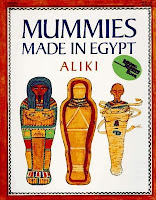
Mummies Made in Egypt by Aliki *

This is a detailed but simple picture book that shows the step by step process of mummification and although it's recommended for ages 8 to 12, it's a great book for anyone who is interested in the how and why of this Ancient Egyptian practice.


 http://www.bookdepository.com/Mummies-Made-in-Egypt-Aliki/9780064460118/?a_aid=journey56


The Boy Pharaoh: Tutankhamen by Noel Streatfeild

http://www.abebooks.com/servlet/SearchResults?isbn=9780718109868&n=100121503&cm_sp=mbc-_-9780718109868-_-used


Written in 1972, the author starts with a vivid picture of life in Ancient Egypt and describes the young Pharaoh's training and what would have been his daily occupations; the robberies of the tombs and the story of Howard Carter and Lord Carnarvon. Hardback with a great double-paged map and abundantly illustrated. Noel Steatfeild wrote the book because she wanted to bring Tutankhamen alive for children up to twelve years of age. She does this admirably, but I wouldn't hesitate to use it with an older child as it is a unique and fascinating literary book. It's out of print, of course, but available at Abebooks. ISBN: 9780718109868


Secrets of Tutankhamen by Leonard Cottrell

A shorter book and also well done but a bit harder to find. ISBN: 978-0237446727

Apologia General Science has a brief mention of Imhotep, the Ancient Egyptian physician who lived approximately 2667 BC - 2648 BC, reproduced here on a pdf.


The Pharaohs of Ancient Egypt by Elizabeth Payne *

A Landmark book first published in 1964, it is suitable as a family read aloud or for students up to grades 6 to 8 and contains the biographies of six Pharaohs.


http://www.abebooks.com/servlet/SearchResults?an=elizabeth+payne&sts=t&tn=pharaohs


The Riddle of the Rosetta Stone by James Cross Giblin

The story of the discovery of the Rosetta Stone and how the mystery of hieroglyphics became unravelled. 96 pages, well-illustrated and researched. The author's bibliography includes Ceram's book above and The Pharaohs of Ancient Egypt. A good introduction for up to about age 12.


http://www.bookdepository.com/Riddle-of-the-Rosett-Stone-James-Cross-Giblin-Giblin-James-Patrici-Tobin/9780064461375/?a_aid=journey56


Mara, Daughter of the Nile by Eloise Jarvis McGraw * - an exciting story with a strong element of romance thrown in. I prefer to leave it until around age 14 and up and consider it more of a young adult book because of the romantic element, but it's a great read.


http://www.bookdepository.com/Mar-Daughter-of-the-Nile-Eloise-Jarvis-McGraw/9780140319293/?a_aid=journey56


 The Cat of Bubastes by G.A. Henty

The Rebu nation is conquered by the Egyptians and their king is killed in the battle. The young prince Amuba is taken captive along with his trusted servant, Jethro, and they become servants in the household of the high priest of Osiris. When a sacred cat is accidentally killed, Amuba and Jethro are forced to flee along with the high priest's son.
This book is an exciting tale of Ancient Egypt and has enough detail to satisfy a reader up to about age 14.


http://www.bookdepository.com/The-Cat-of-Bubastes-G--Henty/9780486423630/?a_aid=journey56


The following two books are reprints of older books published by Bethlehem Books. This publisher is very dependable with their age recommendations regarding mature themes. Both books are suggested for age 10 and up - an indication of content suitability, not readability, as they are well written and not dumbed down. And they each include a map! I get really annoyed if I'm reading a historical book which rattles off names but doesn't include at least a basic map of the area.


Shadow Hawk by Andre Norton (1912-2005) Andre Norton (born Alice Mary Norton) was an American writer mostly known for her science fiction and fantasy novels. Shadow Hawk is set around 1590 B.C. and tells the story of the beginning of Egypt's fight against their hated oppressors, the Hyksos, who had come from Asia Minor with their horse-drawn chariots and defeated the Egyptians some generations beforehand.


www.bookdepository.com/Shadow-Hawk-Andre-Norton/9781883937676/?a_aid=journey56


God King by Joanne Williamson (1926-2002)

God King is based on the author's thorough research of a King called Taharka ('King of Ethiopia and Egypt') in the biblical account of King Hezekiah and the Assyrians. She discovered that Taharka was a Kushite (Sudanese) King of Egypt around 701 B.C. whose actions halted the advance of the Assyrians through the civilised world at that time. The young prince was a very minor royal son who unexpectedly succeeded to the throne.  


http://www.bookdepository.com/God-King-Joanne-Williamson/9781883937737/?a_aid=journey56


A poem that we memorised related to this time period:

The Destruction of Sennacherib by George Gordon Byron.

Bethlehem Books have other titles that fit in with the Old Testament biblical accounts - eg in the times of Sisera in the book of Judges, and Nehemiah which I've used as free reads or read alouds at different times.

Tragedy of Korosko by Sir Arthur Conan Doyle - I wrote about this book here. Although it isn't set in ancient times,the action occurs in Egypt in the days of British rule and shows that in some ways life hadn't changed much over the centuries. It's a great story - a few times I felt it was on the verge of going off in a direction unsuitable for a younger reader but it didn't. A mature 14 year old would probably enjoy it. Benj (16 years old) read it after I did and thought it was a good book.


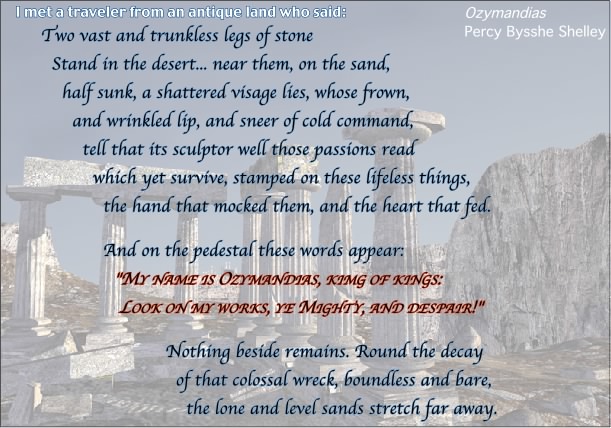
http://www.mit.edu/people/dpolicar/writing/poetry/AV/ozymandias.jpg