Showing posts with label Handbook of Nature Study. Show all posts

Thursday, 18 July 2019

Nature Notebook: Fungi Study

We've had ideal conditions for a study of fungi in the past month and we found some interesting specimens. The green and the black fungi were new to us but we see bracket fungi all the time in our area and the coral fungi pops up now and again.
This is Moozle's nature notebook entry for this past week.


We made some spore prints: turn the cap upside down so its gills sit on top of some white paper; cover with a glass jar or dish to keep out any draught and leave for about 24 hours.
We were able to confirm the name of one specimen we were unsure of by observing the colour of its imprint.


If you wanted to keep these imprints, the paper should be covered very thinly with egg white or an adhesive gum to hold the spores fast. Moozle just observed and drew them this time.


The new discovery...a friend (thanks Anna M!) suggested this might be Dermocybe austroveneta.


Resources:


Handbook of Nature Study, First Studies in Plant Life in Australasia, a guide to our local area's flora & fauna and for young children, Mushrooms & Molds by Robert Froman (out of print) is a good 'Let's Read and Find Out Science Book,' with some hands on activities. There's a preview of it here. 
The Wonderland of Nature by Nuri Mass has a good, basic section with some simple pen & ink drawings.


Online resources:


Fungimap & lichenised fungi

Australasian Mycological Society

Australian Fungi - Australian National Herbarium

An Australian Fungi Blog!

FungiOz


If you'd like a crime mystery with your fungi study, The Documents in the Case by Dorothy L. Sayers centres around a fungi expert whose death was caused when he ingested a bowl of deadly mushrooms! This is the only mystery novel that I've read by Sayers where Lord Peter Wimsey is absent entirely. It's been a while since I've read it but it's probably best for around age 16 years and older.


Wednesday, 27 April 2016

Keeping & the Leisure to Stand and Stare


I'm joining in Celeste's monthly link-up for April at the eleventh hour. If you'd like to know more about this link-up, or what 'Keeping' is all about, have a look at her introductory post. This month Celeste asked us to share what inspires us in our 'Keeping' habits:

Do you have favourite books on the topic?


Charlotte Mason's Original Homeschooling Series is a constant reminder and inspiration to me of the ideas and practices that underpin various forms of Keeping.

Handbook of Nature Study by Anna Comstock - I love the wisdom and practicality of this book. Even though a lot of the content is more applicable to the USA, there is still much to be distilled from this huge book to help me better teach my children:

Nature study is...a study of nature; it consists of simple, truthful observations.

If nature-study as taught does not make the child love nature and the out-of-doors, then it should cease...However, if the love of nature is in the teacher's heart, there is no danger.

Literature in general - beautiful or striking passages inspire me to keep a Commonplace book. There are things I come across that I just don't want to forget, and allowing words to 'pass through my fingertips' onto a blank page helps to impress them upon my mind.

Australian nature resources - some that I use regularly include the books below. I posted a list a couple of years ago with links to some of these plus others here. Some are free online and they are all excellent.

How to Attract Butterflies to Your Garden by Densey Cline
First Studies in Insect Life in Australasia by William Gillies
Nature Studies in Australia by William Gillies

Has a poem inspired your Keeping heart?

Oh, yes! I wrote a separate post for the April Poetry Celebration I've been involved in where I included some nature poetry we've enjoyed.


Inspiration from nature itself - there's nothing like an unexpected encounter to inspire us. On the Easter weekend my 21 year old son called out to me from the back of the house. When I got there he motioned me to be quiet and pointed to a rock wallaby outside. We hadn't seen any for awhile and as we watched, out from behind the bushes came her little joey. So cute! I managed to get a photo from behind the glass door of the mumma, but not the little one. You can see her eyeballing me to make sure I wasn't going to come near her baby...


Sometimes this doesn't lead to a notebook entry - and it didn't that day. We all just savoured the moment. This poem expresses the idea of having leisure in our lives to wonder:


Leisure

What is this life if, full of care,
We have no time to stand and stare.

No time to stand beneath the boughs
And stare as long as sheep or cows.

No time to see, when woods we pass,
Where squirrels hide their nuts in grass.

No time to see, in broad daylight,
Streams full of stars, like skies at night.

No time to turn at Beauty's glance,
And watch her feet, how they can dance.

No time to wait till her mouth can
Enrich that smile her eyes began.

A poor life this is if, full of care,
We have no time to stand and stare.

William Henry Davies (1871-1940)


Another encounter - the kids thought this was great but I was ready to pack up and move. A diamond python that got into our garage a number of years ago because we accidentally left the door open overnight. This was a juvenile; non-venomous, but it can give a nasty bite.


What first inspired you to start notebooking?

I first heard about Charlotte Mason's educational ideas through Susan Schaeffer Macauley's book, For the Children's Sake, about four months before our eldest child was born. I lived on the ideas in that book for years before I came across any other resources. I think the original practice of nature study came out of the ideas presented in that book.
Later on, when my eldest was about 10 or 12 years old I read some other Charlotte Mason inspired books by Penny Gardener & Karen Andreola that helped give me more direction. Then more recently, The Living Page by Laurie Bestvater, has been very helpful as a go-to reference book about various forms of 'Keeping.'

Another inspiration for notebooks was born out of the fact that one of my sons was very late to read. I used notebooking as a way to record his education in areas such as poetry, history, Bible and oral narrations. He would narrate his lessons to me; I typed them out and then he'd illustrate the page. This gave him a visual reminder of what he'd done and were lovely to look back on.

News Articles & Statistics


Often I get inspired to get outside with my children when I read comments from news articles such as: It seems that education is distancing students from the natural world. (I lost the source of this). Or statistics like this one, which I found on an organic gardening website when I was wondering what I should plant this month:

Australia is one of the most urbanised countries in the world, and most people spend more than 90% of their time inside.


Working in the Garden

 I wasn't very inspired to find these little caterpillars eating my lettuce but we could still admire them, sort of, as we picked them off...


I haven't had a great deal of success with vegetable growing (although I'm getting better) so I don't think I'm a great inspiration in that way to my offspring, but the other day Moozle was very excited and took me out to the garden. She had found a piece of a pretty flowering plant the week before and stuck it in the ground like she sees me often doing. It had struck and looked nice & healthy and she was very pleased with herself. Now she's measuring it and watching for a flower.


My April entry...


Bird of Paradise


Moozle's notebook


Bleeding Heart


One man walks through the world with his eyes open, another with his eyes shut; and upon this difference depends all the superiority of knowledge which one man acquires over another.
Charles Kingsley


Saturday, 12 December 2015

We Build a Snailery...

Snail mail...

From time to time we take our mail out of the letterbox to find it's had bits eaten out of it. We finally caught the culprit feasting on a piece of junk mail, so we used this opportunity to do some nature study. It was too hot to be outside so we brought himher (snails are hermaphrodites) inside to observe:

journey & destination


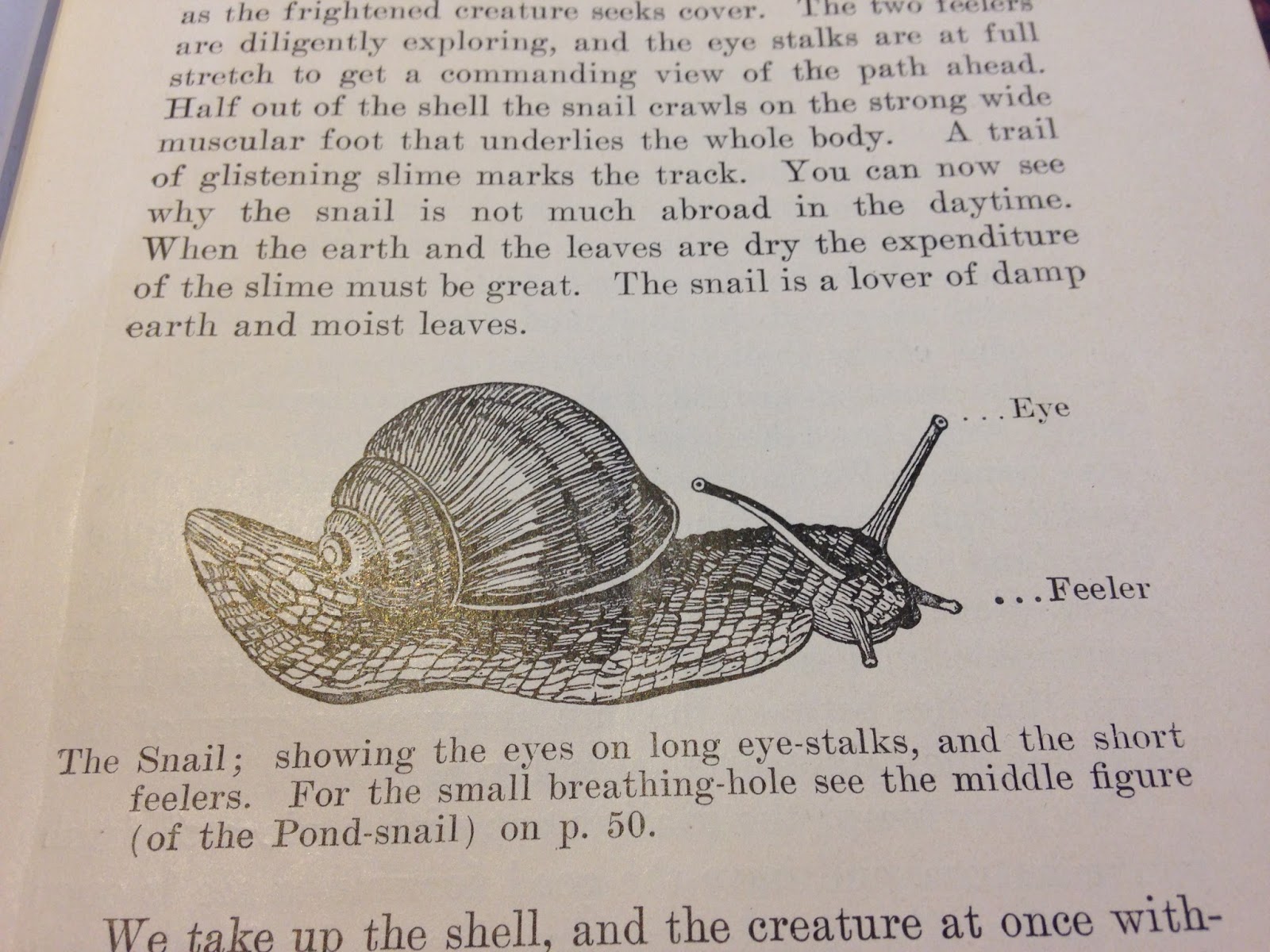
The Handbook of Nature Study by Anna Comstock has a good section on snails and suggests building a snailery to observe them.


So we did...a glass jar, some moss, dirt & leaves & a little container of water


A piece of muslin over the top, held in place with an elastic band keeps the snail in the snailery - we had a piece of gauze triangular sling that we cup up. The next day we found another snail & put himher in the snailery also


They were either lying around tucked up in their shells or stuck to the side of the glass while in the snailery so we got them out to see if they could be coaxed into eating some lettuce.

One of them was keen and popped out of his shell...


The other wasn't much interested at all 


Snail break! Heshe's had a feed and now is off and moving faster than we expected for a snail. Here it is trying to escape.


Nature Studies in Australia by William Gillies has a chapter on snails and I read that aloud while Benj & Moozle did some drawing, but more time was spent checking the snails out, which was the main point of the exercise. 


The Wonderland of Nature by Nuri Mass also has a section on snails:


This is a video Moozle took of the two snails when we put them back into the snailery:


Some precautions when handling snails as they can carry the rat lungworm parasite.

Wednesday, 29 October 2014

Outdoor Hour: Nature Study at the Beach

Once a month I link up with the Handbook of Nature Study Outdoor Hour and join other families from different parts of the world blogging about Nature Study. It has really helped me focus on specific nature study goals and find inspiration to get out of doors with my children. There are plenty of challenges - no matter where in the world you are situated - to help you get started or pick it up if you've lost the motivation. Why don't you join us?

We had a lovely weekend on the coast this month. There's nothing like the sound and feel of the ocean that seems to both mentally refresh and physically exhaust you (in a good way) at the same time. Here are a few glimpses from our time away.

 Pelicans in for a Feed


Looking out across the Tasman Sea


The jellyfish is shaped like an umbrella and its mouth and stomach in the position occupied by the handle of a real umbrella; the tentacles and other sense organs are attached to the outer edge of the umbrella. By means of its tentacles the jellyfish captures the small animals upon which it feeds.
The Handbook of Nature Study (HONS) Pg. 430


A Common Jellyfish


We have the Bluebottle (Portuguese Man of War) jellyfish here which gives a nasty sting but the one above looked harmless. William Gillies in Nature Studies of Australia (I have a link to the free book here) says this of the jellyfish:

If you could see the first stage in the wonderful life-history of this creature you would hardly believe that this mass could spring from it. The egg of this jelly-fish hatches out into a small creature quite unlike the parent. This little animal swims about by means of the hairs that cover it, and after a time settles down upon a rock, and becomes fixed like an anemone.
Like an anemone, too, it has waving arms by which it feeds. By-and-by it throws off bud after bud. Each of these buds becomes a free-swimming disc-shaped jelly, which grows into a jelly-fish...


Oyster Shells


The Sydney Rock Oyster is endemic to parts of the Australian coast while another, the Pacific oyster is introduced. Apparently it is difficult to distinguish between the two especially if you are only looking at the shells as above. This fact sheet is quite interesting as we couldn't find much information in the books we have which surprised me. What we do know is that oyster shells are awful things to stand on as my eldest son found out once when he ventured out into the water on a camping trip and sliced the under side of his foot. When he went to hospital the doctor told him they leave the wound open for about a week and then they stitch it up as the oysters have oodles of bacteria and if it's stitched right away it won't heal.
Some information on the pearling industry in Australia is on this website.

Oysters are bivalve molluscs which initially hatch out of eggs, swim around for a few days and then attach themselves to rocks. Mother of pearl, also known as nacre is a substance formed within an oyster shell and is often used as decorative material. The oyster has quite a few enemies -  the starfish and us, for example, not to mention The Walrus and the Carpenter...
  

"The sun was shining on the sea,
      Shining with all his might:
He did his very best to make
      The billows smooth and bright —
And this was odd, because it was
      The middle of the night.

The moon was shining sulkily,
      Because she thought the sun
Had got no business to be there
      After the day was done —
"It's very rude of him," she said,
      "To come and spoil the fun."

The sea was wet as wet could be,
      The sands were dry as dry.
You could not see a cloud, because
      No cloud was in the sky:
No birds were flying overhead —
      There were no birds to fly.

The Walrus and the Carpenter
      Were walking close at hand;
They wept like anything to see
      Such quantities of sand:
If this were only cleared away,'
      They said, it would be grand!'

If seven maids with seven mops
      Swept it for half a year,
Do you suppose,' the Walrus said,
      That they could get it clear?'
I doubt it,' said the Carpenter,
      And shed a bitter tear.

O Oysters, come and walk with us!'
      The Walrus did beseech.
A pleasant walk, a pleasant talk,
      Along the briny beach:
We cannot do with more than four,
      To give a hand to each.'

The eldest Oyster looked at him,
      But never a word he said:
The eldest Oyster winked his eye,
      And shook his heavy head —
Meaning to say he did not choose
      To leave the oyster-bed.

But four young Oysters hurried up,
      All eager for the treat:
Their coats were brushed, their faces washed,
      Their shoes were clean and neat —
And this was odd, because, you know,
      They hadn't any feet.

Four other Oysters followed them,
      And yet another four;
And thick and fast they came at last,
      And more, and more, and more —
All hopping through the frothy waves,
      And scrambling to the shore.

The Walrus and the Carpenter
      Walked on a mile or so,
And then they rested on a rock
      Conveniently low:
And all the little Oysters stood
      And waited in a row.

The time has come,' the Walrus said,
      To talk of many things:
Of shoes — and ships — and sealing-wax —
      Of cabbages — and kings —
And why the sea is boiling hot —
      And whether pigs have wings.'

But wait a bit,' the Oysters cried,
      Before we have our chat;
For some of us are out of breath,
      And all of us are fat!'
No hurry!' said the Carpenter.
      They thanked him much for that.

A loaf of bread,' the Walrus said,
      Is what we chiefly need:
Pepper and vinegar besides
      Are very good indeed —
Now if you're ready, Oysters dear,
      We can begin to feed.'

But not on us!' the Oysters cried,
      Turning a little blue.
After such kindness, that would be
      A dismal thing to do!'
The night is fine,' the Walrus said.
      Do you admire the view?

It was so kind of you to come!
      And you are very nice!'
The Carpenter said nothing but
      Cut us another slice:
I wish you were not quite so deaf —
      I've had to ask you twice!'

It seems a shame,' the Walrus said,
      To play them such a trick,
After we've brought them out so far,
      And made them trot so quick!'
The Carpenter said nothing but
      The butter's spread too thick!'

I weep for you,' the Walrus said:
      I deeply sympathize.'
With sobs and tears he sorted out
      Those of the largest size,
Holding his pocket-handkerchief
      Before his streaming eyes.

O Oysters,' said the Carpenter,
      You've had a pleasant run!
Shall we be trotting home again?'
      But answer came there none —
And this was scarcely odd, because
      They'd eaten every one."

By Lewis Carroll (1832–1898)