Showing posts with label Ambleside Year 7. Show all posts

Thursday, 1 April 2021

The Talisman by Sir Walter Scott (1825)


‘All Scott’s work is marked by three characteristics: a genius for enriching the past; a love of Nature; a sturdy humanity. He loved the pomp and pageantry of a bygone age. His imagination lived naturally in the stirring tales of yore. He was a historical novelist by temperament rather than by profession... There have been historical romancers more accurate than Scott in the details of the story, but none so true to the inmost spirit of the age depicted.’ - from the Introduction by Robert Harding 

The Talisman is set in the Levant (the historical name for the region of the Eastern Mediterranean) towards the end of the Third Crusade. In 1187 A.D. Jerusalem was captured by Saladin and the Third Crusade was launched in 1189 to retake the city. The book, a work of historical fiction, focusses on Richard I, the ‘Lionheart,’ Saladin, and a fictitious knight by the name of Sir Kenneth. 

The Crusaders were encamped in the Holy Land and in disarray. The Lionheart was very ill with a fever and partisan politics were threatening the progress of the Crusade. Meanwhile, in the desert of Syria, Sir Kenneth meets a Saracen and after fighting and neither winning, they acknowledge each other’s prowess and continue on their travels together. The Saracen leads Sir Kenneth to the hermit he had been seeking and they then go their own ways. 

There are twists and turns, double identities, misunderstood prophecies and plenty of adventure as the story continues. 

'...the unfortunate Knight of the Leopard, bestowed upon the Arabian physician by King Richard rather as a slave than in any other capacity, was exiled from the camp of the Crusaders, in whose ranks he had so often and so brilliantly distinguished himself. He followed his new master...to the Moorish tents which contained his retinue and his property, with the stupid feelings of one who, fallen from the summit of a precipice and escaping unexpectedly with life, is just able to drag himself from the fatal spot, but without the power of estimating the extent of the damage which he has sustained.'

Scott gets a little theatrical and the chivalry is over the top at times, as you might expect of the writing from this time, but he really brings Richard and Saladin to life. Their characters are realistically portrayed and Edith, one of his main female characters and a relative of the King, is interesting, intelligent and plucky. 

Scott doesn’t glorify the Crusades in any way and Saladin is treated very positively. It was interesting to read Scott’s description of him as I had just finished a chapter in another book, In the Steps of the Master by H.V. Morton, where the author stated that Saladin was ‘...the one enemy of Christendom whose name runs through all the history books as that of a brave and chivalrous foe.’

I have to say that I used the dictionary fairly regularly when I was reading The Talisman! There are quite a few obscure words and although a glossary is provided at the beginning, it looks like it's the original from 1825 and doesn’t include all the words that have gone out of circulation since. 

The Talisman is scheduled as a free read for the Ambleside Online Year 7 curriculum and is a book all my children have enjoyed at some point. A great book to add to your Charlotte Mason high school.


If you enjoyed this post you may subscribe here to receive new content when it is posted.

Wednesday, 5 September 2018

Initiating Interests: Architectural Science


Our aim in Education is to give a Full Life. - We begin to see what we want. Children make large demands upon us. We wish to place before the child open doors to many avenues of instruction and delight, in each one of which he should find quickening thoughts... 
We owe it to them to initiate an immense number of interests. 

School Education by Charlotte M. Mason; Pg 170


One of the many reasons I was attracted to Charlotte Mason's ideas on education was her emphasis on a wide and generous curriculum - setting children in a large room:

Thou hast set my feet in a large room; should be the glad cry of every intelligent soul. 

Often the temptation we have is to allow a narrow focus, to follow our child's desires or main interests. On the surface of it, it appears educational and wise. I mean, how satisfying is it to see them completely taken up with something? They don't even want to stop for lunch let alone other studies. Of course, this focus means excluding other things, and the room they are in shrinks.

In fact, how large is the room in which he finds his feet set? and, therefore, how full is the life he has before him? I know you may bring a horse to the water, but you cannot make him drink. What I complain of is that we do not bring our horse to the water. 

Which brings me to...

Architectural Science

We added Architectural Science studies in Year 7 because Moozle expressed an interest in modern architecture. She wasn't interested in Ancient Greek or Roman architecture and would have been quite happy to jump in at the 20th Century. However, I wanted to 'bring my horse to water' and place her feet in a large room, not limited by her idea that older architecture would be boring. I also wanted to lay a foundation and build upon that, so we started with the books I posted here - if you scroll down to 'Fine Arts' in this post you will see what we've used.
As well as watching some of Kevin McCloud's Grand Design DVD's, which she loves, Moozle has done some hands on activities and keeps an Architecture notebook.

The other week my husband showed Moozle our original house plans. The couple we bought our house from built it themselves but obviously departed from some of the plans as they went. Over the past 10 years we’ve done some renovations which included knocking out a weight-bearing wall so there are even more changes that are not in the original plans. My husband went over the plans with Moozle and she worked out how many square metres our house is, what has changed from the original design and using a free app, ‘built’ an updated version of our house on the Ipad. The second photo below is the free app she used. She had a lot of fun doing this but the free app doesn’t let you save the plans ☹️ although you can pay for the upgrade that does.
This exercise was a good one for a girl who would much rather not do Maths!


The books we're using this year for Architectural Science were chosen after a visit to one of our favourite independent bookstores. I was interested to see what books Moozle would be drawn to and I thought she showed a wider interest than she had a year ago when we first started. These are the books we chose:

50 Architects You Should Know by Lowis, Thiel-Siling, & Kuhl

This book starts with the Renaissance and covers a selection of architects from then to recent times. It's concise, but covers a wide range of architects and buildings and is our basic spine for this year.


The series of books by James Gulliver Hancock, All the Building In... are beautifully done coloured sketches of buildings in different cities where the author has lived at different times. We bought the Sydney and Paris books to start with and plan to collect the others in the series which cover Melbourne, New York, and London.


All the Buildings in Paris by James Gulliver Hancock


A Concise History of Western Architecture by R. Furneaux Jordan is a comprehensive book we are using mostly for reference. The author starts with ancient Egypt and continues through to the 19th Century & Modern Times - great to see it includes the Sydney Opera House! Out of print; ISBN 0500 20087 4


The Ambleside Online years are full and generous so if you do add something, it is a good idea to substitute it for something else. We skipped a couple of the science books in Year 7 (Adventures With a Microscope & a large part of Signs & Seasons because we're in the Southern Hemisphere) in order to fit in the books we added. We'll be doing the same this year.


Life should be all living, and not merely a tedious passing of time; not all doing or all feeling or all thinking - the strain would be too great - but, all living; that is to say, we should be in touch wherever we go, whatever we hear, whatever we see, with some manner of vital interest.


All quotations are from School Education; Pg 170


Wednesday, 15 August 2018

Reading, Thinking, & Domesticity #4

Making Room for Contemplation

I’ve noticed more recently that I’ve become increasingly distracted and my attention span hasn’t been as good as it was. I put it down partly to getting a new iPhone (my old one didn't do much and was often unreliable). When you're using your phone for texting, emails, appointments, reminders, timers etc., it's too easy to be distracted and one thing leads to another if you're not careful.

We're also in the throes of bathroom renovations that have dragged on for over 7 weeks (update that to 9 weeks!) & that’s made life a little chaotic, too...burst waterpipes, cement dust, tradesmen not turning up when they said they would or arriving when you aren't expecting them, pluming supplier sending the wrong parts...blah, blah, blah. Besides that, my morning walks have come to a halt because of these renovations, which is a sure recipe for a scattered brain for me.

I haven't listened to any podcasts lately but then I came across this one on the Circe Institute website - an interview with author Alan Noble. I haven’t read the book they mention but the podcast discusses making room for contemplation in the context of living in a distracted world. It’s well worth listening to. I’ve been thinking about ways I can cultivate this space - technology can be a great tool and I know I won't be getting rid of my phone so I need to work around it. Distractions aren’t going to disappear even when our renovations are done - something else will jump in, I'm sure, but I'm considering how I can allow space for contemplation regardless.


My older girls read these books by Elizabeth George when they were in their teens. Moozle has read one and is most of the way through the second. She reads a chapter a few times a week as a sort of devotional, apart from her 'official' lessons, and has been enjoying them. The author covers relationships in general and content-wise, they are just right for girls aged about 12/13 years and up. The author also has a book for younger girls (ages 8 to 12 years). I've read a few of her books myself and thought they were very good.
Her husband, Jim George, has written a few books for boys on similar topics. I like the fact that they don't venture into the 'too much information' side of things and leave it up to the parents to decide when to introduce these topics.


The Green Years by A.J. Cronin - this is the second book I've read by this Scottish author and I do like his writing very much. The Keys of the Kingdom was the other book and while The Green Years was not quite as good, it was, nevertheless very enjoyable. The setting is Scotland, in the same area I came from, so that was a great attraction for me. Cronin often substitutes a fictional place name for the one he's writing about but I recognised some of the places from his evocative descriptions.


I've started to read the books above in preparation for a Women's Retreat in mid-September. I'm speaking on The Friendships of Women & I want to look at this from a couple of different angles.

Life Together by Dietrich Bonhoeffer - a classic by the German theologian who was martyred by the Nazis. I read Eric Metaxas' biography of Bonhoeffer  two years ago so it will be good to hear from the man himself. It's only a short book (my copy is 96 pages) & was published in 1954. From what I've read so far, it's very good and fairly easy to read.

The Secret Thoughts of an Unlikely Convert by Rosaria Champagne Butterfield. I first heard about this book via Brandy @ Afterthoughts and have since read a couple of articles about the author and was intrigued by the impact made upon her life when a couple drew her into their lives by an act of hospitality. I bought my copy at Koorong (an Aussie Christian bookshop). I usually buy new books via BookDepository but they only had the audio book in stock when I tried to order it. Koorong has a 20% off sale a few times a year so it's worth waiting for one if you want to get a few things.

The Gospel Comes With a House Key by Rosaria Butterfield - here the author looks at 'radical hospitality' using her own life as a backdrop and shows us how to enact this in our own homes.


The Barefoot Investor by Scott Page - financial planning, money management in general, investments...a hands-on approach that walks you through the process. Page is an Aussie author and some of what he covers would have to be adapted if you're not living in Australia, but it is a worthwhile book and would be helpful for anyone. My husband read it earlier this year as did our married son and it was passed on to another son who shares a house with three other young fellows and they're all reading it, and actually putting it into practice. There's some Aussie slang and corny humour in places, and of course, the situation here is different in regards to superannuation, loans, health funds etc, but his general financial strategies may be used anywhere.
This would be a great book for an older high school student or any young adult, or those struggling with debt to help them manage their finances and plan for the future.
The book below has been updated for the 2017-2018 financial year.


Saturday, 4 August 2018

A Combination of Mystery & History: The Daughter of Time by Josephine Tey (1951)


The Daughter of Time is an unusual type of crime mystery in that a piece of English history is resurrected and brought into the 20th Century to be investigated. It concerns the reign of Richard III and the murder of the Princes in the Tower.
Josephine Tey’s Inspector Alan Grant of Scotland Yard conducts his own investigations into the four hundred year old mystery from a hospital bed where he is confined after an accident while on duty. Bored and despondent, nothing has much interest for him until one day a friend, endeavouring to cheer him up, brings him a collection of historical portraits of people who had some mystery attached to them.
Grant had always had a passion for faces, made a conscious study of them, and had an almost instinctive way of picking out a criminal on sight.
When he finds a portrait of a man in his mid-thirties, dressed in the fashion of the late fifteenth Century, he is arrested by the expression in the subject’s eyes:

Grant paused in the act of turning the thing over, to consider the face a moment longer. A judge? A soldier? A prince? Someone used to great responsibility, and responsible in his authority. Someone too conscientious. A worrier; perhaps a perfectionist. A man at ease in a large design, but anxious over details...

When Grant turns the portrait over and discovers the subject is Richard III, he is piqued that he mistook a notorious murderer for a judge. His first impression of the man in the portrait was certainly not that of a villain. This arouses his curiosity and so he begins his own investigation into the allegations against Richard.
Each of the four books I’ve read by Josephine Tey have been quite different from each other, although Inspector Alan Grant features in all of them. The Daughter of Time is different from any other mystery/crime novel I’ve ever read and I enjoyed its uniqueness and its mental challenge.
Tey unearths contemporary accounts, documents, and historical resources to present Richard Plantagenet from a different viewpoint. She reveals that Sir Thomas More, the author of More’s History of Richard III, had never known Richard at all and had, in fact, only been eight years old when Richard died at Bosworth. More obtained his account of Richard III from John Morton who was the Archbishop of Canterbury during Henry VII’s reign and a bitter enemy of Richard.
Tey not only turns the Princes in the Towers mystery on its head but also has a little swipe at Cromwell:

Cromwell started that inverted snobbery from which we are all suffering today. ‘I’m a plain man, I am; no nonsense about me.' And no manners, grace or generosity, either...

And Mary Queen of Scots:

Her tragedy was that she was born a queen with the outlook of a suburban housewife...If you are willing to put a country of ten million people in pawn in order to score off a royal rival, then you end by being a friendless failure.

And she also has no time for the Scottish Covenanters:

The Covenanters were the exact equivalent of the I.R.A. in Ireland. A small irreconcilable minority, and as bloodthirsty a crowd as ever disgraced a Christian nation...A dragoon (read policeman) couldn’t arrest anyone without a warrant...but there was nothing to hinder a Covenanter lying snug in the heather and picking off dragoons at his leisure. Which they did, of course. And now there’s a whole literature about the poor ill-used saint in the heather with his pistol; the dragoon who died in the course of his duty is a Monster...Like Richard.

I read this book aloud to my thirteen year old daughter as it’s scheduled in Year 7 of the Ambleside Online curriculum and she really liked it, although it took a couple of chapters for her to get interested. As the AO website states, there are some sections that need editing for this age group, but they’re mostly in the first few chapters and they aren’t central to the story.

This book opened a wonderful door for the discussion of historical perspectives and bias and inspired Moozle to do a bit of reading on the Plantagenets and the Tudors. Then we started reading Shakespeare’s Richard III. Now, this was interesting after the perspective of The Daughter of Time! Shakespeare’s Richard III is a real creep. You only have to read the first two scenes of Act 1 before you believe Richard capable of every vile deed known to man.
Shakespeare’s Globe sheds some light on Shakespeare’s view of Richard. His portrait of Richard as a physical and moral monster is not accepted by modern historians.
The Daughter of Time is a splendid way to learn some history as well as being an enjoyable mystery.
Available free for Kindle

Updated to add this link: The Search for King Richard III (thanks to GretchenJoanna for passing this on!)


This is my choice for A Classic by a Woman Author in the 2018 Back to the Classics Challenge

Linked to Books You Loved.


Thursday, 12 July 2018

Ambleside Online Year 7 Highlights

Year 7 has finished up for the seventh time in our home, although this was only the second time we've used Ambleside Online for Year 7.  As I usually do, I asked my daughter which books were her favourites from this year's work, but I gave her a limit of ten. These are the books she chose:


I read aloud The Brendan Voyage, The Daughter of Time, and All Creatures Great and Small (which we are only half way through. It’s an omnibus edition and isn't scheduled in AO year 7.) She read the others on her own. The Magna Carta was a book we had that I added in - she really enjoyed this. The Daughter of Time and Fallacy Detective sparked a lot of interest, conversation, and ‘that’s a red herring’ type of comment on a regular basis!

As I mentioned, this is the second time we've done AO Year 7, and when I asked my next child up, Benj, who did Year 7 in 2014, what books were highlights for him. These are the books he chose:

Whatever Happened to Penny Candy
Ivanhoe
Watership Down
The Age of Chivalry
Eric Sloane's Weather Book
The Lord of the Rings Trilogy
The Talisman
Hereward the Wake
The Birth of Britain 


They almost have opposite tastes in reading. Ivanhoe, Watership Down, and Eric Sloane's Weather Book were not among Moozle's favourites and she still hasn't read The Talisman because she says she does not like Sir Walter Scott. Actually The Talisman was everyone else's favourite Scott novel.
Moozle loved the science selections but Eric Sloane's Weather Book went above her head at times - it was one of Benj's favourites. He didn't care for The Life of the Spider by Fabre (we have one of the world's deadliest spiders in our area so that probably didn't help) but Moozle got right into it and just about every reading was accompanied by a science journal entry.
However, they both loved The Lord of the Rings trilogy!

This verse from Ecclesiastes, that Charlotte Mason quotes in Volume 6, is very apt:

'In the morning sow your seed, and at evening withhold not your hand, for you do not know which will prosper, this or that, or whether both alike will be good.'


Ecclesiastes 11:6

One child may imbibe certain ideas from a book, while a different child won't, but we can't predict what ideas will inspire them. Our job is to provide a wide variety of books the same way we would provide food for a scrumptious smorgasbord. I've been quite surprised at some of the books that have been the trigger for ideas; books that I wouldn't have expected to charm them, but they have. Having children who've had almost opposite reactions to books has made this observation even more apparent to me:

Education is a life. That life is sustained on ideas. Ideas are of spiritual origin...we must sustain a child's inner life with ideas as we sustain his body with food. Probably he will reject nine-tenths of the ideas we offer, as he makes use of only a small proportion of his bodily food, rejecting the rest. He is an eclectic; he may choose this or that; our business is to supply him with due abundance and variety and his to take what he needs...out of a whole big book he may not get more than half a dozen of those ideas upon which his spirit thrives; and they come in unexpected places and unrecognised forms...

A Philosophy of Education, Pg. 109

I don't think a child has to love a book. They might find it difficult, and we may be tempted to drop it, but there needs to be some books that make them work a bit harder, build some more muscle, or they won't grow. It's not a cruel & unusual punishment to require them to persevere.

Many children are fussy eaters but we don't allow them to just eat junk because that's what they like & it will help avoid conflict for us if we just give them what they desire. If a child is sick or is convalescing, we make allowances by giving them the food they desire, within reason, but a well and healthy child doesn't get the same treatment.
A child may not be ready for some of the ideas presented in a book, but they will seize some of them while others may give them a foretaste that could develop at a later time. Smoked salmon, haloumi, and blue vein cheese might be passed over for other better known foods the first or second time around, but then one day they decide to try them and find they are very moreish. The other thing we need to consider is if overall the material is at a suitable level for them. If every book is difficult, perhaps we need to rethink our choice of books or grade level. 
Something I've made a point of doing this last year is to stretch Moozle's reading so that she's just not reading books with lots of action. She is a good reader but doesn't like slow books. A couple of those books I've mentioned towards the end of this post.

Other Highlights From This Year

In my original plans for Moozle's Year 7, I mentioned we were doing Apologia's Anatomy & Physiology. We finished that and then continued with The Way We Work by David Macaulay. Moozle loves Macaulay's illustrations in this book and I was surprised at how in depth the text is.


This section covered lipids and Macaulay used a number of technical terms that she wasn't familiar with. I found a video on lipids to help out. We'll be continuing with this book in Year 8.


A notebook page 


When my children get to about 15 or 16 years of age, I have them do a Senior First Aid course. In the past I've organised this and opened it up to some other families with older children & it's an intensive 2 day course. A few months ago, a homeschooling friend organised a course that ran over 4 weeks, one afternoon per week. Both Moozle and I did the course (a refresher for me) & I thought that spreading it out over a month was a good way to do it. There is so much information and doing it this way was much easier & left more time to let it all soak in.


Another focus this year was on Natural History Illustration which I wrote about here and here.

Handicrafts - the past few months have been devoted to patchwork and quilting. This is her major project.

Cello - this year she's preparing for the AMEB Grade 7 exam and has also had the opportunity to play in church a few times.

On the family front, the role of Aunty has come very naturally & she is a favourite with her little niece. We're all looking forward to the birth of our son and his wife's first child due in October and the wedding of our second daughter in September.


Some of Moozle's reading this year:

The Refugees by Sir Arthur Conan Doyle - 'Quite a good book but the main character behaved stupidly at times. Conan Doyle tends to make the Frenchmen excitable little wimps, while in books like this the Frenchmen always think the English are calm cool and collected, with no emotions whatsoever.' 4 out of 5

Lorna Doone by R.D. Blackmore - scheduled in AO Year 8 as a free read. 'It took ages to get into the book, rambled on at times, but it was a good story.' 4 out of 5
An illustrated kindle version is here.


The Spy by James Fenimore Cooper - set during the American Revolutionary War and written by an author who lived around that time period. This was Moozle's first book by Cooper and she didn't mind it, but I think she'll appreciate some of his other books a bit more later on. 3 out of 5

Midwinter by John Buchan - a little different to his Richard Hannay series. Midwinter is a tale of the  Jacobite rising set in 1745. John Buchan always gets a good rap in our house. 4½ out of 5:

'The Jacobite army marches on into England and Alastair Maclean, close confident of Charles Edward Stewart, embarks on a secret mission to raise support for the cause in the west. He soon begins to suspect someone close to the Prince is passing information to the Government, but just as he closes in on the traitor his own life is put in danger.'

The Black Stallion series by Walter Farley - this is a series that Moozle has enjoyed for a few years now and she added a couple more to her collection recently. 4½ out of 5.  

I've been thinking about the next year's work and my plan is to cover AO Years 8 & 9 over eighteen months. I have a couple of reasons for this. One is that the school year here in Australia goes from February to December with a fairly long break over Christmas. We've never followed the school terms but I'm finding more and more that our outside activities do. Just about everything shuts down for the school holidays and the Christmas break and we often end up catching up with people during the official school holidays. There's also much less traffic at those times so it's easier to get out and about.
The other reason is so that Moozle isn't straddling two years - she started Year 7 in the middle of last year. At the end of next year she will have completed Year 9 and then she'll start Year 10 at the beginning of the next year...if that makes sense!  Anyhow, that's the plan & I'm looking at the AO schedule here - starting at Week 25, which will take us through to the end of the year and then continuing with this next year. So instead of doing AO Years 7, 8, & 9 in two years, we'll be doing Years 8 & 9 in one and a half years. Clear as mud?

Edited to add our weekly schedule. This is what I've done for many years - give the schedule out at the beginning of the week and let them decide which books to do each day. I check each day to see what's been done and if I find they've gotten a bit lax, I'll give them a list of things I'd like completed. Each of my children has had a preference for certain subjects so I make sure they haven't left things out and if they have, get them to attend to it the first thing the next day. 
They have all tended to like doing a book chapter in one hit & not spreading it out over a week - even the longer reads such as Churchill's Histories.


My original plan for Moozle's Year 7 - I made some modifications especially with Devotional reading and Science. 

Highlights from Term 1

Australian content

Apart from what I mentioned in my original plans, Moozle read & re-read some Australian titles this year. Many of the books I want to use I've either used in earlier years or plan to use later on when she's a little older. I picked up a couple of Nan Chauncy books we didn't have, Tiger in the Bush & Tangara and she read those but they were easy for her. 
The Silver Brumby series are some she re-read and enjoyed doing so. They are excellent reading.

I have a page at the top of this blog where I record some of the Australian titles we've read.


Monday, 19 March 2018

In Defence of Old Science Books


A common charge against Charlotte Mason educators is that we use too many old books. When it comes to teaching science, this objection is even more vehement. How can you teach science using books that were written ten, twenty, thirty or worse still, over a hundred years ago?
Yes, we do tend to use older books but that's not because older books are intrinsically better than more modern titles. There are plenty of dud older books that we'd never use for the good reason that they aren't well-written. The reason we'd choose an older book over a more recent is because it has a literary approach, i.e. it presents facts that are clothed in literary language.
More and more, education has become utilitarian in its approach, and this is reflected in the teaching of science and the content of the books that are used. David Hicks made this observation:

'...as science took a technological turn and as education began preparing students for work rather than for leisure, for the factory rather than for the parlor, the school itself came to resemble the factory, losing its idiosyncratic, intimate, and moral character...
In its utilitarian haste, the state often peddles preparation for the practical life to our young as the glittering door to the life of pleasure; but by encouraging this selfish approach to learning, the state sows a bitter fruit against that day when the community depends on its younger members to perform charitable acts and to consider arguments above selfish interests.'


Norms & Nobility by David Hicks

When a book is too direct and factual there's the possibility that the student may not appropriate the material.
I've thought about this not only in relation to my children but also to my own reading. Some thoughts on uniting the literary & the scientific here.

Of course some things will have changed from when a science book was first written, but we could say that about a science text that was written a year ago. There are ways to bring the knowledge up to date without too much trouble while still giving your student the foundational concepts padded out in a literary medium. YouTube videos are one way that's worked well for us. The chapter from the book is read first and then an appropriate video is shown after that.
We take care that:


'...all knowledge offered him is vital, that is, that facts are not presented without their informing ideas.' 
Towards a Philosophy of Education, pg xxx


Some of the science books I've been using this year for my 13 year old daughter are in the 'old' category. Some are more modern, but they are all good. The first three book below are scheduled for Year 7 (Form III) at AmblesideOnline.


The Life of the Spider by Jean Henri Fabre (1823-1910)

Notebook page for The Life of the Spider 


The Wonder Book of Chemistry by Jean Henri Fabre - translated into English in 1922

These two books by Fabre are my daughter's favourites. Interestingly, Fabre was not only a scientist but a poet (see a short bio here). Charlotte Mason said of French scientists that,

'...they perceive that as there is an essence of history which is poetry so there is an essence of science to be expressed in exquisite prose.'


 Notebook page after reading Chapter 17 of The Wonder Book of Chemistry
 

I've used some of the University of Nottingham's Periodic Table of the Elements to not only bring some of the concepts in The Wonder Book of Chemistry (and other books we've used in the past couple of years) up to date but also to see demonstrations of science experiments that we wouldn't be able to perform safely at home.

Eric Sloane's Weather Book (1952)

The BBC's Wild Weather series narrated by Richard Hammond have been helpful with Sloane's book which on the surface looks simple enough but contains some difficult topics where a visual or simulated demonstration is helpful.

Architecture Shown to the Children by Gladys Wynne (1913)


This year we started Architectural Science and Gladys Wynne's book is our primary text. I've added in a couple of other books we have that relate to the science behind architecture such as String, Straightedge, & Shadow: The Story of Geometry by Julia E. Diggins (1965)
Although this would be classified as Mathematics and not Science, we're using it alongside the above book as it relates to Architecture in the Ancient World. The Grand Design DVD's are also an enjoyable addition from time to time.


Some examples from Moozle's Architecture Notebook


Secrets of the Universe by Paul Fleisher - this was originally published in 1987 and is out of print but it was re-issued as five separate books in 2002. Moozle is reading this one at present:


This is a series that a few of my children have enjoyed and learnt quite a lot from. Fleisher has explained the concepts well and included experiments that are do-able in the home situation. This was one Moozle did on light reflection last week:


Signs & Seasons by Jay Ryan (2007) is a more recent science publication but I'm supplementing with The Constellations & How to Find Them by Sir William Peck (1942) as he writes from a Southern Hemisphere perspective.


I managed to find a sundial in a local park


Natural Science

The older books really shine with this subject and just about every book I have related to this field is old. I have up to date field guides for studying birds and plants in our part of the world but reading the writing of earlier naturalists is very inspiring. An interesting article I found about this: What Early 20th Century Nature Study Can Teach Us.
Some of the books I use the most are:

Natural History in Australia by William Gillies & Robert Hall (1903)

Handbook of Nature Study by Anna Botsford Comstock (1911)

Bush Calendar by Amy Mack (1909)

I posted a list of some of these that are available free online here. 


Mother Culture Science


These are some science titles I've read for my own education, or have used with my older children in the high school years. I've linked to reviews I've written on them or where we've used them in high school.

Uncle Tungsten: Memories of a Chemical Boyhood by Oliver Sacks (2001) - my own reading and one of my sons read it around the age of 16 years.

Longitude by Dava Sobel (2011) - this was a book I read aloud about 5 years ago to multiple ages

Madame Curie by Eva Curie (1937)

The Immortal Life of Henrietta Lacks by Rebecca Skloot (2010)

The Double Helix: A Personal Account of the Discovery of the Structure of DNA by James D. Watson (1968)

Understanding Physics by Isaac Asimov (1966) - we used this in Years 9-11

Mr. Tompkins Inside Himself by George Gamow & Martynas Ycas (1967)

The following books are medically related, inspirational/devotional & highly recommended:

Fearfully & Wonderfully Made by Philip Yancey & Dr. Paul Band (1980)

Ten Fingers for God by Dorothy Clarke Wilson (1965) - a biography of Dr. Paul Brand


Friday, 26 January 2018

January Notes: Nature, Camping, Keeping & Notebooks

We went on a family camping trip in mid-January which was a great nature study opportunity. We only went about three hours north of our home but it's surprising how much difference that short distance makes in the local flora & fauna.


For years I've heard cicadas but I've only found their shed skins so I was surprised to find full-grown cicadas in plentiful supply while we were away. Most of them were dead & I found out later that that was probably due to the run of very hot weather we've had. The one below was about 3" or 9 cm long. For an article about Aussie cicadas see this newspaper piece.
For a website devoted to them see Cicada Mania. For a poetic piece on these maddeningly noisy but fascinating creatures check out 'The Song of Cicadas' by Roderic Quinn.


Moozle's Nature Notebook


Anatomy & Physiology


Moozle just had her 13th birthday, while we were camping, actually, & I'd been holding off starting a Commonplace Book with her until now. I'd been allowing her to choose some of her own copywork material in the past year or so and lately she'd begun reading out passages in books that caught her attention so I thought now would be an opportune time. She chose a notebook and made a title for the front.


She's acquiring the habit of commonplacing without me reminding her...


My Diary of Firsts - I also record walks, camping etc here:


Happy campers - it rained overnight on the second day, hence all the towels & clothes hanging up around the place.


Not to mention a tent fail. It hadn't been used in a while & when Moozle & Benj set it up they discovered that it didn't have a fly so they got a little wet during the night & the whole thing drooped:


 Wet weather coming in


Goanna - a good three feet in length. I took this photo from a distance with my phone.  


On the first night a fellow camper mentioned to my husband that he'd seen a large snake on the path to the bathrooms so when I woke up in the middle of the night needing to visit the loo, I got my husband to accompany me just in case I met the creature. We decided that as we were up that we might as well go for a walk along the beach, about five minutes away. So in the early hours of the morning we were looking up at the spectacular Milky Way and listening to the sounds of the sea. Living in suburbia you just don't see the sky like that and even where we were camping just over the ridge, the trees obscured a good part of the sky. We also had a great view of bioluminescence as the waves were crashing in onto the beach.


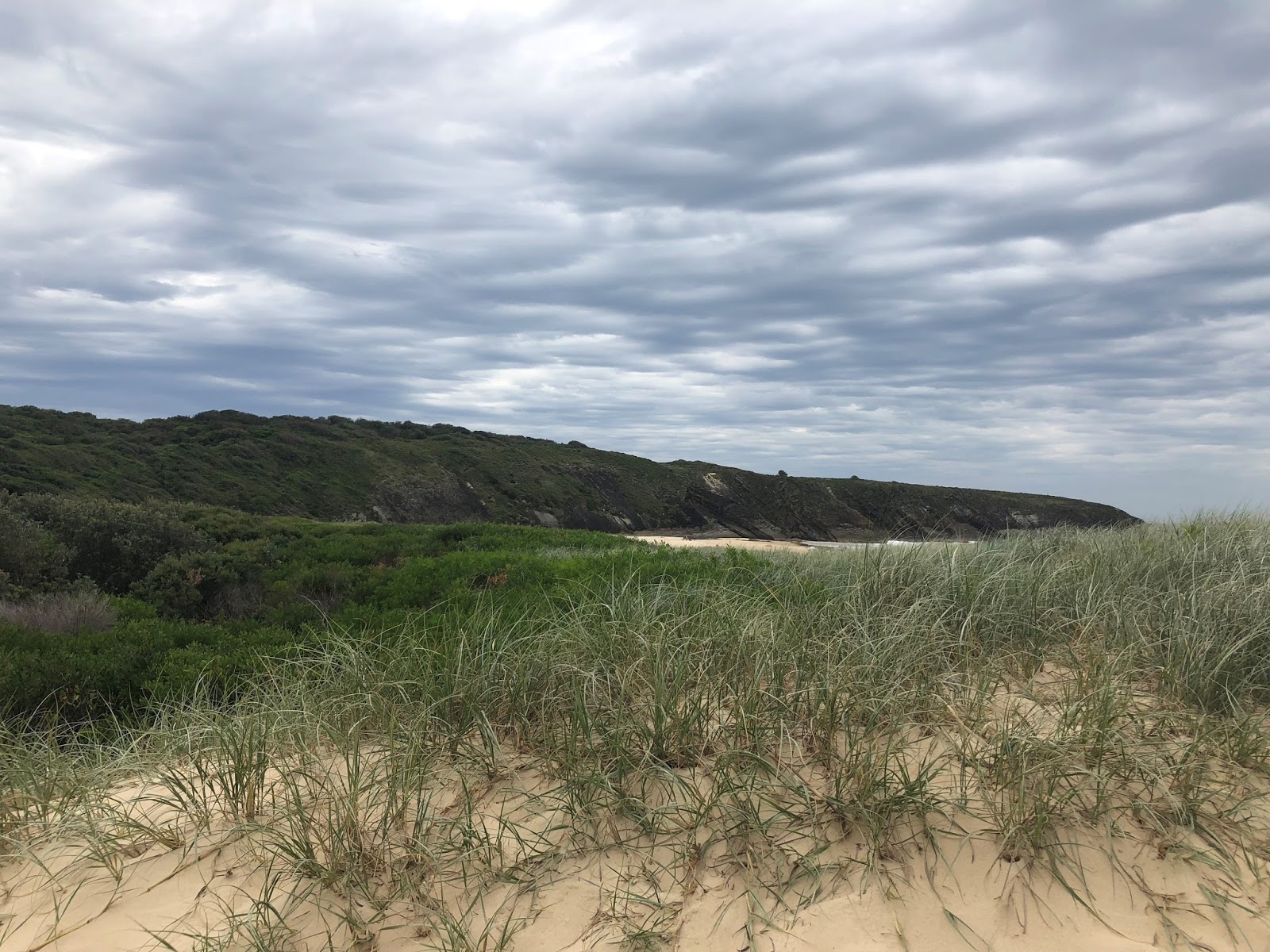
This is the path we walked down on our night visit to the beach. The beach is just past the bushes & down a hill. I'm happy to say we didn't come across any snakes!


On the second night we all had an evening walk along the beach and found hundreds of crabs as it became dark, scuttling around as we shone a torch on them.


Science Notebooks


I read this in Charlotte Mason's Formation of Character last week. Moozle had done two science experiments and decided that she'd like to redo them and make a video. It took quite some time and when her Dad saw them that night he observed that it looked like the science was an aside to the video production. Which was true, but she'd already done the experiment & written it up. However, I can understand Mason's concern that the show of things can take over and fill their minds, with the facts themselves getting lost in the process.


I posted the videos on my Instagram account which I've had for a little while but haven't used much. My old phone made it difficult for me but now I've got a decent one I've started to post there. 

This is one of the experiments she did on the video:


This was an experiment Moozle illustrated after reading about it in The Wonder Book of Chemistry


Anatomy & Physiology


And this is from 'Secrets of the Universe' (see the Science schedule for Year 7 at AmblesideOnline)


As you can see, she has been getting good use out of the watercolour set she received at Christmas. When she's done one of her more artistic notebook entries, I have her explain the concept she's illustrated to make sure she has a good understanding of it, even though she hasn't included a lot of detail in the entry.


Peace

The steadfast coursing of the stars,
The waves that ripple to the shore,
The vigorous trees which year by year
Spread upwards more and more;

The jewel forming in the mine,
The snow that falls so soft and light,
The rising and the setting sun,
The growing glooms of night;

All natural things both live and move
In natural peace that is their own;
Only in our disordered life
Almost is she unknown.

She is not rest, nor sleep, nor death;
Order and motion ever stand
To carry out her firm behests
As guards at her right hand.

And something of her living force
Fashions the lips when Christians say
To Him Whose strength sustains the world,
'Give us Thy Peace, we pray!'

by Bessie Rayner Parkes (1829-1925)


* Bessie Rayner Parkes was Hilaire Belloc's mother. Belloc, a prolific author, who was a friend of Chesterton, is famous for his Cautionary Tales for Children.


A visitor to our backyard later in the month: a Black (or Swamp) Wallaby