Showing posts with label Middle Ages. Show all posts

Tuesday, 29 April 2025

Katherine by Anya Seton (1954)


Katherine is a fictionalised account of Katherine Swynford (1349-1403) the woman who was John of Gaunt, the Duke of Lancaster’s mistress for twenty years. Gaunt was the fourth son of Edward III and the Tudor dynasty descended from their illegitimate children.Katherine and her older sister Philipa, daughters of a knight in what is now Belgium, are left orphaned. Philipa is sent to serve the queen at the English court while Katherine is placed in a convent in England and is educated there for a number of years until she, too, is summoned to court.

Katherine unwillingly marries Sir Hugh Swynford, a retainer in the Duke of Lancaster’s service, and bears him two children. When the Duke is away on a campaign, his wife Blanche contracts the plague and Katherine takes care of her and is with her when she dies. John hears of her kindness and courage and engages her as governess to their children. John is devastated by his wife’s death and turns to Katherine for comfort, but she refuses a relationship as his mistress as long as Sir Hugh is alive.
John has to marry again, and of course, he cannot marry a woman who is not of noble birth, so he marries a woman he does not love, Constance, the Princess of Castile, for political expediency. He does love Katherine and takes her as his mistress after the death of her husband. She bears the Duke’s four children, the ‘Beaufort Bastards,’ and after Constance’s death she marries the Duke after many years as his paramour.

There were aspects of this book I loved and then there were other aspects I didn’t. A number of historical figures and events are featured in Seton’s story – Edward III, Richard II, Wat Tyler and the Peasant’s Revolt, the Black Plague, John Wycliff, Julian of Norwich, and Geoffrey Chaucer (who was married to Katherine’s sister, Philippa) to name a few, which gave the book added interest, but as is usual with historical fiction, it’s difficult to sort out how much is actual historical fact and how much is the author’s imagination.

Parts of the story are highly romanticised and I became a bit tired of the love affair between the two main characters and Katherine’s agonising, ‘He loves me, he loves me not…’ while she disregarded the fact that she was monopolising him and his poor Constance was neglected.
Katherine’s first husband, Hugh, loved her in his own way but she found him repelling and he felt this keenly. Their first child, Blanche Mary, was born while he was away on a campaign and she loved the child. I thought that this would soften her attitude to Hugh when he returned, but she remained remote.
Her later relationship with the Duke deeply affected the children from her marriage to Hugh. The Beaufort’s, up until they were legitimised after Katherine and John’s marriage, had very little prospects and uncertain futures. The couple was often thoughtless about those who were adversely affected by their relationship.

Alison Weir has written an historical account of Katherine Swynford (Katherine Swynford: The Story of John of Gaunt and His Scandalous Duchess) and in this article she sheds some light on the real life of this woman who ended up bearing John of Gaunt’s Beaufort children and later married him.

The Middle Ages was a brutal time. Life was cheap, fortunes rose and fell depending on who was in power, life expectancy was short, infant mortality was high. Marriage was often a tool to gain political power and all sorts of unsuitable alliances were made for children of the nobility in order to add to their estates or elevate their status, and many women died in childbirth.
Reading books like this do make me thankful that I’m living now and not back then. To be sure, I would have died at sixteen from appendicitis if an infectious disease hadn’t taken me out before then.

This royal throne of kings, this scepter’d isle,
This earth of majesty, this seat of Mars,
This other Eden, demi-paradise,
This fortress built by Nature for herself
Against infection and the hand of war,
This happy breed of men, this little world,
This precious stone set in the silver sea,
Which serves it in the office of a wall,
Or as a moat defensive to a house,
Against the envy of less happier lands,
This blessed plot, this earth, this realm, this England,
This nurse, this teeming womb of royal kings,
Fear’d by their breed and famous by their birth…

-John of Gaunt ‘s speech (from Shakespeare’s Richard II)

Anya Seton (?1904-1990) was an American best-selling author of Romantic and biographical novels. Her father was the English naturalist and author, Ernest Thompson Seton, and her mother an American travel writer. Writing was obviously in her genes ðŸ™‚ and apart from my comments above about what I didn’t like about the book, I found it very well-written and engaging.


Tuesday, 28 January 2025

Simon the Coldheart by Georgette Heyer (1925)


Georgette Heyer was in her early twenties when Simon the Coldheart was published. She was a severe critic of her own work and this title was one of about five or six that she said she didn’t want to be republished. After Heyer’s death in 1974, her son decided that his mother had judged her work too harshly and the book was reprinted in 1977.

Simon Beauvallet is the fourteen-year-old illegitimate son of Geoffrey of Malvallet. His mother died when he was about ten and his father had never bothered with him.

🏰As the book begins, Simon presents himself at Fulk of Montlice’s castle, his father’s enemy, with the desire to become his page. Alan of Montlice, Fulk’s son, was a little younger than Simon. He happens to meet Simon as he is intercepted by a guard when trying to enter the castle. Taking an instant liking to him, he leads Simon in to meet his father. Fulk is impressed by Simon’s attitude and makes him page to Alan. Fulk later made Simon his own page and swore that there was more of himself in Simon than in his own son.

Simon grew to manhood. He became firm friends with Alan and Simon’s older half-brother, Geoffrey, but there was always an icy reserve in his manner with everyone. His prowess in battle earns him knighthood and lands. He fights under Prince Henry, the future Henry V. By the time of the Battle of Agincourt, Simon has turned thirty and, 

Henry and Alan believed that there was something in Simon that would spring to life one day, but Geoffrey’s response was,

Heyer’s last book written before she died was My Lord John which overlaps slightly with this book. Her first love was for the Middle Ages, although she is best known for her Regency romances. Simon the Coldheart reminded me of the type of historical fiction my sons really enjoyed in their early teens and although they didn’t get to read any of Heyer’s novels, I’m sure they would have taken to her writing. She is very good at portraying family life and in this book, male friendship. 

Lots of ye, thou, hast and battle exploits, chivalry and derring-do. ðŸĪš

Although Simon had a cold manner, he was loyal. His relationship with Fulk of Montlice and that man’s acceptance of him became almost that of father and son and Alan and Geoffrey were true and devoted friends. As you’d expect, something in Simon did spring to life in time but I won’t go into that. ðŸ˜Š

Recommended for those who enjoy the historical time period of the Middle Ages. There are romantic elements but not enough to turn off younger readers who prefer action. It has a slightly G. A. Henty feel about it with the added benefit of humour.


Thursday, 1 April 2021

The Talisman by Sir Walter Scott (1825)


‘All Scott’s work is marked by three characteristics: a genius for enriching the past; a love of Nature; a sturdy humanity. He loved the pomp and pageantry of a bygone age. His imagination lived naturally in the stirring tales of yore. He was a historical novelist by temperament rather than by profession... There have been historical romancers more accurate than Scott in the details of the story, but none so true to the inmost spirit of the age depicted.’ - from the Introduction by Robert Harding 

The Talisman is set in the Levant (the historical name for the region of the Eastern Mediterranean) towards the end of the Third Crusade. In 1187 A.D. Jerusalem was captured by Saladin and the Third Crusade was launched in 1189 to retake the city. The book, a work of historical fiction, focusses on Richard I, the ‘Lionheart,’ Saladin, and a fictitious knight by the name of Sir Kenneth. 

The Crusaders were encamped in the Holy Land and in disarray. The Lionheart was very ill with a fever and partisan politics were threatening the progress of the Crusade. Meanwhile, in the desert of Syria, Sir Kenneth meets a Saracen and after fighting and neither winning, they acknowledge each other’s prowess and continue on their travels together. The Saracen leads Sir Kenneth to the hermit he had been seeking and they then go their own ways. 

There are twists and turns, double identities, misunderstood prophecies and plenty of adventure as the story continues. 

'...the unfortunate Knight of the Leopard, bestowed upon the Arabian physician by King Richard rather as a slave than in any other capacity, was exiled from the camp of the Crusaders, in whose ranks he had so often and so brilliantly distinguished himself. He followed his new master...to the Moorish tents which contained his retinue and his property, with the stupid feelings of one who, fallen from the summit of a precipice and escaping unexpectedly with life, is just able to drag himself from the fatal spot, but without the power of estimating the extent of the damage which he has sustained.'

Scott gets a little theatrical and the chivalry is over the top at times, as you might expect of the writing from this time, but he really brings Richard and Saladin to life. Their characters are realistically portrayed and Edith, one of his main female characters and a relative of the King, is interesting, intelligent and plucky. 

Scott doesn’t glorify the Crusades in any way and Saladin is treated very positively. It was interesting to read Scott’s description of him as I had just finished a chapter in another book, In the Steps of the Master by H.V. Morton, where the author stated that Saladin was ‘...the one enemy of Christendom whose name runs through all the history books as that of a brave and chivalrous foe.’

I have to say that I used the dictionary fairly regularly when I was reading The Talisman! There are quite a few obscure words and although a glossary is provided at the beginning, it looks like it's the original from 1825 and doesn’t include all the words that have gone out of circulation since. 

The Talisman is scheduled as a free read for the Ambleside Online Year 7 curriculum and is a book all my children have enjoyed at some point. A great book to add to your Charlotte Mason high school.


If you enjoyed this post you may subscribe here to receive new content when it is posted.

Sunday, 29 November 2020

The Brother Cadfael Series by Ellis Peters

 Ellis Peters was the nom de plume of Edith Mary Pargeter (1913-1995). I started reading her Brother Cadfael series of Mediaeval whodunnits set in England in the 12th Century about fifteen years ago. They are best read in order, although I haven't done so as the books are not always easy to find here.

Cadfael, originally from Wales, had turned Benedictine monk after life as a soldier and sailor and was well versed in the ways of the world. The earlier books elaborate on this and introduce some characters such as Hugh Beringar - the deputy sheriff and Cadfael’s close friend; Abbot Radulfus and others who re-appear in subsequent books.

The Leper of Saint Giles was written in 1981 and is the Fifth Chronicle of the series. The story is set in the year 1139 when King Stephen was on the throne.

‘He had seen battles, too, in his time in the world, as far afield as Acre and Ascalon and Jerusalem in the first Crusade, and witnessed deaths crueller than disease, and heathen kinder than Christians, and he knew leprosies of the heart and ulcers of the soul worse than any of these he poulticed and lanced with his herbal medicines.’

When visiting the leprosy hospital at Saint Giles to restock their medical supplies, Cadfael arrives just as preparations for a noble wedding are in progress. He witnesses the bridegroom, Huon de Domville, arrive with his entourage. Domville is a shrewd, malevolent man, and quite a bit older than his intended young bride. 

The young woman rides in later, accompanied by her uncle and his wife, her guardians after her father died. Cadfael recognised her as the granddaughter of a famous knight who had fought in the Crusades. It was also obvious to Cadfael that the young girl had had no say in the matter of her marriage and discovers that the girl is secretly in love with one of Domville's squires.

Before the marriage could take place, two deaths occur and Cadfael uses his position and his past to help discover a murderer, absolve an innocent man, uncover a mystery, and unite two lovers.

The Leper of Saint Giles is a satisfying mystery and a tale of treachery with the unique twists and turns that are the hallmark of Ellis Peters.

The Virgin in the Ice is the sixth chronicle in the Cadfael series and was written in 1982. This book reveals a piece of Cadfael's past that should be read before going on to subsequent books. I won't say too much about this book but it could almost be called a thriller.

In the year 1139 King Stephen is on the throne but his cousin, Empress Maude, daughter of Henry I, has an equal claim to the throne. A civil war (the Anarchy) results and refugees have fled from Worcester, the scene of the latest conflict.

Among the refugees are a boy of thirteen, his seventeen year old sister, and a young Benedictine nun. They were known to have been  seeking refuge at Shrewsbury Abbey where Brother Cadfael resides but they fail to arrive. A monk of Cadfael's order is found near death from wounds inflicted by persons unknown and Brother Cadfael is drawn into both mysteries.

This is a gripping book with many false trails and intertwining plots. I thought there was just a wee bit of contrivance and overdone coincidence towards the end but Ellis Peters can get away with it. Her descriptive writing is a pleasure to read and her ability to draw the reader into the wintery, bleak atmosphere of the England of Mediaeval times adds to the appeal of these books.

As Cadfael reflects on his younger days and his time as a soldier in the Holy Land twenty-six years earlier he observes,

'In a land at war with itself...you may take it as certain that order breaks down, and savagery breaks out.'

The Virgin in the Ice covers a brutal period of English history and portrays the hardships that fall upon the common people when leadership forgets them. '...where royal kinsfolk are tearing each other for a crown, lesser men will ride the time for their own gain, without scruple or mercy.'


Monday, 27 October 2014

Ambleside Online Year 7 in Review


The Lady of Shalott by J.W. Waterhouse, 1888


Bengy, our 14 year old, turning 15 later this year, has come to the end of AO Year 7. I've mentioned in other posts that the upper years of AO are sufficiently challenging for a students over a range of ages. It helps to think in terms of forms (as used in Charlotte Mason's schools) as opposed to grades for History and Literature in particular, while the content covered in a subject such as Maths is a separate consideration and more indicative of a student's 'grade' level.

For Year 7 we basically followed the schedule as it is written, omitting a few things, adding in others for various reasons, including the fact that we'd started before the new changes for Year 7 came in earlier this year. This year also included preparing for a Grade 7 AMEB piano exam which requires a lot of preparation. The Ambleside Online website states:

This is a collection of some of the best resources for this time period. Even Advisory members aren't able to cover all of these with every single one of their own students and have to be selective. Feel free to pick and choose from among these suggestions. The best choice may just be the book you already own, and the one from which your student can narrate.


What we didn't include:

The Once and Future King, by T. H. White - didn't have the book; had a look at a copy from the library & thought we could skip it.

We didn't use these books either, mainly because of the time factor, but plan to at some time:

How To Read a Book, by Mortimer Adler and Chares Van Doren 
The Fallacy Detective, by Nathaniel Bluedorn & Hans Bluedorn 
The Story of Painting, by H. W. Janson

Devotional:

* Mere Christianity by C.S. Lewis
** The Pursuit of God by A.W. Tozer
Saints & Heroes - as scheduled

Literature & Poetry:

The Grammar of Poetry, by Matt Whitling - slowly going through this.
The Albatross Book of Verse
Poets: G.K. Chesterton & Alfred, Lord Tennyson

Easy Grammar Plus - completed this book a couple of months ago and since then has used his Latin studies for grammar.

Chaucer - we used one of the selections before the changes were made.

This is an interesting post with a variety of Chaucer resources and suggestions:
 
Shakespeare:

The Winter's Tale

We are going to see the Bell Shakespeare production of Henry V in a few weeks.


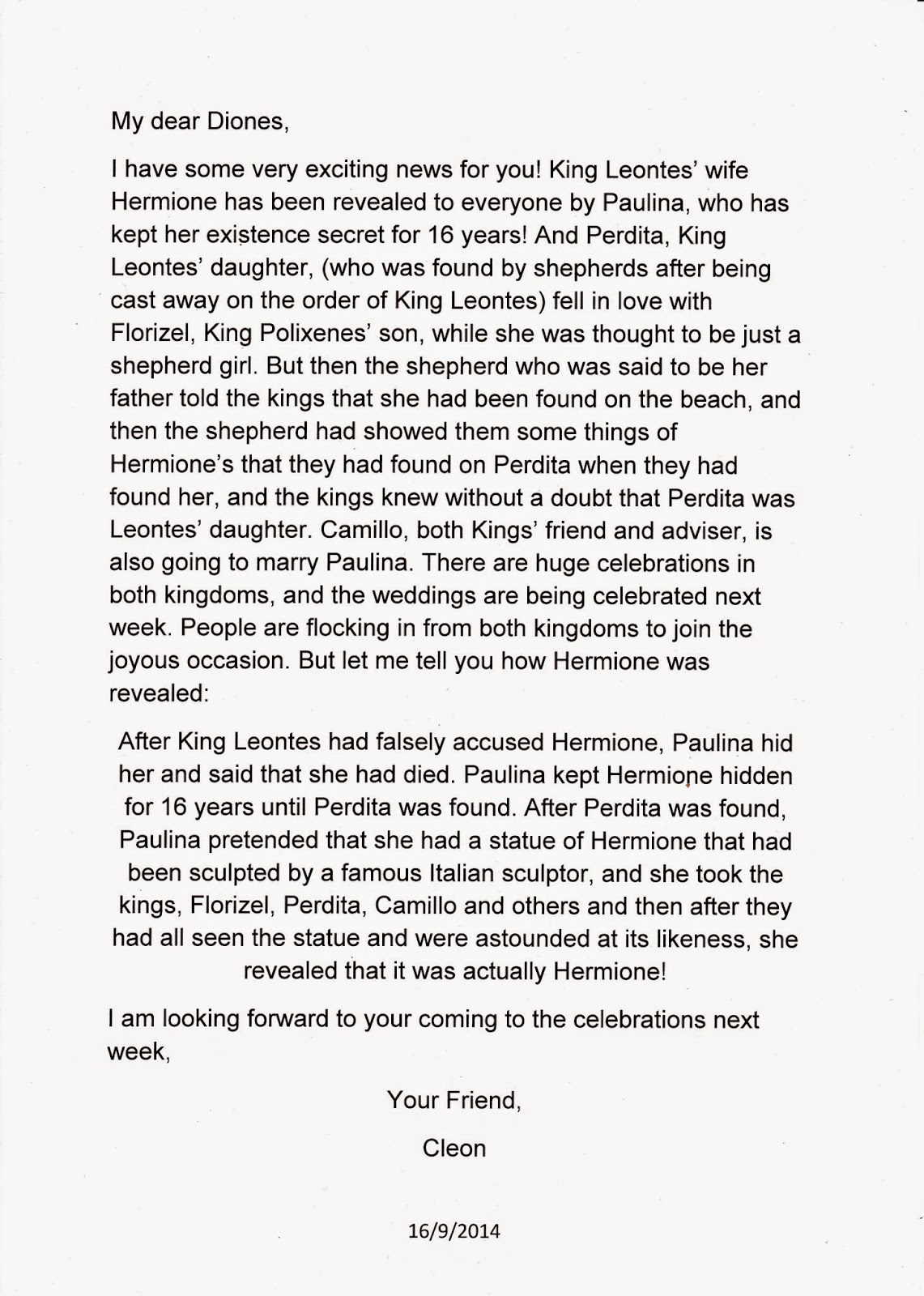
A narration from The Winter's Tale:


Plutarch:
Quintus Fabius Maximus - Some thoughts on our study of this man

I've linked to the study guides on the men below:
Nicias


Natural History

Life of the Spider by Henri Fabre

Warrigal the Warrior by C.K. Thompson - a fascinating insight into the Australian dingo as well as being a great story.

Bush Calendar by Amy Mack - we continue our monthly reading; free online.

Nature Study - we've been bush walking regularly and have had some good beach visits and a focus on rocks and clouds.

Maths

Saxon Algebra 2 with Art Reed's DVD

Latin

After finishing Getting Started with Latin by William Linney, (which I highly recommend) Bengy commenced Linney's Latin Class, a free online course by the same author.
The website has audio lectures/lessons which can be downloaded and uses an out of print book available on Google Books or at archive.org:


(Don't do what we did and start with the wrong book. There is another by the same author called Latin for the First Year.)
Each audio lasts from around 1/2 hour to an hour and includes explanations and instructions on when to do exercises in the book etc. An answer key is included on the website to go along with the lectures. We spread a lesson out over a week, sometimes two if it's a long one.


We aren't in the USA and we generally can't access Google Books so we usually go to archives.org to download books but we found that two pages were missing on our download. I emailed Mr. Linney who replied about an hour later. He was very helpful and sent us a link to Google Books Australia (which I didn't know about) but the pages were also missing in that so then he sent us a PDF of the missing pages. This man provides this course free of charge and then goes out of his way to help a random person on the other side of the world find two missing pages - I'm impressed and very grateful!
Here are those two pages in case you have the same problem:


There is enough material in this course to cover the equivalent of high school Latin I & II and it has been a good fit for this young man. He did try Henle Latin first and really disliked it so I was happy to find a Latin course to replace it that didn't cost me anything!

Science

The Human Body - see here.
Apologia General Science
Eric Sloane's Weather Book, by Eric Sloane 
Great Astronomers, by R.S. Ball (Ptolemy, Copernicus, and Brahe) 
Science Notebook & below an example of a narration in the form of a science quiz ie. set a list of questions to which he had to know the answers:

"The mind can know nothing save what it can produce in the form of an answer to a question put to the mind by itself." 
A Philosophy of Education pg.16


Fearfully & Wonderfully Made - we started this late so we are still going. It's a wonderful book.

Picture Study:

Jan Vermeer - I have a Pinterest board with the paintings we studied.
Marc Chagall
Diego Velasquez

Music Appreciation:

Chopin
Spanish Composers - we spent a few months listening to this wonderful music.
AMEB Grade 7 piano exam

Physical Education

Indoor Soccer
Swimming

Handicrafts/Manual Skills

Cooking
Fiddling around with electronics
Meccano:


Scottish folk songs - this is a post I did on these and other Scottish material that fits into this time period.

Free Reading

The Talisman by Sir Walter Scott
Lorna Doone by R. D. Blackmore (AO Year 9)
Safely Home by Randy Alcorn (AO Year 11) 
The Hunt for Red October by Tom Clancy (AO Year 11)

The following two books by Regina Doman:

The Shadow of the Bear
Black as Night


I'd recommend previewing these first; there are more in this series of modern day fairy tales but they're for an older age group. There is a parent's guide here and the two books above are recommended for ages 14 years and up.

The "D'Artagnan" Romances by Alexandre Dumas: (they're all here.)

The Three Musketeers
Twenty Years After
The Vicomte De Bragelonne
Ten Years Later
Louise de la Valliere
The Man in the Iron Mask

 
I asked Bengy to tell me which books were his favourites this year and these are the titles he gave me:

The Pursuit of God
Whatever Happened to Penny Candy
Ivanhoe
Watership Down
The Age of Chivalry
Eric Sloane's Weather Book
The Lord of the Rings Trilogy
The Talisman
Hereward the Wake
The Birth of Britain