Wednesday, 14 August 2013

Bible Memory & Bible Literacy

I went for a walk with my husband the other night after a messy week in one way and another. I often find as I talk about things on my mind I get some perspective but on this particular evening I was feeling frustrated and as my husband was talking about his day I was only half listening.
By the time he'd finished talking we were trudging up a hill (which was only adding to my feelings of disgruntlement) and I was ready to launch forth and pour out my vexation when, without any warning, the words from Psalm 121 came to the front of my mind, almost as if I could see them in print:

"I lift up my eyes to the hills,
Where does my help come from?
My help comes from the Lord, the Maker of heaven & earth."

I wasn't thinking of anything remotely like those words! - they'd sprung up from the deposit I'd placed there sometime ago. I felt like I'd been thrown a rope and that I was being pulled up as I held on. It hit me that I'd been looking to the wrong place for the kind of help I needed at that time and that just letting my mouth spill out my disagreeable thoughts wasn't going to do me (or my husband) any good.


'How did the old Cavaliers bring up sons and daughters, in passionate loyalty and reverence for not too worthy princes? Their own hearts were full of it; their lips spake it; their acts proclaimed it.....'
Home Education; Volume 1, Charlotte Mason


'Impress them upon your children...'

Our eldest son, just turned 22 years of age, said to us a short time ago that one of the best things he thinks  we've done as parents was being serious about instilling God's Word and having regular family devotions.


It's a  very secure thing for our children to know that they and we are all under the same authority - God's Word is the benchmark, not some arbitrary  rules we might enforce depending on our mood at the time.
I know there are all sorts of ways to memorise & review scripture but I know what I'm like - I need to keep it very simple & just do it - otherwise I tend to get paralysed trying to figure out how to implement a system.
Memorising scripture wasn't easy for me, but I found that if I could put verses to a tune that I knew I would remember the words. I've used this and other methods with my children.
I started with Psalm 23 when our children were about 2 years of age and made up some simple actions to go with the words. They'd get to the stage where I could prompt their memory with a couple of actions such as pointing to a cup (my cup overflows), tapping the table (prepare a table) etc as we recited it together.

We've put verses to folk tunes, the boys have done rap versions of some verses, we've printed sections out and stuck them to the doors, we've used CD's such as Colin Buchanan, Steve Green (Hide 'Em in Your Heart) and Sons of Korah and I've assigned them for copy work at different times.


Until they really know the verses, we recite or sing them each day or a few times a week until they're familiar.


Here are some other resources that we've found very helpful.

                      
The Psalty Kid's Company was one of the few resources around when our older children were little. The songs are not for Bible memory as such but they encouraged children in developing their faith. A couple that our children enjoyed & listened to endlessly were:

Psalty's Hymnological Adventure Through Time - children learn about the hymn writers of the Church and the heritage of Christian music in history when they accidentally go back in history via a time machine.
Psalty's Missing 9 is a fun way of learning how to grow in the Lord as Psalty and kids search for the secret of how to grow in the Lord.


Psalm 139 - Knowing God's Word helps our children understand their worth. They are not the centre of the universe but they are unique, precious in His sight, were made for a purpose and were not accidents. A good psalm for anyone!


It's said that the Bible created the soul of Western Civilization but in more recent times that soul has been disintegrating and Biblical literacy is almost absent in modern day books. It's not until you read an author from an earlier time period - John Buchan is one who comes to mind - that this loss becomes apparent.
I basically had zero Bible knowledge growing up so it was a whole new world to me. My husband was the opposite and he'd had the benefit a a fairly thorough knowledge of the Bible.
When it came to starting out with our own family we just did a few simple things:

Family Devotions - reading through a section of the Bible after dinner as a family & everyone praying for something/someone. This becomes a much more difficult thing to do with a span of ages, work and study committments and other things that come with a growing family, but laying down the habit in the early years does provide a foundation, even if it's difficult to continue on a regular basis later on.

Bible Memory - this is something I usually do with them during the day as part of our together time. Some of our children memorized things very quickly and others didn't seem to be remembering anything but they do eventually. I think of it like fruit - sometimes growth takes a long time but you eventually reap what you sow.

Learning the books of the Bible in order - we put the books of the Bible to the tune of Onward Christian Soldiers and they picked that up fairly quickly - my oldest could recite these at the age of 2 (she has a great memory; it took longer with some of the others).

Their own Bible - when they could actually read we made a special trip out to buy them their own Bible - not a story book - we use the NIV generally.

Devotional Living - by this I mean using daily opportunities to apply & live out God's Word. Nature study affords some obvious ways to do this (check out Psalm 19!); praying as needs arise during the day; checking out what the Scriptures say about certain situations eg. anger, quarrelling, forgiveness.


My husband and his siblings grew up with these books and our children have enjoyed what's left of them. They are good  for a general overview of the Bible stories and great for boys, reluctant readers and non readers. I have seen them in one volume somewhere.


'Do not let this Book of the Law depart from your mouth; meditate on it day and night, so that you may be careful to do everything written in it. Then you will be prosperous and successful. Have I not commanded you? Be strong and courageous. Do not be terrified; do not be discouraged, for the 
lord your God will be with you wherever you go.'  
Joshua 1:8-9


Update: another book we've found helpful: What the Bible is all About by Dr. Henrietta Mears is a handbook to help you to navigate the books of the Bible and understand why they were written. Very easy to use, it's an easy book to pick up before you start reading a book of the Bible you don't know much about. Especially helpful with the minor prophets in the Old Testament.


Monday, 12 August 2013

Kids Cooking - Gluten Free Pancakes for One

As an alternative to eating bread my two youngest sometimes like to make themselves pancakes for lunch. I gave them a basic recipe to start with that worked well and they've made a few adaptions, all edible. I suggested to my youngest that she use our little electric omlette maker because our frying pan is very large and heavy. The recipe makes two pancakes.- but you can double it and still only use one egg.


Recipe:

1 egg
2 Tablespoons of brown rice flour
1 Tablespoon of coconut flour
2 Tablespoons of water or milk
Teaspoon of vanilla extract (optional)
Sweetener e.g. honey or a few drops of liquid stevia (optional but nice)

Break the egg into a bowl, add the liquid ingredients and then add the flour bit by bit, stirring to mix it all up well. Grease the omlette maker or frying pan and heat. Divide the mixture into two and pour into each section of the omlette maker, frying pan or griddle.  If using the omelette maker allow 2 minutes per side; if frying pan cook as normal for pancakes then serve.
The photo makes them look more yellow than they really are - they should look like pancakes, not omelettes.  


Some substitutions that have worked well:

2 Tablespoons of millet flour in place of the coconut flour.
Buttermilk or coconut milk in place of water or milk.
Buckwheat flour can replace some of the flour but it tastes better if it's cooked in a frying pan.
My kids add cinnamon to just about everything so they've tried that too. They thought it was ok but I didn't.


Saturday, 10 August 2013

Australian Stories for Children......with a Christian twist

The Spindles books by Barry Chant are a series of books with a gospel message in the form of unique parables set in the outback of Australia. Spindles and his animal friends are involved in many exciting situations and the author uses these to explain Biblical truths and make them plain to children. They were written for 8 year olds and up to read for themselves but they also make good read alouds for younger children. I've put them here in the order they were written in although they may be used as stand alones.


In Spindles and the Wombat, Spindles (who lives on an outback station and does his lessons by correspondence) attaches himself to a highschool group from the city on an excursion looking at fossils. He gets talking to one of the students who mentions fossils and hears one of the teachers answering questions from the students on evolution and how life began.

'That sounds a bit far-fetched!' said Spindlesout aloud without realising it. "I thought God created everything."
There was an outburst of laughter from all around him........Spindle blushed a bright pink, turned and ran off, the laughter still stinging and shaming him.
Later, he sat at the foot of the Redgum tree, and tried to work things out. How did those fossils get here....? 
........Spindles was really confused and upset.'

Spindles' wise old friend, the great eucalyptus tree Redgum, advises Spindles to find out what it was that made him so unique and different from everyone else and so a study of DNA gets underway with the help of his various animal friends.


'And Spindles remembered all that had happened over the last few days. He thought about the magpie's nest - and - genes - and little joeys - and the possibilities of all this happening by chance.......
He thought about the alternatives. A few microbes just happening to find life in the primeval ooze of a shapeless world. Or the all-wise, all-loving, all-knowing Creator, infusing His own qualities into the creature that He made - and forming him in His own image!
Somehow, he liked that better!'


In Spindles and the Crocodile, Spindles and Freckles (an orphan who lives with Spindles' family) find a rare bird, meet a Tasmanian tiger, trap a dingo and Spindles falls down a mine shaft and learns about God's faithfulness.


All of our children have enjoyed reading these books at around age 8 to 10 years. For non-Aussie readers these books are an interesting way to introduce children to the unique Australian wildlife and outback. A helpful glossary is provided in the back of the first six books with short explanations of Australian idioms and animals; average length of books - about 130 pages.

'What a pity that our education system often tends to restrict, rather than foster the delightful God-given imaginative creativity that most children have!'   Barry Chant


Saturday, 3 August 2013

Pied Piper by Nevil Shute

This is the second book by Neville Shute that I've read and enjoyed very much - the first was A Town Like Alice. In both books an elderly man is a central figure in the story; in the first as the narrator and in the second as the protagonist, and the author has expressed so well the pathos and weariness of men who have lived faithful, quiet and sensible lives but have struggled with the pain of sudden loss and disappointment.


www.bookdepository.com/Pied-Piper-Nevil-Shute-Norway-John-Boyne/9780099530220/?a_aid=journey56


Frustrated by his inability to aid the war effort, Englishman John Sidney Howard travels to the relative peace of a village in the French countryside in 1940 and waits for the fishing season to begin. Insulated by Switzerland from Germany, the village feels detached from the war but before long news comes of the capitulation of King Leopold of Belgium followed by the evacuation of Dunkirk and Howard makes up his mind to return to England.

Asked by some friends to take their two young children with him he agrees and commences what he thinks will be a straightforward journey across France to the coast where he plans to cross the Channel by boat but with the German invasion of France his original plans are thwarted and he has to conceal his British identity.
By the time he reaches the English Channel he has six children of multiple nationalities in his care, the Nazis are closing in and in an unexpected turn of events he is charged with the care of another child.

'Up to the last it had seemed incredible that he should not get through, hard though the way might be. But now he realised that he would not get through. The Germans were between him and the sea. In marching on to Angerville he was marching to disaster, to internment, probably to his death.
That did not worry him so much. He was old and tired; if an end came now he would be missing nothing very much. A few more days of fishing, a few more summers pottering in his garden. But the children - they were another matter. Somehow he must make them secure........
And what about the dirty little boy who was now with them, who had been stoned by old women mad with terror and blind hate? What would become of him?
The old man suffered a good deal.'

This book views World War II through the eyes of an unusual protagonist, making it a thought-provoking read well worth the time.


Thursday, 1 August 2013

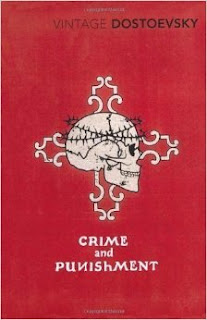
Crime & Punishment by Fyodor Dostoevsky

www.bookdepository.com/Crime-and-Punishment-Fyodor-Dostoevsky-Richard-Pevear-Lariss-Volokhonsky/9780099981909/?a_aid=journey56


Well, the 'Crime' occurred in the seventh chapter of this large book, leaving the rest of the book - another thirty-two chapters and an epilogue to deal with the 'Punishment.'

Raskolnikov, the main character, believed that some men are extraordinary; they are men of genius and as such are above the law. He believed himself to be in this class of men and when his circumstances became impoverished and his anxiety increased over his mother and sister's circumstances, he planned to kill the miserly old pawnbroker he had been dealing with, considering her to 'be worthless' and that 'the world was better off without her.'                                                                                                                                  
All through the book he tries to justify his crime and he doesn't repent of his actions even when he decides to give himself up, admits that he is the murderer and gets sent off to a Siberian prison.

I kept thinking of what I'd read in The Philosophy of Education by Charlotte Mason,

'From Cain to the latest great offender every criminal act has been justified by reasoned arguments which come of their own accord to the criminal...
reason will put a good face on any matter we propose; and, that we can prove ourselves to be in the right is no justification for there is absolutely no theory we may receive, no action we may contemplate, which our reason will not affirm.'

Raskolnikov had people in his life who loved him, even when his crime was exposed, but his inner struggles kept pushing against their love and isolating him. Ultimately, though, it was love that broke his pride and released him from his inner prison.

'Raskolnikov sat gazing, his thoughts passed into day-dreams, into contemplation; he thought of nothing, but a vague restlessness excited and troubled him. Suddenly he found Sonia beside him; she had come up noiselessly and sat down at his side. It was still quite early; the morning chill was still keen. She wore her poor old burnous and the green shawl; her face still showed signs of illness, it was thinner and paler. She gave him a joyful smile of welcome, but held out her hand with her usual timidity. She was always timid of holding out her hand to him and sometimes did not offer it at all, as though afraid he would repel it. He always took her hand as though with repugnance, always seemed vexed to meet her and was sometimes obstinately silent throughout her visit. Sometimes she trembled before him and went away deeply grieved. But now their hands did not part...


The Blackstone audio version is quite good. It's narrated by Anthony Heald and he does make the character real and psychopathical. I needed to read the book also as keeping the Russian names in my head doesn't work for me unless I can actually see them written.
This is one of those books that deserves at least a second reading.


Crime & Punishment is recommended as supplementary reading in Literature in Ambleside Online Year 11. 'Not for the faint of heart.' It's a raw read which I'd personally leave for a more mature reader. It would be an interesting book for a student studying psychology or criminal law.


Sewing Project for an 8 Year Old


Moozle needed a bag for her soft leather dancing shoes so we chose some pre-cut felt rectangles, checking  that the shoes would fit before she went ahead with the sewing.


I'd given her a lesson in using the sewing machine a couple of weeks beforehand so I decided it would be good to do some of the project on the machine. 


First of all she drew a picture on one of the felt pieces and chose the colours of embroidery cotton she wanted to use. Then she stitched the outline of her bird using a backstitch with three strands of cotton.


The two pieces of felt were sewn together on the outside leaving the top edge free. A pink coloured pencil was used to colour in the bird and make its body look fluffy.
With a large needle threaded with some thinnish ribbon and some dots in pencil about an inch and a half (4cm ish) from the top I placed there to guide her, she threaded a drawstring for her bag.


Materials Needed:

2 pieces of felt - felt is a good choice because it doesn't slip as much as some materials and it doesn't fray on the edges.

Embroidery cotton - we used what we had which was DMC stranded cotton. 3 strands is thick enough to show up nicely. 

A length of narrow ribbon for the drawstring - we used about 35 inches (90 cm) of ribbon.

All up it cost $2.50 for the felt and ribbon.