Showing posts with label Australian Fiction. Show all posts

Monday, 29 June 2020

A Foray into Some Modern Books

Lila by Marilynne Robinson (2014)


I’ve been interested in reading something by this author for some time but as I’m always cautious about more modern novels and am generally disappointed with them, I wasn’t prepared to buy a new copy. Fortunately, I found a copy of at a secondhand book sale and then I discovered that my local library has other books by Marilynne Robinson, which is wonderful as I enjoyed this book very much.
Lila was a neglected child who found her way into the heart of an itinerant worker. Doll was a single woman on the fringes of life who slept at Lila’s house most nights. One evening she came home and found the young child half asleep outside the house in the cold, after being kicked out because her family was sick of her crying. Doll picked her up, wrapped her in her shawl, went into the house where everyone was asleep, took her bundle of possessions and went out into the night.

‘Doll may have been the loneliest woman in the world, and she was the loneliest child, and there they were, the two of them together, keeping each other warm in the rain.’

From then on Doll kept on the move with Lila, always with the fear that Lila would be taken from her. After a time they they joined up with a group of itinerant families and travelled with them. These were good years with enough food, a sense of security, and a year of school for Lila.
But the Great Depression drew near and the good years came to an end. The itinerant work dwindled and Doll and Lila, left to fend for themselves, were separated.
Lila had a life of misery and ended up in a whorehouse at one stage. After escaping from that place she wandered the countryside until one day she found herself in a small town called Gilead and took shelter from the rain inside a church.
Lila is a beautifully told story that goes back and forward in time revealing the details of Lila’s life as the story progresses. This type of writing doesn’t always work well but the author uses it to great advantage. The flashback technique was also good at showing the fracturing of families and society in the impoverished years of the Great Depression and the Dust Bowl times in the 1930’s. The storyline has an aura of mystery surrounding it and was a book I found difficult to set aside because it always had me guessing. Lila is someone you come to care about, especially as she comes to a watershed in her life where her choices will either make or destroy her. I kept hoping her fear wouldn’t keep her on the run.
A major theme in the book is trust and when Lila put aside the fear she had been brought up with and decided to walk into that church in Gilead she started on a pathway where she was to learn to trust.
Acceptance, love and an unusual romance were part of this.
Highly recommended and I am definitely going to read more of this author.


A Dangerous Language by Sulari Gentil (2017)


A Dangerous Language is the eighth book in Sulari Gentill’s Rowland Sinclair Mystery series. I’ve read all eight and each book in the series seems to get better than the last. This one took off from the start and was hard to put down so I read it very quickly.
As usual, the author weaves in Australian history, politics, culture, and news items from the 1930’s. Her writing is extremely well-researched and I really appreciate the Australian history I pick up effortlessly when I read her novels.
Rowland Sinclair and his three friends are embroiled yet again in the dangerous world of political intrigue; this time in Canberra, the nation’s newly developed capital, when a Communist agent is murdered on the steps of Parliament House. (‘Old Parliament House’ as it’s now known opened on 9 May 1927)
Rowland has volunteered to fly an international peace advocate from Fremantle to Melbourne where he is scheduled to speak but the right-wing militia responsible for the agent’s assassination are determined to stop him.
The predicaments and dangerous situations that Rowland and his three friends find themselves in this mystery series are definitely far-fetched but the writing is witty, fun and intelligent.
I’d recommend reading the books in order as many of the characters in previous books make a reappearance and they build on each other. The four main characters are also developed more fully as the series progresses and the longstanding interest that Rowland has for his friend, Edna, is a work in progress. I do wonder how long the author will string out this relationship! I think readers need some closure here and Edna & Rowland really have had plenty of time to get over their pasts and get their act together.
These books afford a unique presentation of our more local history and factional politics in a well done fictional setting.

Death in Holy Orders by P.D James (2001)


Death in Holy Orders by P.D. James is a sinister multiple murder mystery set in an Anglican Theological College on the East Anglican coast.
All through the book there is an underlying tension that keeps the reader in suspense as the murders seem unconnected and random. The author’s strength lies in her exploration of the psychological aspects of her characters and their inherent motives. These explorations open up a Pandora’s box and complicate the investigation process. Part of the enjoyment of James’ writing is the intellectual pursuit she engages the reader in, not to mention her excellent command of the written word.
In Death in Holy Orders, Commander Dalgleish returns to a place he frequented as a child (his father was a rector) and relives some of his boyhood experiences. We don’t often get personal insights into Dalgleish’s life and I always enjoy them when they are included. In this book Dalgleish also finds romance. His first wife had died in childbirth a number of years ago and he distanced himself emotionally.
The murders aren’t described in great detail but she always includes some (often bizarre) element of a s*xual nature. I don’t think these are necessarily gratuitous as James had seen the seamy side of life in her work in the forensic science department of the police force and later in the Criminal Policy Department. She also served as a magistrate in Middlesex and London and worked in the National Health Service and used her varied experience to help her write her books.

There are actually some likeable characters in this book. Sometimes James seems more than a little misanthropic but there was more nuance in the personalities here than in some of her other novels.
One scene was a lovely redemptive act that dealt with the acceptance of guilt in thought:

‘What was there about this place that forced him to confront the greater as well as the lesser lies? He had known she was in danger if death. He had hoped that she would die. He was in the eyes of his God...guilty of murder...How could he continue to minister to others, to preach the forgiveness of sins, when his own great sin was unacknowledged? How could he have stood up before that congregation tonight with this darkness in his soul?

He got out of bed and knelt, burying his head in his hands. It wasn’t necessary to search for the words; they came to him naturally, and with them came the promise of forgiveness and peace. ‘Lord be merciful to me, a sinner.’

Death in Holy Orders is well-written and engrossing crime mystery. It's of the best books I’ve read by this author and apart from the one or two scenes which may not sit well with some readers, I’d recommend it as a very interesting and complex murder mystery.


Wednesday, 25 July 2018

An Australian Classic: The Shiralee by D’Arcy Niland (1955)

D’Arcy Niland (1917-1967) was an Australian author who is probably best known for his classic book, The Shiralee, although he also wrote over five hundred short stories.
The Shiralee was a best-seller both in Australia and overseas and has never been out of print since it was first published in 1955.
Now that I’ve read it I’m not surprised at its success. It is a raw story of fatherhood, rejection, betrayal, and the human heart’s response to these. The author was in his teens during the Great Depression and although the time period of the story isn’t directly referenced, the setting seems to be during or around that time.


The Story

Macauley was a swagman (a labourer who walked his way from job to job, carrying a swag which contained his bedding and all his belongings) and he worked all over New South Wales. He had been married for five years and his wife and their three and a half year old daughter lived in the city while he worked in country towns or in the outback.
One day he returned home unexpectedly and found his wife with another man. In his rage, he beat up the interloper, grabbed Buster, his daughter, and made his way out on the road again.
Six months later he is still on the road and resentful that he is lumbered with his shiralee, his swag, the burden that he took on himself to spite his wife.

He had had no word from his wife since that time but she turned up in a town where he was working and tried to take Buster back to the city. Her plan was one of revenge. She didn’t want to be lumbered with the child and planned to get back at her ex-husband by putting her daughter into an orphanage without his knowledge. Macauley discovered she had taken the child and took her back but he was unaware of her real intention at that time.

It had come to this, the two of them wrangling over a scrap of humanity, like dogs wrangling over a bone; only dogs wrangle for the same reason: her reason and his were totally different. He was sure of that.

Macauley began to realise just how attached he had become to his little girl. This burden that he had to carry with him had compelled him to consider someone else besides himself. Begrudgingly he had had to adapt himself to a little person’s needs and in so doing he had become tethered. The swag that felt like a burden in the heat of the day, became a shelter at the end of it. And now he could not bear to be parted from her.

This book is unusual in its depiction of a single father. I know its extremely difficult for anyone in a single parent situation, but in the few instances I’ve known where the father is the solo parent, it seems doubly hard.
Macauley found it almost impossible to get suitable work. He was considered to be incompetent to raise a child, especially a female one. The type of work he did, the sort of people he associated with, the conditions of travelling on the road, were all considered totally unsuitable for a child.

Macauley wasn’t the most likeable sort of fellow when first encountered in this book. He lived by his fists and acted before he thought, if he thought at all. Thinking only brought him the pain of memory. He was aggressive, surly, and had a devil-may-care attitude. There were a few flashbacks to his own childhood and they were not pretty, but they helped to reveal how the man had become who he was. He had entered his marriage wanting the woman but not the life. He had no great love for his daughter and only took her with him to get back at his wife, not knowing that his wife didn’t want to be burdened with a child.

The developing relationship between father and daughter is poignantly portrayed but without sentimentality. Niland’s writing is terse, real and downright moving at times. He takes a total jerk, gets between the chinks of his armour and his angry exterior, takes him through a refining fire and reveals his humanity and heart.

Life on the road was also shown in its highs and lows. There were some dangerous and nasty characters but there were also others who would stand with you in trouble and still others who would lay down their lives for a friend.

Some practical points:

There are no chapter breaks in this book of 257 pages, but apart from the temptation to keep reading because there were no enforced breaks, it didn’t bother me.
Niland uses colloquialisms and Australian slang, some of them outdated now, that may be a hindrance to some readers - but then maybe not, judging by the international appeal of the book.
Parts of the book may cause offence to some readers . Macauley has many negative things to say about women, police, and Aboriginals, for example. But then, he is angry at just about everyone, even his own child, and has a basic distrust of people in general. However, I think the author has written honestly about the life of an itinerant worker in the early 1900’s in Australia. It wasn’t an easy life and it was a very different generation that had been through an atrocious world war and a world-wide depression. I appreciate books that honestly depict a time period without trying to impose a more modern worldview upon it.

The Shiralee is a true Australian classic but is definitely for a mature or adult audience.
D’Arcy Niland was married to the New Zealand author, Ruth Park, and they lived in Sydney where they raised their five children. She wrote a ballad, an extract of which I found in my copy of The Shiralee pictured above:

The swagman crawls across the plain;
The drought it prowls beside him,
A hundred miles from rim to rim,
And a shadow-stick to guide him.
The crow speaks from the broken branch,
And he replies, delirious;
But in the dark he drinks the dew,
Beneath the stare of Sirius,
And from his shoulder drops the swag,
The shiralee, the tether,
That through the cruel, stumbling day,
Drove all his bones together.
The load too heavy to be borne -
He cursed it in the swelter,
But now unrolls with humble hands
And lies within its shelter.


From 'The Ballad of the Shiralee’ by Ruth Park


If you scroll down this page, there are some lovely photos of Niland with his twin daughters and his wife.


Friday, 16 February 2018

Australian Historical Fiction: The Light Between Oceans by M. L. Stedman


The Light Between Oceans is M. L. Stedman’s 2012 award-winning debut novel. It is set in Western Australia where the author was born and raised, and is a well-written and heart-wrenching story.
Without giving away too much of the plot...the story takes place in the years after The Great War and centres around Tom Sherbourne, a young man who becomes a lighthouse keeper upon his return from active service. Memories of the war haunt him and he struggles with the fact that so many others did not return, or did so maimed and psychologically ruined. In many respects he is able to pick up his life again but his choice to be a lighthouse keeper is influenced by his desire for a solitary life, a direct result of both his unsettled upbringing and the trauma of war.
Then he meets Isabel, a young woman ten years younger than himself, and she has made up her mind that she wants to marry him.
Well, they do marry and go to live at Janus Rock, a fictitious, remote island off the coast of south-west Western Australia where their only contact with the outside world is the supply boat that visits the island four times a year from Point Partageuse (a fictitious town).


Lighthouse keepers were required to keep meticulous records in a logbook - visitors to the island, wreckage from the sea, every significant event at or near the lighthouse, whether it was a passing ship or a problem with the lighthouse’s apparatus - it was a legal requirement to document those events straight away.
One day in 1926, something occurs that doesn’t get documented. Tom is an honourable man but out of concern for Isabel’s fragile emotional state, he makes a decision that leads to longterm tragic consequences.
The Light Between Oceans is a sensitive story that explores moral choices and the deceitfulness of the human heart. It shows that our decisions do not only impact our own lives but have repercussions for those around us; that our emotions are not always reliable and that we can reason away just about anything if we lean on them alone.

This is the first time I’ve read anything by this author and I was impressed by her style of writing and descriptive ability. The historical and technical details about lighthouses and the work of lighthouse keepers were quite fascinating, even for this very non-technically minded woman, and the portrayal of the problems encountered by returned servicemen and their families was handled brilliantly.
The only negative for me was the profanity which became more frequent towards the latter part of the book, although it’s not out of character for the times, or for some people going through the type of circumstances and pressures described.
A very worthwhile book and one of the best written modern books I’ve read in a long time.

Tom's comment about his war service:

‘Being over there changes a man. Right and wrong don’t look so different any more to some.’

The impact of the war:

Throughout its infancy, the unspoken belief in Partageuse was that real hints happened elsewhere...
Other towns in the West had known things different, of course: Kalgoorlie, for example, hundreds of miles inland, had underground rivers of gold crusted by desert...
The world wanted what Kalgoorlie had.

...Then in 1914 things changed. Partageuse found that it too had something the world wanted. Men. Young men. Fit men. Men who spent their lives swinging an axe or holding a plough and living it hard. Men who were the prime cut to be sacrificed on tactical altars a hemisphere away.


The author has a nice way with similes and other figures of speech:

And Janus Rock, linked only by the store boat four times a year, dangled off the edge of the cloth like a loose button that might easily plummet to Antarctica.

‘Tom Sherbourne. Pleased to meet you,’ Tom replied, putting out his hand.
The older man looked at it absently for a moment before remembering what the gesture meant, and gave it a peremptory tug, as if testing whether the arm might come off.


Post-traumatic trauma:

Something solid. He must turn to something solid, because if he didn’t, who knew where his mind or his soul could blow away to, like a balloon without ballast. That was the only thing that got him through four years of blood and madness: know exactly where your gun is when you doze for ten minutes in your dugout; always check your gas mask; see that your men have understood their orders to the letter. You don’t think ahead in years or months: you think ahead in years or months: you think about this hour, and maybe the next. Anything else is speculation.

Tom's character:


Regulations require that each Sunday he hoist the ensign and he does, first thing. He raises it too when any ‘man o’ war’, as the rules put it, passs the island. He knows keepers who swear under their breath at the obligation, but Tom takes comfort from the orderliness of it. It is a luxury to do something that serves no practical purpose: the luxury of civilisation.

Other blokes might take advantage, but to Tom, the idea of honour was a kind of antidote to some of the things he lived through.

Thanks to Sherry at Semicolon Blog for mentioning this book. I'd heard of the title but I don't often read modern fiction and probably wouldn't have if Sherry hadn't said how much she enjoyed it.


Tuesday, 14 November 2017

A Murder Unmentioned by Sulari Gentill


A Murder Unmentioned by Sulari Gentill is the sixth book in the Rowland Sinclair series of crime mysteries set in Australia in the 1930’s.
One of the author’s trademarks throughout this series, and one of its most enjoyable aspects, is the cast of historical characters she skilfully weaves into the narrative.
Kingsford Smith, Nancy Bird, Robert Menzies, along with some notorious Sydney underworld figures, are some of these characters she includes in A Murder Unmentioned, bringing to life the atmosphere of Australian life in the post-Depression years.
Historical characters of the times have been a focal point in each of her books, however, in A Murder Unmentioned the plot takes centre stage, and it’s a good one. Suspense, mystery and plenty of twists kept me glued to its pages and made this my favourite book in the series so far.

Rowland’s father, Henry Sinclair, died when Rowland was 15 years of age and throughout the series references to his authoritarian and domineering personality are made, but he is mostly kept in the background. His portrait hangs on the wall of Woodlands, Rowland’s home that he shares with his three Bohemian friends, Clyde, Milton and Edna, an imposing and disapproving presence glowering over everyone that comes within view. Frequent mention is made of Rowland’s reactions to this painting over the course of the series, and here he remarks to Edna that the reason he hung the picture in his home was because,

“My father always liked to keep an eye on me.”

Edna wondered if she had misjudged Henry Sinclair. Rowland rarely spoke of his father but that need not, of itself, mean that their relationship had been strained. Perhaps it was a silence born of loss. Perhaps, beneath the outward severity, Henry Sinclair was an artistic soul. Rowland’s talent, Edna reasoned, must have come from somewhere. “It’s a shame he didn’t live to see your work, Rowley,” she said quietly.
Rowland frowned, his jaw tightened . “It’s not a shame at all, Ed.”


In previous books we had a hazy view of Henry Sinclair, but now we learn who Henry Sinclair really was and of his harshness and cruelty to his youngest son, Rowland.
When new evidence emerges about Henry Sinclair’s death and a former employee turns up to implicate family members, Rowland and his older brother, Wilbur, have to face the past, their individual fears and their secrets.
As always, Sulari Gentill doesn’t shy away from difficult subjects, but in her delightful way she infuses some well-timed Aussie humour that takes the edge off the heavy stuff without detracting from the seriousness of it. Quite a skill!
I’m looking forward to the next book so much but I’m getting impatient for Edna to get over herself and reciprocate Rowly’s feelings!


I’m linking up with Brona’s Books for the AusReading Challenge 2017 over the month of November. Come and have a look at some of the great Aussie titles on her blog!


Sunday, 5 November 2017

AusReading Month: Come Danger, Come Darkness by Ruth Park (1978)


Ruth Park (1917-2010) was a prolific, multiple award-winning, New Zealand born Australian author. The author’s background in rural New Zealand and her later experience of the Great Depression while living in Sydney, gave her much to draw upon in her writing.
Come Danger, Come Darkness is set on Norfolk Island, about 1,000 km off the east coast of Australia. The author lived on the island for a number of years and described its natural features vividly.


Norfolk Island was discovered by Captain Cook in 1774 on his second voyage around the world. In 1788 a settlement was established on the island. This was later abandoned, but a second settlement began in 1825 and continued until 1855, and Norfolk Island came to be described as the 'Hell of the Pacific.'  The story takes place at this time in the island's history.

Thirteen-year old Otter Cannon and his seven year old brother, Paddy Paul, were brought from Ireland to Sydney by their recently widowed mother. The plan had been to join Major Daniel Cannon, her husband’s brother, and his family, in order that her boys would grow up as gentlemen and follow the family tradition of serving as officers in the army.
However, by the time the bereaved family arrived in Sydney, Major Cannon had been appointed Commandant of the prison settlement at Norfolk Island, a nineteen-day sea voyage from New South Wales, and the plan had to change.
The boys’ mother made the agonising decision to send the boys to Norfolk Island to join their Uncle and his family while she remained in Sydney.
The younger boy was excited about going to the island. His ambition was to be an army officer just as his father had been, but Otter’s greatest desire was to become a surgeon. This was frowned upon and his mother hoped that his uncle’s influence would change the boy’s mind.

The steersman skilfully inched the vessel as far as he dared towards the land, and the anchors whomped into the placid sea. Now the sounds of the land, forgotten since Sydney, drifted towards them - human voices, the freak of a windlass, the sweet splash of the cascade. In spite of himself, Otter was captivated by the scene. In full sunrise, the island looked like an illustration from a romance of kings and goblins. The steep plushy hills to the west demanded castles on their heights, of watch towers, or hermits’ ruined cells. But there were no towers except the pines, no ruins but the blocks of black stone piled on the narrow beach like wrecked masonry.


This is an exciting, action-filled story that keeps your attention until the very end. Mystery, danger, a whale hunt, escaped convicts, shipwreck; themes of loyalty, courage and justice - a great choice for a family read aloud with much to discuss and explore.

Not far away he saw a whale’s head, an old bull’s, marbled with age, water gushing out of the    downcurved mouth in torrents. Food, mostly tiny shrimps, was retained behind the black baleen that fringed the animal’s jaw...
Like an island emerging from the sea, the whale surfaced, tearing up the water, cascades foaming down its wet-leather flanks. It was over twenty metres long and nearly three metres higher than the men’s heads. It’s one visible eye, blue with a brown ring, glared in astonishment from that wall of head. Whissssht! The harpooner sent the javelin-like weapon hissing into its flank.

The whale hunt might be a little intense for a sensitive soul; a couple of times the word ‘damned’ is used and once an Irish Catholic convict cried, ”Oh, Holy Mary, they’re on to us!” Otherwise I’d say about age 10 years and up for a child to read on their own.
The book brims with the understanding, empathy and insight that Ruth Park had for her young audience and her writing style is excellent.
163 pages; out of print but available for a reasonable price at AbeBooks. I noticed many of the book sellers were in Austalia or N.Z. so check postage as it may be cheaper if you're ordering from either of those places.

Norfolk Island was self-governed for 36 years but that changed in 2015 when the Norfolk Island Legislation Amendment Bill 2015 replaced the Norfolk Island Legislative Assembly.

Some Norfolk Island information is here & here.

Author information: Ruth Park, A Celebration.


Linking up with Brona's Books for the AusReading Challenge 2017


Thursday, 22 September 2016

A Few Right Thinking Men by Sulari Gentill


How much do you know about Australia in the 1930's? I didn't know a great deal, but I recently had an enjoyable history lesson that brought this time period to life for me.
As a result of the Great Depression, around thirty-two percent of Australians were out of work in the mid 1930's.
In 1930, the Australian Government was advised to cut wages in order to increase profits and make exports more competitive. Social services were also cut, and Britain demanded that Australia not default on her loan obligations. The controversial Premier of New South Wales at the time was Labor leader, Jack Lang, and when he decided to withhold repayments, he was dismissed from office.
The building of the Sydney Harbour Bridge, the Old and New Guards, the fear of Communism and the belief that Australia was heading towards a revolution on the scale that Russia had experienced - these historical facts are intertwined in Sulari Gentill's book, A Few Right Thinking Men.

Published in 2010, it is the first in a series of historical crime fiction books that introduces an Aussie sleuth, the artist/painter, Rowland Sinclair.
The crime in the first book is more incidental to the story, with the introduction of the main characters, the general feel of the time period, and the prevailing political atmosphere being the main focus. This gives the book a slowish start, but as it is the first book in the series, I have the feeling it promises some interesting twists and turns later on.
Rowland Sinclair is the youngest son of a wealthy pastoralist. He is ten years old when he farewells his two older brothers, Aubrey and Wilfred, in 1914 as they leave for Egypt on a troop ship. Aubrey dies in action and Wilbur later returns home, a different man.
Rowland has an artist's attraction to the left wing and is tolerant of Communism, and much to Wilbur's disgust, occupies the family mansion in Sydney with his penniless Bohemian friends. Wilbur is one of the 'Old Guard,' conservative, and convinced that the Communists are going to overrun Australia. He lives with his wife and child on the family farm at Yass, in country New South Wales.
Rowland is indifferent to politics until a murder occurs and unsatisfied with the police investigation, he takes matters into his own hands and uncovers a bizarre conspiracy.

Some interesting aspects:

Rowland is a talented painter and his Bohemian friends have interesting characters and backgrounds: one is an ardent Communists who quotes poetry as if it were his own, to which Rowland always responds in an undertone with the name of the original poet; another is a sculptress.

Many of the chapters begin with a short extract from the newspapers of the day.


There are a wide range of political and social views represented.

The author's background is in law and she is married to an historian whose area of interest is the Fascist movement in Australian history.

The attitudes that came about after World War I  - this reminded me of my own Grandmother's reactions stemming from the Second World War. She would refuse to eat the 'German rye bread' my mother bought (decades later) when she moved to Australia to live with us. My husband's Grandmother wouldn't buy anything made in Japan because she knew men who had been killed or maltreated by the Japanese forces in South-East Asia:

"Rowly," he said, as he shook his brother's hand.
"Hello, Wil."
"I see you're still driving that Fritz monstrosity," Wilfred said curtly.
"She's a good car," Rowland replied, his voice a little tight, knowing what was coming.
"The Germans killed our brother." Wilfred's response was cold.
Rowland sighed. This was not a new quarrel, and Wilfred was not alone in seeing the Mercedes as a betrayal of Aubrey. Rowland saw it differently.


The details of life in and around Sydney were very interesting: the opening of the Harbour Bridge, the descriptions of various suburbs, razor gangs and crime, and the effects of the depression.

There are seven books in the series so far, which I'm looking forward to reading. I heard about the author's books from a few different sources - a good friend, my daughter, Zana, who has collected all the books in the series so far, & Brona, who has written about some of them here. If you enjoy some history with your crime, I'd also recommend this author.

Originally published by PanteraPress, which is the copy I have above (ISBN 9781464206375) and re-printed by Poisoned Pen Press.

Monday, 18 April 2016

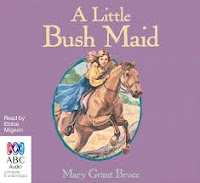
A Little Bush Maid by Mary Grant Bruce (1875-1958) - Classic Children's Literature Event 2016


A Little Bush Maid was published in 1910 and is the first book in the Billabong series by Mary Grant Bruce. There are fifteen books altogether and they follow Norah Linton from when she was a twelve year old growing up at Billabong, her father's property in rural Victoria, through to her adult years.

It's best to read the books in chronological order just to get the characters straight (although we didn't because it took us a decade to gather all the titles in the series) but the books do stand alone.
The author wrote the Billabong series over the years 1910 to 1942 and they reveal a very different Australia than that of today. They are historically interesting - three of them have World War I as a backdrop (From Billabong to London; Jim & Wally; Captain Jim) and are set in locations other than Australia.

A Little Bush Maid starts off slowly as Norah and the other characters are introduced. Norah's father was widowed when she was a baby, and he was left to bring up both her and her beloved older brother, Jim. Her upbringing so far has been unconventional. She has had no formal schooling and she spends her days in her father's company, helping out on the property and growing 'just as the bush wild flowers grow.' Jim is at boarding school in Melbourne and as the story opens, he comes home with two of his friends, Wally and Harry, for the school holidays.

A Little Bush Maid may not immediately entice a young reader as they may initially be put off by the lack of action, but it is worthwhile to keep going. There is still a good deal of lighthearted, humorous banter between the characters and when the action does begin, the story picks up quickly. Norah discovers the camp of a mysterious old hermit, the young people have encounters with venomous snakes, a disgruntled swaggie sets fire to the Linton property and a visit to the circus nearly ends in tragedy.
The title of the first book probably isn't appealing to boys, but although Norah is the main character, there are strong male characters in all the books.
Age-wise, a confident reader of nine would enjoy this book, but if they like the book as much as some of my children did, you will want to start looking for more books in the series. They are out of print but the first title can generally be found easily enough and a kindle version is available online at Gutenberg (see below).
The Mary Grant Bruce Official Website has a list of the books in chronological order.

As the book was written in 1910, the attitudes and views reflect that time period. Chinese workers, Aboriginals and servants have attributes ascribed to them that are not acceptable these days and in 1992 a revised edition produced by Angus & Robertson was published with some omissions to reflect this.

 1992 Version


We have an unabridged copy and a 1992 edition and I noted some of these changes:

Norah was driving a horse and carriage and referred to the two horses as 'Darkie' and N***er. In the revised edition the second horse's name was changed to 'Blackie.'

A remark made about black Billy, the Aboriginal station hand was omitted:

"Queer chap, that," said Dr Anderson, lighting a cigarette. "That's about the only remark he's made all day."

I'm surprised they didn't omit the reference to the cigarette...

This sentence referring to the Chinese gardener was omitted:

Wally's own idea was to tie him up by the pigtail, but this Jim was prudent enough to forbid.

In the afterward written by Barbara Ker Wilson in the 1992 revised edition she states:

With hindsight, we disclaim many of the ideas, opinions and attitudes of 1910, and a few paragraphs which might be thought of as racist today have been omitted from the text. But it would be profitless to criticise the author of a story written at that time for relaying the attitudes of her day through her characters.

Another revised edition (illustrated, same text as the book above & easy to find)


Interesting - we've been listening to an audio version of Tom Sawyer by Mark Twain and I was thinking how that book would be absolutely decimated if you took out the ideas, opinions and attitudes of the time in which it was written.
Literature is the product of a culture. Alexandr Solzhenitsyn said that 'literature is the living memory of a nation.' If we sanitise our past we are removing those memories and how do we learn and overcome our blind spots if we do not remember?

Gutenberg has four books in the series available in a kindle edition:

1) A Little Bush Maid
2) Mates at Billabong 
6) Captain Jim
7) Back to Billabong


This hardback version is unabridged and was published by John Ferguson Pty Limited in 1981. It also contains the next book in the series, Mates at Billabong:


An unabridged audio published by Bolinda Publishing is also available. I haven't listened to it but there's an excerpt here.


http://www.bookdepository.com/Little-Bush-Maid-Mary-Grant-Bruce/9781486288267?ref=grid-view


We used The Little Bush Maid as a substitute for American Tall Tails in AO Year 3. The Billabong books fit chronologically into Years 5 & 6 of Ambleside Online but we've mostly used them as free reads from the age of around 9 years.

Linking this to the 2016 Children's Classic Literature Event at Simpler Pastimes.


Wednesday, 25 November 2015

The Silver Brumby by Elyne Mitchell (1913-2002)


Once there was a dark, stormy night in spring, when, deep down in their holes, the wombats knew not to come out, when the possums stayed quiet in their hollow limbs, when the great black flying phalangers that live in the mountain forests never stirred. On this night, Bel Bel, the cream brumby mare, gave birth to a colt foal, pale like herself, or paler, in that wild, black storm.


The Silver Brumby was published in 1958 and is the first book in a series of thirteen novels written by Elyne Mitchell. It is the story of Thowra, a young colt born during that stormy night on the Australian Alps. The story follows Thowra through his early years as he learns from his mother the cunning and wisdom needed to survive in the wild. His lifelong battles with men who prized him for his silvery coat, the friction with other stallions as he comes to the peak of his strength, and later, the birth of his own daughter, Kunama, is told with vigour and close attention to detail.


http://www.absolutealpine.com.au/jindabyne/jind_summer/


 Spring comes to the Australian Alps like an invisible spirit. There is not the tremendous surge of upthrust life that there is in lowland valleys, and no wild flowers bloom in the snow mountains till the early summer, but there is an immense stirring of excitement. A bright red and blue lowrie flits through the trees; snow thaws, and the streams become full of foaming water; the grey, flattened grass grows upwards again and becomes greener; wild horses start to lose their winter coats and find new energy; wombats sit, round and fat, blinking in the evening sunshine; at night there is the cry of a dingo to its mate.


 Wildflowers on the Australian Alps in Summer


Elyne Mitchell grew up around horses and married a grazier. She had a close connection to the land, especially the Snowy Mountains area, and the places she describes in her books are those that were familiar to her.
I've visited the Snowy Mountains a few times and her writing evoked memories I have of the area. There is a ring of authenticity as well as a literary quality to her writing.


All the world was very quiet, high up there on the range. It was rarely that any other horses, except Storm and his herd, ever came as high, and most animals were already heading lower, anyway, before the snow came.
They saw dingoes, and occasionally a red fox, his pelt thick and good for winter, would show up against the grey-green grass. Thorwa noticed how busy the scurrying insects were, from the tiny ants to the great bright blue and red mountain grasshoppers - but he, too, knew that it was going to be a heavy winter.


 Summer on the Snowies


Some thoughts & comments

Brumbies are wild, undomesticated, feral horses that are not native to Australia but which have become closely identified with the Australian landscape. You only have to recall the popularity of the movie The Man From Snowy River and the opening ceremony of the Sydney 2000 Olympic Games to understand this affinity.

The Crackenback River referred to in the book is now known as the Thredbo River.

 Down by the Crackenback the wattles were in flower and the golden balls fell on to his back, stuck to his mane. Under foot were the little puce Black-eyed Susans. The Bitter Pea scrub was flowering, brown and gold, nearly shoulder high to a cream stallion. The mountain world was bursting into flower, everything filled with joy in living.


The book reminds me in some ways of the original story of Bambi, partly because of the style of the writing and partly the manner in which both authors depicted the animals they wrote about. The main difference between the two is that the animals in Bambi were helpless before the threat man posed, whereas the stallions in The Silver Brumby were wild, could often hold their own, and sometimes injured their pursuers. They were not hunted and killed for sport like the deer in Bambi, but admired for their strength and agility and prized for their potential if caught and trained.


Although the animals in The Silver Brumby talk to each other, it doesn't make the story less real. The animals are true to their natures; the narrative never feels false or unbelievable. The communication between the animals gives insight into how they respond in different situations and helps the reader to understand their actions and have some empathy for them.

When Elyne Mitchell published the first book in her Brumby series in 1958, there was very little Australian content to be found in children's literature. Already an established writer, she wrote this series for her daughter, Indi, to whom the book is dedicated. Below is a quote from an article written about the author:

Towong Hill was isolated and lacked access to libraries, and Elyne was not happy with the reading matter available for her daughter, especially books, with a lack of Australian content. So she wrote The Silver Brumby using the mountains and brumbies as her setting and characters and Indi at age ten was after all, ‘crazy about ponies.’ It started off as a short story but soon Indi was ‘waiting at the typewriter for the next instalment.’

Since then, these stories of the wild brumbies of the Australian High Country have been loved by readers of all ages and have been translated into eight languages.

The Silver Brumby would suit a confident reader around the age of about 10 years and would be a wonderful read aloud from around age 7. It has a good balance of descriptive writing wrapped up in an exciting adventure which keeps you wondering and hoping Thowra will come through all the danger and obstacles he encounters.
The edition below was published to celebrate the centenary of Elyne Mitchell's birth and contains the first four titles in the series - The Silver Brumby, Silver Brumby's Daughter, Silver Brumbies of the South, and Silver Brumby Kingdom. 


http://www.bookdepository.com/The-Silver-Brumby-Centenary-Edition-Elyne-Mitchell/9780732294335?ref=grid-view


Some information on the Australian brumby here


Linking up with Brona's Books and Book Lovers Books Aussie Reading Challenges

Tuesday, 20 October 2015

AusReading Month


Once a year, in November, Brona hosts an Australian book reading month.

Join us as we read, review and blog about all things Australian - classic books, contemporary stories, children's books, poetry, non-fiction, short stories, popular, literary, award-winning - whatever.

The only stipulation is that it has to be written by an Australian based author or predominantly set in Australia.


This year my choices are (subject to change):

Playing Beattie Bow by Ruth Park
My Brilliant Career by Miles Franklin

Updated to add:

The Silver Brumby by Elyne Mitchell

I'd like to add some children's picture books if I have time and a book by Nevil Shute (I've been slowly working my way through his wonderful novels).

If you'd like to join just head over to Brona's Books and sign up. You don't have to be an Aussie to enter!


Saturday, 10 October 2015

The Secret River by Kate Grenville (2005)


Kate Grenville's work of historical fiction, The Secret River, was inspired by her own family history. The main character in this story, William Thornhill, was born into an impoverished family living in the London of 1777. He roamed the streets of London with his brothers and a couple of friends, Dan and Collarbone, but his best friend was Sal Middleton. Sal's father was a waterman and he, his wife and Sal lived in relative comfort.

When William was thirteen years old his mother died and shortly afterwards his father also, and the responsibility for the family's welfare came to rest upon his shoulders. Between William's work at the shipyard and his older sister Lizzie bringing in a little income, they managed to scrape together a living. When William turned fourteen, Lizzie became ill and was unable to work. Around the same time the Thames froze over, resulting in no work for William. The family began to starve.
It was at this point that Sal's father stepped in. After the loss of yet another child, Mr. Middleton knew that no son would ever be born to him and his wife, so he decided to take William on as an apprentice and teach him the waterman's trade.
At the end of his seven year apprenticeship, William married Sal. He could hardly believe the turn his life had taken.
Eight years later, his life took another turn and he and Sal with their two young children, stepped off the convict ship, Alexander, and onto Sydney Cove.
The rest of the book recounts their lives in the new colony and the effects of William's decision to take up land belonging to the Darug people on the Hawkesbury River after he had earned his freedom.


Some thoughts:

Some important themes were portrayed in this book. The emancipated William Thornhill became an oppressor himself. This was evident in his behaviour to the convicts assigned to him when he was given his freedom, one of whom was his former childhood friend, Dan. His treatment of the Dharug people reflected the treatment he experienced from his 'betters,' the English upperclass. As far as they were concerned, he was subhuman. The strata mentality of London was transferred to this new land.
The author gave a tangible picture of life in early Sydney and her descriptions of the Hawkesbury River were well captured. I thought she was fairly even-handed in her portrayal of the interactions between the newly arrived settlers and the Aboriginal inhabitants. There were misunderstandings on both sides and the treatment of the Aboriginal people mirrored what was suffered by those English unfortunates who were considered little more than animals.

This is the first book I've read by Australian author Kate Grenville, and in fact, the first modern work of historical fiction I've read in a long time. I liked her style of writing, it was descriptive and engaging, but the book was spoilt for me by the inclusion of some obscene and profane language that I didn't think enhanced the narrative. If it had been otherwise I would have considered using the book as part of our Australian History studies.
I've read a number of books in the same genre (Australian Historical fiction) but written closer to the time period. For the Term of His Natural Life is one that immediately comes to mind. It's a harrowing tale that doesn't water down the cruelty and senselessness of Australia's convict days, but it does so without using the type of language so many modern authors seem to find necessary to include.


Linking this to the Aussie Author Challenge