Showing posts with label Aussie Author Challenge 2015. Show all posts

Monday, 28 December 2015

Living Books for the 20th Century: Geography - I Find Australia by William Hatfield (1892–1969)


William Hatfield was the non-de-plume of Englishman Ernest Chapman, who emigrated to Australia in 1912 by working as a ship's steward. Arriving in Port Adelaide in the middle of summer, he jumped ship and struck out on foot for 'the interior.' With just the clothes on his back, and a cloth cap on his head, he reached Glenelg at sundown after walking in temperatures of over 110 degrees Fahrenheit.
The next day he had his first job - painting the exterior of a hotel. This lasted three weeks, and not long afterwards he was on his way to the centre of the continent. His aim was to see the enough in his travels to enable him to write about it one day.


I Find Australia is an autobiographical account of Hatfield's adventures and observations of Australia as he worked and travelled in mostly remote areas over the course of about 20 years.
When he first arrived in Australia, the author had basically no practical skills, but in his years of outback travel he became a skilled bushman, worked as a kangaroo shooter, dingo trapper, on sheep stations and cattle drives, and later became a well known author.

Unless you happen to be an astronomer, professional or amateur, you can go through life without really seeing the stars if you never camp out. And unless you camp out in the dry air of the desert, you will never believe, even then, what makes the traveller put them so rapturously into his tales.
You have to lie down clear of any trees somewhere out in the plains, looking straight up without tilting your head, to get the real beauty of them, the magnificence if it all. Out there in that dry air the stars won't wink. I had heard that only atmospheric moisture  gave stars the appearance of twinkling in and out, and here was proof, at any rate, that the air we were in was dry.

Some thoughts:


* This book is similar to A Fortunate Life by A.B. Facey in that it depicts a very different Australia from that of today. Facey's book was mostly set in Western Australia and although Hatfield's travels took him all over the continent, his book concentrated on Central and Eastern Australia. The two books complemented each other very well in that regard, although they were very different from each other in other ways. Facey's book included some good basic outline maps; Hatfield's didn't, and I wish publishers would think to add them to these types of books.

* William Hatfield was sympathetic to the Aboriginal people, which surprised me in a book written in the early to mid 1900's. He includes some derogatory words, 'n----r' etc but I don't think they reflected his personal stance.
  
The first handling of Colts was carried out mostly by black boys, a thing that came as the biggest contradiction I had to swallow in all my Australian experience, these men of a race classed by ignorant observers in the first place as the lowest species of humanity on earth; lazy, useless, cowardly and incapable of organised effort.
Instead of which I found them doing most of the stock work on all the big unfenced runs, where their bushcraft is unmatchable, doing all the hardest riding on all the roughest horses...

They knew each individual horse's track in the mob once they had seen it, and could follow it wherever it went, no matter how many others crossed it. Our finger-print experts lay down the assertion that no two men's fingers leave the same print. The blackfellow lays down the same thing with regard to tracks. The difference in his case is that he doesn't need charts and a microscope, relying entirely on his eye and his memory.


Being unlettered, they could not count, but they could tell by sight that a few sheep were missing from a mob of two or three thousand. They saw individuality in sheep, where we just lump them as so many ewes, lambs, wethers, or whatnot.


 A personal tragedy drove Hatfield to search for the man who had been the cause of it. He was consumed with getting his revenge and at one stage in his quest ended up stranded in the desert. It was there in his search for water that he met an Aboriginal man whose tribe had been responsible for a white massacre. He, too, had his own personal vendetta and would have killed Hatfield if the white man's knowledge of tribal ways hadn't intervened and spared him. He spent some time wandering with the tribe, waiting for the rain, which eventually came in torrents, experiencing the hospitality due to a friendly visitor.  It was there in the desert that he came to realise that if he continued on his course, he was doomed to end his life as a wanderer. There would be no peaceful old age for him.

And I looked on that soft new green spreading over the desert under the rain's caress and knew that it was good to live and let live...

And I rode away from old Grungunja's camp wondering what that old wizard of a stone-age race knew of the things he had done to me.


The book is out of print but not too difficult to find secondhand; it is 348 pages in length and includes a few black & white photographs.


I Find Australia was included as a Geography selection for Grade 10 in the Charlotte Mason/Parents' National Education Union (PNEU) curriculum. I'll be adding it to our 20th Century plans which I'm adapting from Ambleside Online Year 11.

Some information on William Hatfield can be found here & here.


This book is one of my choices for the Aussie Author Challenge 2105


Sunday, 20 December 2015

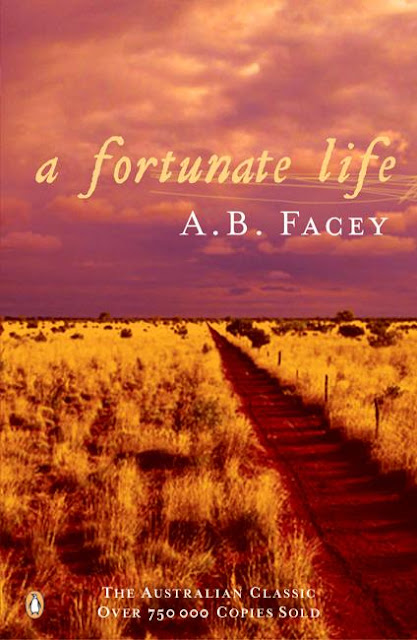
A Fortunate Life by A.B. Facey (1894-1982)


It's a tribute to Albert Facey that in his simply told, poignant autobiography, he was able to say that his had been a 'fortunate' life.
There were many episodes in his life which many would class as most unfortunate, but although he acknowledged his life had its share of hardship and difficulties, he was grateful for much.
Before he had turned two his father died, and not long afterwards his mother deserted him. His kind grandmother took on his care, but even so, circumstances forced him to start working when he was only eight years of age.
Denied a formal education, he grew up illiterate and because of this disadvantage he missed out on opportunities to learn a proper trade. As a young lad he was ill-treated and ill-used at times, doing work which was akin to slavery. He eventually taught himself to read and write, but it was a slow and difficult process.


http://www.bookdepository.com/Fortunate-Life-B-Facey/9780143003540?ref=grid-view


He survived Gallipoli, but two of his brothers were killed there, and Albert was to endure years of pain and disability from injuries he suffered in the trenches.
After four months on Gallipoli ('the worst four months of my whole life') a shell exploded in his trench, killing a mate and badly injuring himself. He was sent to Cairo for treatment and was repatriated back to Australia in 1915.

Albert said that he had two lives that were miles apart. Up until just after the war he had had a lonely and solitary existence but then he met Evelyn, the woman who was to become his wife:

After our marriage my life became something which was more than just me.

Albert and Evelyn raised a family through the depression years and Albert involved himself with the Trade Union movement and battled to improve the general conditions for workers.
When World War II broke out three of their sons enlisted. Only two of them returned home after the war. Their eldest son was killed in a bomb attack while defending Singapore.
Albert Facey was an ordinary man who overcame extraordinary circumstances. When he retired, Evelyn encouraged him to write down the story of his life. He crammed his stories into school exercise books, thinking that at some stage he would get copies printed for family members. The manuscript sat in a cupboard for years but in 1979, when he was eighty-five years of age, his autobiography came to the attention of the Fremantle Arts Centre Press and was accepted for publication.
A Fortunate Life was published in 1981, nine months before Albert died.

Some thoughts

A. B. Facey was a true historian, a story-teller. As I read the story of his life I could almost imagine he was sitting in the room speaking. It is simply written, understated, almost matter of fact, but totally real and engaging.

It's sobering to think that many people born in the late 19th or early 20th Century would have seen and endured similar circumstances - WWI, the Great Depression, WWII, industrial expansion. Death was a common visitor to many families and not just during the war years. We live in a very different world today.

Apart from Albert's time in Gallipoli, the book is mostly set in Western Australia and it is a fascinating account of frontier life in that state.

It was also interesting to read of the early days of the Trade Union Movement. Albert was a true Labor man and believed the Labor Party was on the side of the workers. I wonder what he would think about the Labor Party we have now?

Albert had a definite belief that Providence had brought his wife and him together, but towards the end of the book he said that the wars changed his outlook on things and that he found it difficult to believe in God.

I highly recommend this book for anyone - Aussie or otherwise. It is a valuable insight to the changes which swept through the 20th Century as seen by an ordinary person. It's also a beautiful love story and a lesson in perspective.


From the Afterword by Jan Carter:

What has Albert Facey left us? There is his description of childhood and adult-child relations at the beginning of this century which indicate how great the changes in childhood have been. There is his personal account of the dehumanising and brutal effects of war (the one defeat he felt morally unable to accept).
There is his documentation of the types and processes of work including some vanishing occupations. There are all these things and more, but in the end, Albert Facey's  autobiography must be classified as political history, for he contributes to the neglected history of this country...
From Facey, we know what it was like to be poor and young at the gold rushes...
We know what it was like to be an itinerant worker...
We understand the predicaments of a first-world-war private...
He describes being a husband and father with mouths to feed in the Depression...
Albert Facey is Australia's pilgrim.


Besides being a wonderful story for adults, this book is also suitable as a read aloud with some editing for younger listeners, or for readers around the age of 14 years and up. There is also an abridged version of the book for younger readers which is very well done.


A Forunate Life was one of my choices for the Aussie Author Challenge 2015.


Wednesday, 25 November 2015

The Silver Brumby by Elyne Mitchell (1913-2002)


Once there was a dark, stormy night in spring, when, deep down in their holes, the wombats knew not to come out, when the possums stayed quiet in their hollow limbs, when the great black flying phalangers that live in the mountain forests never stirred. On this night, Bel Bel, the cream brumby mare, gave birth to a colt foal, pale like herself, or paler, in that wild, black storm.


The Silver Brumby was published in 1958 and is the first book in a series of thirteen novels written by Elyne Mitchell. It is the story of Thowra, a young colt born during that stormy night on the Australian Alps. The story follows Thowra through his early years as he learns from his mother the cunning and wisdom needed to survive in the wild. His lifelong battles with men who prized him for his silvery coat, the friction with other stallions as he comes to the peak of his strength, and later, the birth of his own daughter, Kunama, is told with vigour and close attention to detail.


http://www.absolutealpine.com.au/jindabyne/jind_summer/


 Spring comes to the Australian Alps like an invisible spirit. There is not the tremendous surge of upthrust life that there is in lowland valleys, and no wild flowers bloom in the snow mountains till the early summer, but there is an immense stirring of excitement. A bright red and blue lowrie flits through the trees; snow thaws, and the streams become full of foaming water; the grey, flattened grass grows upwards again and becomes greener; wild horses start to lose their winter coats and find new energy; wombats sit, round and fat, blinking in the evening sunshine; at night there is the cry of a dingo to its mate.


 Wildflowers on the Australian Alps in Summer


Elyne Mitchell grew up around horses and married a grazier. She had a close connection to the land, especially the Snowy Mountains area, and the places she describes in her books are those that were familiar to her.
I've visited the Snowy Mountains a few times and her writing evoked memories I have of the area. There is a ring of authenticity as well as a literary quality to her writing.


All the world was very quiet, high up there on the range. It was rarely that any other horses, except Storm and his herd, ever came as high, and most animals were already heading lower, anyway, before the snow came.
They saw dingoes, and occasionally a red fox, his pelt thick and good for winter, would show up against the grey-green grass. Thorwa noticed how busy the scurrying insects were, from the tiny ants to the great bright blue and red mountain grasshoppers - but he, too, knew that it was going to be a heavy winter.


 Summer on the Snowies


Some thoughts & comments

Brumbies are wild, undomesticated, feral horses that are not native to Australia but which have become closely identified with the Australian landscape. You only have to recall the popularity of the movie The Man From Snowy River and the opening ceremony of the Sydney 2000 Olympic Games to understand this affinity.

The Crackenback River referred to in the book is now known as the Thredbo River.

 Down by the Crackenback the wattles were in flower and the golden balls fell on to his back, stuck to his mane. Under foot were the little puce Black-eyed Susans. The Bitter Pea scrub was flowering, brown and gold, nearly shoulder high to a cream stallion. The mountain world was bursting into flower, everything filled with joy in living.


The book reminds me in some ways of the original story of Bambi, partly because of the style of the writing and partly the manner in which both authors depicted the animals they wrote about. The main difference between the two is that the animals in Bambi were helpless before the threat man posed, whereas the stallions in The Silver Brumby were wild, could often hold their own, and sometimes injured their pursuers. They were not hunted and killed for sport like the deer in Bambi, but admired for their strength and agility and prized for their potential if caught and trained.


Although the animals in The Silver Brumby talk to each other, it doesn't make the story less real. The animals are true to their natures; the narrative never feels false or unbelievable. The communication between the animals gives insight into how they respond in different situations and helps the reader to understand their actions and have some empathy for them.

When Elyne Mitchell published the first book in her Brumby series in 1958, there was very little Australian content to be found in children's literature. Already an established writer, she wrote this series for her daughter, Indi, to whom the book is dedicated. Below is a quote from an article written about the author:

Towong Hill was isolated and lacked access to libraries, and Elyne was not happy with the reading matter available for her daughter, especially books, with a lack of Australian content. So she wrote The Silver Brumby using the mountains and brumbies as her setting and characters and Indi at age ten was after all, ‘crazy about ponies.’ It started off as a short story but soon Indi was ‘waiting at the typewriter for the next instalment.’

Since then, these stories of the wild brumbies of the Australian High Country have been loved by readers of all ages and have been translated into eight languages.

The Silver Brumby would suit a confident reader around the age of about 10 years and would be a wonderful read aloud from around age 7. It has a good balance of descriptive writing wrapped up in an exciting adventure which keeps you wondering and hoping Thowra will come through all the danger and obstacles he encounters.
The edition below was published to celebrate the centenary of Elyne Mitchell's birth and contains the first four titles in the series - The Silver Brumby, Silver Brumby's Daughter, Silver Brumbies of the South, and Silver Brumby Kingdom. 


http://www.bookdepository.com/The-Silver-Brumby-Centenary-Edition-Elyne-Mitchell/9780732294335?ref=grid-view


Some information on the Australian brumby here


Linking up with Brona's Books and Book Lovers Books Aussie Reading Challenges

Saturday, 10 October 2015

The Secret River by Kate Grenville (2005)


Kate Grenville's work of historical fiction, The Secret River, was inspired by her own family history. The main character in this story, William Thornhill, was born into an impoverished family living in the London of 1777. He roamed the streets of London with his brothers and a couple of friends, Dan and Collarbone, but his best friend was Sal Middleton. Sal's father was a waterman and he, his wife and Sal lived in relative comfort.

When William was thirteen years old his mother died and shortly afterwards his father also, and the responsibility for the family's welfare came to rest upon his shoulders. Between William's work at the shipyard and his older sister Lizzie bringing in a little income, they managed to scrape together a living. When William turned fourteen, Lizzie became ill and was unable to work. Around the same time the Thames froze over, resulting in no work for William. The family began to starve.
It was at this point that Sal's father stepped in. After the loss of yet another child, Mr. Middleton knew that no son would ever be born to him and his wife, so he decided to take William on as an apprentice and teach him the waterman's trade.
At the end of his seven year apprenticeship, William married Sal. He could hardly believe the turn his life had taken.
Eight years later, his life took another turn and he and Sal with their two young children, stepped off the convict ship, Alexander, and onto Sydney Cove.
The rest of the book recounts their lives in the new colony and the effects of William's decision to take up land belonging to the Darug people on the Hawkesbury River after he had earned his freedom.


Some thoughts:

Some important themes were portrayed in this book. The emancipated William Thornhill became an oppressor himself. This was evident in his behaviour to the convicts assigned to him when he was given his freedom, one of whom was his former childhood friend, Dan. His treatment of the Dharug people reflected the treatment he experienced from his 'betters,' the English upperclass. As far as they were concerned, he was subhuman. The strata mentality of London was transferred to this new land.
The author gave a tangible picture of life in early Sydney and her descriptions of the Hawkesbury River were well captured. I thought she was fairly even-handed in her portrayal of the interactions between the newly arrived settlers and the Aboriginal inhabitants. There were misunderstandings on both sides and the treatment of the Aboriginal people mirrored what was suffered by those English unfortunates who were considered little more than animals.

This is the first book I've read by Australian author Kate Grenville, and in fact, the first modern work of historical fiction I've read in a long time. I liked her style of writing, it was descriptive and engaging, but the book was spoilt for me by the inclusion of some obscene and profane language that I didn't think enhanced the narrative. If it had been otherwise I would have considered using the book as part of our Australian History studies.
I've read a number of books in the same genre (Australian Historical fiction) but written closer to the time period. For the Term of His Natural Life is one that immediately comes to mind. It's a harrowing tale that doesn't water down the cruelty and senselessness of Australia's convict days, but it does so without using the type of language so many modern authors seem to find necessary to include.


Linking this to the Aussie Author Challenge


Friday, 25 September 2015

Aussie Author Challenge 2015


Just making it in by the skin of my teeth...another 2015 Challenge, and this time it's all about Australian authors. This challenge is hosted by Book Lover Books and there are three different challenge levels to pick from. I've chosen the second level: 

WALLAROO

– Read and review 6 titles written by Australian authors, of which at least 2 of those authors are female, at least 2 of those authors are male, and at least 2 of those authors are new to you;
– Fiction or non-fiction, at least 2 genres.

I already had some books chosen to read this year so even though I'm coming in very late, I have at least one finished book plus a review and have started two others. All three below are by male authors, two of whom were new to me, and they are all basically autobiographies:

I Can Jump Puddles by Alan Marshall
A Fortunate Life by Albert Facey
I Find Australia by William Hatfield - the author was born in England and emigrated to Australia when he was about 20 years old. He served in the Australian Forces during WW2 so I think he would be classified as an Aussie. He wrote a few books about his experiences while travelling throughout Australia.


So I need to come up with two female Australian authors, and choose another genre and as I haven't read any modern books for quite some time, I'll possibly choose something more recent for at least one of those. 
I'd better get cracking.

Updated to add:

The Secret River by Kate Grenville (2005)
My Brilliant Career by Miles Franklin (female author; fiction)
The Silver Brumby by Elyne Mitchell (1958; female author; children's fiction)


Completed on the 28th December 2015