Tuesday, 13 September 2016

8 Favourite Fairy Tale Re-tellings for Teens


Regina Doman's first fairy tale novel was published in 1997 by Bethlehem Books under the title, Snow White and Red Rose. A few years later it was re-published with the title Shadow of the Bear, and there followed more books in the series. I found these novels when I was searching for suitable books for my daughter's birthday. I think she was about 14 years of age when I bought the first one and she loved it and requested more in the series.
Each book is a modern re-telling of a Grimm Brother's fairy tale and each chapter commences with a quote from the original story. These classic tales are put into a modern setting (e.g. New York City), and the characters face various cultural challenges and battles that young people may find themselves in today. A familiarity with the original fairy tale is helpful (I've linked to online versions of the original tales) and enhances the story, but it's not essential.
The books mature with the reader, with subsequent books tackling darker themes. The first three should be read in order as the main characters re-appear in the books.

The Shadow of the Bear


Originally published by Bethlehem Books under the title 'Snow White and Red Rose,' this is a modern day retelling of the fairy tale of the same name. The two sisters in the re-telling are Blanche and Rose, and Bear is a mysterious, street-wise young man.

'Once upon a time in New York City...
...there lived two sisters who loved books, poetry, music, and fairy tales.
They lived with their widowed mother in a brownstone with two rose bushes in front of it.
One winter night, a Bear came to their door and they let him in, even though he could not tell them his real name or his real mission.
He became their friend, protector, and constant companion.
They never dreamed that his friendship might cost them their lives.'


Picky parents guide to this book.


My book isn't a 1950's throwback—it's not a sweet book. I'm a child of the '70s, a teen of the '80s and, growing up in the teeth of the sexual revolution, I lost the innocence of the imagination early, as many kids today still do. I have no nostalgia for a safer and purer time—I never knew one.

My two heroines, Blanche and Rose, face the ugliness that is out there today, and they don't back down. They face the battle for the culture, and they fight it by how they live their lives. I think that's one reason why teens love them. And the "enchanted prince" of the story, Bear, is a great character—guys seem to identify with his sense of purpose and his convictions. He's on a lonely, dangerous mission for justice that few would understand or appreciate, and I think that resonates with teens.


Black as Night


http://www.bookdepository.com/Black-as-Night-Regin-Doman/9780981931821/?a_aid=journey56


This sequel to The Shadow of the Bear is based on Grimm's Snow White and the Seven Dwarves,
only in this case, the seven dwarfs are seven Franciscan friars. The story revolves mostly around Blanche, but it's a great book for boys, with its strong male characters. It moves more quickly than its predecessor and although there is some harsh realism, the author's writing isn't bleak, and the themes of faith, love and honour are embedded in the story. It's a step up, maturity level wise from the first book.


Waking Rose

http://www.bookdepository.com/Waking-Rose-Regin-Doman/9780981931845/?a_aid=journey56


Waking Rose is a re-telling of The Sleeping Beauty and centres around nineteen year old Rose and her relationship with Fish, Bear's brother. Fish is struggling with an abusive past and fears that Rose wouldn't understand his situation so he distances himself from her. When tragedy strikes, Fish is drawn into web of corruption and retaliation, and into a battle for Rose's life. This is quite a suspenseful book and has some mature themes. Recommended for readers 16 years of age and up.


The Midnight Dancers


A re-telling of The Twelve Dancing Princesses.
This book is quite different from the first three and can stand on its own (one of the characters, Paul Fester, makes an appearance in Waking Rose). Rachel is eighteen and tired of her restricted life with her father, stepmother and her eleven step-sisters. When the girls discover a secret passageway from their old historic home, they make night visits to a bay, meet some interesting characters, and Rachel begins to live a double life.

 But why live in the light, when the night seems so irresistibly intriguing? 

Regina Doman is a Catholic author and in this book, Rachel's parents are strict Fundamentalists. I think she does quite a good job of showing the effects of outer (legalistic) control and its inability to change the heart. Recommended for ages 16 years and older.


www.bookdepository.com/The-Midnight-Dancers-Regin-Doman/9780981931869/?a_aid=journey56


Alex O'Donnell and the 40 Cyber Thiefs


www.bookdepository.com/Alex-ODonnell-and-the-40-Cyberthieves-Regin-Doman/9780982767702/?a_aid=journey56


This is a  modern retelling of the classic Arabian Nights tale Ali Baba and the Forty Thieves and is less intense than the other books. Alex finds out that his dad, a computer hacker and software programmer has accidentally found a mysterious website that promises instant wealth. Alex and his very untechnological girlfriend, Kateri, end up taking on 40 cyber thiefs. A good bit of technological jargon is thrown about in the book, which is probably why I didn't enjoy it quite as much as the others, but it's still a worthwhile read.
The author recommends it for ages 14 years and over.

 
Rapunzel Let Down

This is the author's latest re-telling, published in 2013. I haven't read it yet but will be buying a copy for my 23 year old daughter and probably my daughter-in-law also, as they both love Doman's books. It is definitely a book for 18 year olds and over, according to the author.


www.bookdepository.com/Rapunzel-Let-Down-Regin-Doman/9780982767771/?a_aid=journey56


There are no magical or fantasy elements in these stories and the characters are very ordinary people living ordinary lives. This 'ordinariness' has allowed the author to create characters we can relate to and identify with. I read somewhere that she set out to take Chesterton's challenge and write a moden novel as if it were a fairy tale. As Chesterton observed in his book, Orthodoxy:

The old fairy tale makes the hero a normal human boy; it is his adventures that are startling; they startle him because he is normal. But in the modern psychological novel the hero is abnormal; the centre is not central. Hence the fiercest adventures fail to affect him adequately, and the book is monotonous. You can make a story out of a hero among dragons; but not out of a dragon among dragons. The fairy tale discusses what a sane man will do in a mad world. The sober realistic novel of to-day discusses what an essential lunatic will do in a dull world.  

G.K, Chesterton 


Beauty by Robin McKinley

I read this book many years ago and recently read it again. It's a re-telling of Beauty and the Beast and is suitable for around age 13 years and up. Beauty was the nickname for the youngest of three girls whose given name was Honour. She was the ugly duckling of the three girls, a tomboy but much loved by her family. To save her father's life (or so she thought) she was obliged to go to live with the Beast in his enchanted castle. It really is a lovely story with some important but not heavy handed themes. A younger child could read it but I was thinking that my 11 year old would turn up her nose at any sign of romance so I'll be leaving it for awhile.


www.bookdepository.com/Beauty-Robin-McKinley/9780552572323/?a_aid=journey56


I'm putting this here as an option for teens or adults who haven't read or may have had difficulty reading Spencer's Faerie Queen. We've used Fierce Wars and Faithful Loves, by Roy Maynard which is scheduled in Year 8 of Ambleside Online but the re-telling by Macleod is good for a range of ages.


Linking up at Top Ten Tuesday for 'Top Ten ALL TIME Favorite Books Of X Genre' - i.e. Fairy Tale Re-tellings for Teens - even though I only managed eight out of ten.

and here:


Monday, 29 August 2016

Nature Notes - wattle, black cockatoos and other encounters


We have three nature walks we do regularly. Two of them are just down the road, while the other is about a ten minute drive away. We save this one for when my daughter-in-law has a free space in her physio work schedule and sends us a message to say she's taking the dog for a walk and would we like to join her. We did that this afternoon and I was reminded of something that Tammy Glasser wrote on Why We walk the Same Trail Every Week. All three places are quite familiar to us and they give us the opportunity to observe the changing seasons and notice new things. I agree with Tammy, that walking the same trail regularly isn't boring. Last week we saw this beauty below, sitting quietly,  and what we thought might be a fairy-wren. I later found out it was a 'male eclipse of a Superb Fairy-wren, which I'd never heard of before. And in our garden last week we had a very short visit from an echidna - by the time I'd grabbed the camera, he was gone.


Crimson rosella Platycercus elegans - common to our area


One day, just after we'd moved into this area, we heard a 'thump, thump' on the skylight in our family room. It kept happening so I went out to see what was causing it and saw a couple of huge black parrots up in an overhanging banksia tree. The thumping was caused by the birds pecking at the 'banksia bombs' as my children called them, and dropping them onto our roof. They stayed for about ten minutes and then flew off, wailing with their mournful cries. The yellow-tailed black cockatoos (Calyptorhynchus funereus) have returned on a number of occasions and each time we've heard them in the distance before they arrive. And each time, they heralded rain. I was wondering about this as it happened again the other day, and so I was excited to find this poem!

 
Rain is Coming

High up, along the clear blue sky,
Black cockatoos come sweeping by,
Calling and crying as they go—
To tell us it will rain, you know.

There's not a wee cloud anywhere,
All bright and shining is the air;
The sky is iust one great blue plain —
But now I know there will be rain!

The paddocks all are brown as sand,
You see long cracks along the land;
We long for rain to make things
And it is coming now, I know.

The creek that danced among the
fern.
With racing ripples at each turn.
Has changed into a stony track;
I'm glad the rain is coming back.

The run is parched and bare and dry.
The hungry sheep move restlessly;
I wonder if they know the rain
Is coming to make grass again?

The thirsty cattle and the flowers
Will soon be all refreshed by showers,
Out from the bush sweet scents will
swing,
The creeks will rise, and dance and
sing.

Although it's hot and dried up yet,
The land will soon be green and wet,
For rain is coming fast, I know!
Black cockatoos have told me so!
 
Veronica Mason, ?1907


 We've never been able to take a decent photograph so here is one from wikipedia:


https://en.wikipedia.org/wiki/Yellow-tailed_black_cockatoo


The first of September is Wattle Day, at least it has been since 1992, but we usually find some wattle in flower throughout the year. We did a search of the local area to find out which varieties were in flower and then entered the findings in our nature notebooks. So - what do you know about wattles?


Sydney Golden Wattle, Acacia longifolia

 
The bush was grey
A week to-day
(Olive-green and brown and grey);
But now the spring has come this way,
With blossoms for the wattle.

It seems to be   
A fairy tree;
It dances to a melody,
And sings a little song to me
(The graceful, swaying wattle).

See how it weaves
Its feathery sheaves!
Before the wind a maze it weaves,
A misty whirl of powdery leaves—
(The dainty, curtseying wattle)!

Its boughs uplift
An elfin gift;
A spray of yellow, downy drift,
Through which the sunbeams shower and
sift
Their gold-dust o'er the wattle.

The bush was grey
A week to-day
(Olive-green and brown and grey);
But now its sunny all the way,
For, oh! the spring has come to stay,
With blossom for the wattle!


Sally Wattle, Acacia floribunda


Wattle & Weather


Sally Wattle


Sunset


Saturday, 27 August 2016

Weekly Review & Caffeine Withdrawals

This is my second week of no caffeine. I don't drink a great deal of coffee, although my consumption has increased in the past year or two, but my tea intake is embarrassing. My dentist asked me how much tea I drank per day and I couldn't tell him because one cup just flows into the next. I leave half drunk cups of tea all over the place. So just to say I could do it, I went cold turkey on caffeine, which I've done before but not for quite awhile.

Day 1 & 2 - not too bad. I didn't really have headaches, just a dopey feeling and I felt like going to bed earlier than I usually do.
Day 3 & 4 - as soon as I lay down to go to sleep I started getting pains in my lower back and all over my legs. Not cramps, flu-like aches but they were so bad I ended up having some Nurofen so I could get some sleep. I couldn't believe it!
Day 5 - still some leg aches but nothing like the previous couple of days.
Day 10 - my family thinks I should end my caffeine fast because I was easier to live with when I was on it. 

I've been drinking herbal tea - peppermint mostly, which I thought was wonderful for the first couple of days, but I'm really over it now and would love a real cup of tea...


 'On Tea'

 In vino Veritas. In Aqua satietas. In … What is the Latin for Tea? What! Is there no Latin word for Tea? Upon my soul, if I had known that I would have let the vulgar stuff alone.


We've just finished the fourth week of Ambleside Online Year 6. It's the second time for us to cover this particular year. Benj did a beefed up version a few years ago and it's a great year with wonderful books. Moozle is basically following the schedule as is, with a couple of Australian substitutions. This is what she did this week:


We're continuing with History of Australia by Clark, Hooper & Ferrier. We started this in Year 4 and have enjoyed it.

Grammar-Land by M.L. Nesbitt - this book has 17 chapters so we're using it for 17 weeks and then going back to Easy Grammar Plus. Between French & Latin, we've been covering quite a lot of grammar. Easy Grammar Plus is very good but it stays on a concept (eg prepositions) for ages and I wanted to give her a quick, broad overview, which this book does. I have a store of various grammar resources that I've gathered over time. Some of my children have done well with some of them and not others. I thought of using Winston Grammar for Moozle, mostly because I really only used it with one child and feel bad that I haven't made better use of it, but she seems to be doing fine with what she's been doing since we started formal grammar in Year 4. A homeschooler has provided free worksheets to use with the book, bless her.


We have some lovely ancient copies of William J. Long's books and all my children have loved them, as well as books by Ernest Thompson Seton. This one is a 1902 edition that I found for a couple of dollars and we're keeping this on the schedule even though the animals written about in the book are native to the Northern Hemisphere. A couple have been introduced to Australia so they are familiar and I'll be adding in some Australian Natural History titles later.


I've added in videos on the periodic table that Benj used. They fit in nicely with The Elements by Theodore Gray and The Mystery of the Periodic Table by Benjamin Wiker and Jeanne Bendick. The 'Gold' (Au) video below was very interesting:


A written narration on Never Give In: The Extraordinary Character of Winston Churchill by Stephen Mansfield:


We use Seterra for geography practice. There's a language option that Moozle found today so she did the map practice in French and said it was easier than doing it in English??
We downloaded the programme; it's very easy to use and fun to compete with each other to see who gets the highest score. 

Typing - I've just started Moozle with Rapid Typing, which we downloaded for free and have been using for ages. It uses extracts from decent books such as Pinocchio for practice. Some of the programmes we looked at were fluffy but this does the job and does it well.

Benj is busy with his Liberal Arts Certificate and fits in with us when time permits. (We do Plutarch & Shakespeare with him each week.) We've had some good discussions about what he's been reading and learning. One of our discussions related to the topic discussed on this Circe podcast which I recommend as it's not something I've heard addressed very often: On Being Discerning Cultural Consumers. (I wrote a little more about it in a previous post) 
He's reading and doing some performing of Romeo and Juliet as part of his course but he joins us for King Lear once a week. I found a version of this play on YouTube. I've previewed the first six videos and they've been fine so I plan to use at least some of it. It has a good cast: Lawrence Olivier as King Lear, John Hurt as the Fool, and Diana Rigg as Regan:


Hymn Study - we've been listening to this version of The King of Love my Shepherd Is.
Lovely:


Benj & I are reading The Root of the Righteous by A.W. Tozer

'One marked difference between the faith of our fathers as conceived by the fathers and the same faith as understood and lived by their children is that the fathers were concerned with the root of the matter, while their present-day descendants seem concerned only with the fruit.'

I finished a couple of books and added others to my reading pile:

The Road From Home - important if only for the fact that it is an event that has almost been forgotten. Used in the Sonlight Year 10 curriculum.

The Metamorphosis - I've seen this in a lot of highschool lists; also used in Sonlight.

Far From the Madding Crowd by Thomas Hardy - I'm only a few chapters in but I love it already.


 We had a kettle: we let it leak:
Our not repairing it made it worse.
We haven’t had any tea for a week. . . .
The bottom is out of the Universe! 

Rudyard Kipling


Linking up with Weekly Wrap-up


Friday, 19 August 2016

The Metamorphosis by Frank Kafka (1915)


As Gregor Samsa awoke from unsettling dreams one morning, he found himself transformed in his bed into a monstrous vermin.

With these words Frank Kafka begins his bizarre, dark fantasy.


www.bookdepository.com/The-Metamorphosis-and-Other-Stories-Franz-Kafk/9781593080297/?a_aid=journey56


Gregor is a hard-working travelling salesman, the sole provider in his family; his parents and sister dependent upon him. He loathes his work and admits that he is the 'boss's creature, mindless and spineless.'
On the morning of his transformation, his family are alarmed that he is still in his room at quarter to seven and knock on his door. He lies in bed, expecting the illusion he thinks he is under to gradually dissolve, and even as he makes a reply to his concerned family, he doesn't doubt that the change in his voice is due to a severe cold coming on.
Meanwhile, the head clerk arrives to find out why Gregor hasn't turned up for work, and is also waiting outside the bedroom door.
Gregor gets out of bed after a great exertion and manages to get to the door and eventually unlock it and so his metamorphosis is revealed to the horrified group standing there.
At first his family, especially his sister, cares for him and brings him food, but gradually he is neglected and expected to keep to his room. After a while they think of him no longer as a son or brother but as 'it.'
Gregor had decided he was going to send his sister to the Conservatory the next year, even though it involved considerable expense, and was planning to announce his intentions on Christmas Eve. A very poignant moment occurs when her parents ask her to play the violin for their three boarders. As she performs, Gregor advances into the room, mesmerised by her playing.

Her face was tilted to one side and she followed the notes with soulful and probing eyes. Gregor advanced a little, keeping his eye low so they might possibly meet hers. Was he a beast if music could move him so? He felt as though the path to his unknown hungers was being cleared.

This is definitely an unusual story, fascinating, but in the end not very satisfying. Even the author thought this and said it had an 'unreadable ending. Imperfect almost to its very marrow.'
Kafka was born in Prague and spoke both Czech and German, but he wrote in German. As with any translation, choices are made by the interpreter. The 'monstrous vermin' of the translation I read, has been rendered 'unclean animal not suited for sacrifice' and 'gigantic insect' in other translations.
Kafka was intentionally vague about the metamorphosed Gregor and when the book was going to press he told his publisher, "The insect itself cannot be depicted. It cannot even be shown from a distance." (Endnotes of the Barnes & Noble Classics edition above)
I spent the whole book wondering how large Gregor the 'insect' was. He managed to reach the lock on the door but he could hide under a sofa. He could also be pushed around the floor with a broom. If he had been the size of a regular insect, even an very large one, he wouldn't have been so obvious to everyone and no one would have equated him with once having been a man. It sounds rather illogical - but Kafka doesn't make sense! This comment from the introduction to the book above partly explains why:

Kafka's fiction examines a universe largely unexplored in the literature preceding him, one full of implications that venture into the remote regions of human psychology. It's a universe with different rules than those governing our reality. And there's no map. 
 

According to the writers of Invitation to the Classics, Kafka's worldview is Nihilism, that is, he rejects all meaning, so he is left with a great nothingness:

Human beings, once seen as a link in the Great Chain of Being connected both upward to God and downward to animals, are now connected only downward. Without the image of God, humans beings are dehumanised. With the death of God has come the death of humanity. This is Kafka's central lesson.

Frank Kafka (1883-1924) was only forty-one years of age when he died of tuberculosis. His family was Jewish and although at first he was indifferent to  his religious heritage, he later became fascinated by it.
In 1933 the Nazi's banned and publicly burned Kafka's work. In 1942 they put two of his sisters into a Polish ghetto where they died. His youngest and closest sister was married to an 'Aryan' and was not deported, but in an act of defiance, she divorced her husband and was sent to Auschwitz and died there.

Further reading:


Invitation to the Classics: A Guide to Books You've Always Wanted to Read - edited by Louise Cowan and Os Guiness. There's a chapter devoted to Kafka, mostly relted to another of his books, The Trial, but it offers some insights into his life.

How Should We Then Live: The Rise & Decline of Western Thought & Culture by Francis A. Schaeffer. I love this book and how the author weaves in history, music, art, and literature. Although first published in 1976, this book is just as pertinent for our times.

The Barnes & Noble edition I read had a short bio and some notes which enhanced my understanding of Kafka.


This book is my entry in the Back to the Classics Challenge 2106 for a Classic which has been banned or censored.


Monday, 15 August 2016

Reading Europe: Turkey - The Road From Home by David Kherdian


www.bookdepository.com/The-Road-from-Home-David-Kherdian/9780688144258/?a_aid=journey56


David Kheridian prefaces the story of his mother, Veron Dumehjian, with the statement by Adolf Hitler below. Hitler was referring to the Turkish Government's decision twenty-three years previously that all Armenians living in Turkey were to be destroyed.

 I have given orders to my Death Units to exterminate without mercy or pity men, women, and children belonging to the Polish-speaking race. 
It is only in this manner that we can acquire the vital territory which we need. After all, who remembers today the extermination of the Armenians?
Adolf Hitler (August 22, 1939)


The author uses his mother's voice to tell her own story, from her childhood growing up in a prosperous, loving home with her extended family in the Armenian quarter of Azizya in Turkey, up until her mid-teens.
The Armenian population made up about ten percent of the population of Turkey prior to World War I but with the rise of nationalism, the Ottoman Army used the cover of war to settle the 'Armenian Question' and to bring about the 'Turkification' of the country. Talaat Pasha, as the Minister of the Interior, was the chief architect of this process.


Throughout the country tens of thousands of Armenians, which included Vernon and her family, were forcibly deported to the Syrian Desert.
By about 1920, one and a half million out of the two million Armenians living in Turkey at the start of the war had been killed. Today, it is estimated that there are only about 50 to 70 thousand Armenians in Turkey but for years the Turkish government has refused to acknowledge this massacre of its Armenian citizens.

The Road From Home is a 1980 Newbery Honor Book and is a simply told story about a young girl's journey of faith, courage and hope in the midst of this little known period of history.
The book goes into some of the details of how the Armenian deportees were treated: the youngest boys were circumcised and converted to Islam, the oldest sold into slavery; the women who were willing to convert were attached to harems; those who didn't convert were raped and then either murdered or sold to the Arabs.
I was shocked to read about what happened to some of the refugees who managed to reach Smyrna on the western coast of Turkey. After three years of Greek administration, their rule ended in that city and the Turks took over and began to march through the streets. Veron escaped and crowded onto the quay with other refugees when the Turks set fire to the Armenian quarter. French, American and British ships were in the harbour ready to take their own citizens but they made no move to help the refugees. However the Italians were shouting to the people nearest to them to jump and swim to their small boats so they could be saved. The Turkish soldiers blocked off any escape from the fires and people either died or threw themselves into the sea. A raft load of refugees was attempting to leave the shore when two Turkish soldiers flung kerosene over them and set them alight.
When people tried to swim out to the large ships only the Italians would take them aboard. The English poured boiling water down upon them and the Americans were lined up on their decks with their movie cameras going!

Veron lost most of her family during this period but nonetheless the story is full of hope and has a lyrical quality. Yeah! The author includes a map showing the places mentioned - I don't know why all authors who write books relating to history don't do this. It annoys me no end when they don't because it is so helpful and helps me to connect with the story. Age appropriateness -  high school age (around 14 yrs and up or a read aloud with younger students; there's no offensive or inappropriate language). Adults would also appreciate it, especially as there probably isn't a great deal written on this subject.

All the love that was given me since we left home I had simply taken for granted, but I was no longer the child that I had been when we started on our
journey. Something deep inside me, which I knew was love, was going out to all the people who were with us on our march. Everything was being shared; no one thought only of himself, but rather, it seemed as if each of us put the other person first. We all were trying to make the other person's load lighter, and for some reason this, more than anything we might have done for ourselves, made our own load lighter as well. I realised that without the children to be saved, the elders might not have found the reason to go on, and without the elders to guide us, we, of course, would have been helpless victims.

Sonlight Curriculum schedules this book in Grade 10, World History.


http://educationpossible.com/finishing-strong-2/


Tuesday, 9 August 2016

Top Ten Tuesday - my top ten uncomfortable reads


http://www.brokeandbookish.com/2016/08/top-ten-tuesday-rewind.html

Top Ten Uncomfortable Reads


Crime & Punishment by Fyodor Dostoevsky - to be shown inside the mind of an emotionally detached, psychopathic, cruel character was unpleasant, especially as he remained in that state for about the first 400 pages. The  Russian names of the characters were difficult to keep in context, especially as many of them had the same initials: Rodion Romanovich Raskolnikov, Avdotya Romanovna Raskolnikov, Razumikhin, Zossimov, Zamyotov...

Killing Fields, Living Fields by Don Cormack - an exquisitely crafted true story that tears your heart apart. I put off reading this book as I didn't think I could handle it emotionally, but it was so beautifully written and compelling that I didn't regret it. Uncomfortable, yes, but although it describes a nation traumatised beyond belief, it is also an incredibly hope-filled account of the Cambodian Church, 'the church that would not die.'

...Cambodia has achieved a distinction which has so far eluded even those countries unfortunate enough to experience the full weight if terror brought to bear by even the most monstrous tyrants of our time; it is the first country to be transformed into a concentration camp in its entirety...
Quoted by the author from The Times, April 22, 1976


http://www.bookdepository.com/Killing-Fields-Living-Fields-Don-Cormack-Peter-Lewis/9780825460029/?a_aid=journey56


1984 by George Orwell - ugly and chilling is how I'd describe this book. It was quite prophetic considering that Orwell wrote it in 1949 and I think it's one of those 'must reads.' The terms Big Brother, Newspeak, Doublethink...all came from this book. An eye opening, awful, but important novel about the evils of totalitarianism that has as much to say now as it did when it was first published. It's available free online.

For the Term of His Natural Life by Marcus Clarke - a classic on convict life in Australia based on real events. Brutal.

Innocent Blood by P.D. James - I read somewhere that this was the novel that launched the author's career but I don't think it is as well written as some of her earlier books. I was intrigued by the idea of the exploration of identity - the main character, Philippa Palfrey, is adopted and she has built up a fantasy surrounding her biological family. What she discovers is nothing like what she imagined. I thought James lost the plot and went too far, especially regarding Philippa's relationship with her adoptive father. This was a shame, as it had all the ingredients for an interesting storyline without the shabby embellishments.

The Good Earth by Pearl Buck - a beautifully written story but emotionally raw. The fate of one the characters was so undeserved and too painful for me. It haunted me for weeks after I read it.


http://www.bookdepository.com/The-Good-Earth-Pearl-S-Buck/9780743272933?a_aid=journey56


Madame Bovary by Gustave Flaubert - Madame was too stupid for words. I felt embarrassed by her selfish and indulgent behaviour but Flaubert was a poetic writer.

A Good Man is Hard to Find by Flannery O'Connor - uncomfortable, yes, but with a purpose (which I didn't always understand!)

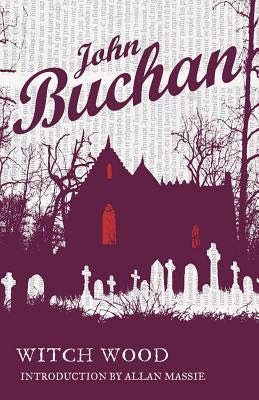
Witch Wood by John Buchan - an unusual story about a young idealistic minister working amongst religious extremists in a narrow minded community in Scotland in the mid 1600's. The story raises disturbing questions about human nature and our capacity for self-deception. It's a book that draws you back because you don't feel you quite got it the first time.


www.bookdepository.com/Witch-Wood-John-Buchan/9781846970719/?a_aid=journey56


Lord of the Flies by William Golding - when a plane carrying a group of schoolboys crashes into the lagoon of a remote island, the boys have to survive on their own with no adult supervision. At first they are exhilarated by the sense of freedom, but before long their behaviour degenerates as all order collapses. It's a disturbing exploration of human behaviour when external controls are removed, made all the more uncomfortable because you could imagine a bunch of schoolboys behaving like that if left to their own devices.


www.bookdepository.com/Lord-of-the-Flies-William-Golding/9780399501487/?a_aid=journey56


Sunday, 7 August 2016

The Good, the Bad and the Ugly: Moozle's review of Ambleside Online Year 5


As I mentioned in a previous post, here is 11 year old Moozle's opinion of her Year 5 books. The original schedule is here. As this year required some Australian substitutions, mostly for history, I posted about the books we used here.
A couple of things to bear in mind:

•    Some of the books were read a while back and I've noticed that once a book is off her radar she tends to have a lower opinion of it than she may have done at the time she read it.

•    These are her lesson books and generally not the type of books she'd be likely to take down off the shelf and curl up in a comfy chair and read.

•    I don't take her negative or low ratings as an indication that I need to change to another curriculum. She doesn't like eating certain foods but I don't change our diet because I know it's healthy and good for her. If I left it to her to choose she'd end up vitamin deficient and probably anaemic.

•    When I went through the books we'd used for Year 5 and asked her opinion of them for this post, she said to me that the AO books are not 'her type of books.' Her books of choice at present would be Biggles, the Jungle Doctor books, Biggles, anything by G.A. Henty, and more Biggles. I know the AO books challenge her to think and to dig out knowledge for herself. There isn't any lack of understanding on her part and her narrations are given freely and without complaint (mostly) plus she shows an interest in the content of the books at the time she is reading them.

•    Anything she considered too sad got a very low rating - I omitted Trial & Triumph in previous years because of this. We used it for about a year with no complaints, but after her uncle died suddenly two years ago, she started commenting about how horrible it was that people were killed all the time. I dropped it after that and decided she could do Saint & Heroes by George Hodges in Year 7 instead.

I asked her to give the books a rating out of 10 so here we go:

Australian History & Biographies

History of Australia - 7 (I read this aloud)
Dr. Hunger and Captain Thirst - 2 ('stupidly sad') Well, the early explorers had an awful time of it, dying of thirst in deserts, getting hopelessly lost and disappearing without a trace. It is rather depressing at times but that's what happened. I read the first half aloud and then Moozle finished it herself.

Margaret Catchpole - 7 (interesting)
River Rivals - 7 (quite good)
The Singing Wire - 10 (the best of the three)
She read the three books herself.

Other History

Abraham Lincoln's World - 7 (read herself)
Story of the World - 10 (read herself)
Passion for the Impossible - 7 (I read this aloud for 3/4 of the book and then she read the remainder herself. I'm surprised that she really engaged with book. It is stiff going)

Science/Natural History

The books below were read on her own:
Robert Boyle - 7 (in place of Isaac Newton, which I'd previously read as a family read aloud)
The Story of Madame Curie - 5 (in place of George Washingon Carver)
Wild Animals I Have Known - 4 (too sad)
Christian Liberty Nature Reader - 2 (boring)
Story of Inventions - 3 (didn't like it; old fashioned & boring)
 Always Inventing:Alexander Grahame Bell - 9

Madame How & Lady Why - 8 (I read this aloud)

Literature - read on her own

Age of Fable - 7
The Story of King Arthur - 10 (Roger Lancelyn Green)
Oliver - 5 (too sad - although she was interested enough in the story to keep  wanting to read ahead)
Kim - 8 (good!)

Favourite free reads:

Lad: A Dog - 10
The Adventures of Tom Sawyer - 8

Other ratings:

Murderous Maths - 10 (great!)
Hamlet - 4 (way too sad)
Book of Marvels - 6

If you asked your student to give ratings on their books would it look anything like this?? Rather brutal, don't you think?
I think I'll go and curl up in a corner.

Friday, 5 August 2016

Weekly Review - the start of a new year


This was Moozle's first week of Ambleside Online Year 6 and a good week it was. A highlight for her, especially after visiting Hobbiton in New Zealand earlier this year, was the first chapter of The Hobbit, which I'm reading aloud to her. This is the first time I've actually read the book - I know, one of the few persons on the planet - everyone else in the family has read the book and seen the movie. I decided to wait and enjoy it this year with my daughter knowing it was coming up in Year 6 Literature.

Benj is halfway through his Liberal Arts Certificate (two days per week) and continues to fit in some of the Ambleside Online Year 11 & 12 selections along with piano practice, work one afternoon a week and a piano student once a week.

We've started a new composer, Gabriel Faure and a new artist, James Abbott McNeill Whistler.
I've made a YouTube playlist for Faure with the selections we'll be listening to this term. Lovely music!

Shakespeare


King Lear is our play this term, using the Naxos version below, that so far sounds very good. We've used a few Naxos Shakespeare productions and have been very pleased with them.


http://www.bookdepository.com/King-Lear-William-Shakespeare-Paul-Scofield-Alec-McCowen-Kenneth-Branagh-David-Burke-Harriet-Walter-Emili-Fox-Sarah-Kestelman-Richard--McCabe-Toby-Stephens/9789626342442/?a_aid=journey56

Plutarch


Marcus Porcius Cato (234 BC-149 BC) - Marcus Cato the Censor, also known by a few other names,
using Anne White's Guide. We've done two lives without the complete guides (Demetrius & Themistocles) as I started them and didn't realise until we were halfway through that they were still unfinished. I made sure to check this time!

Poetry

This term Moozle is savouring the poetry of A.B. (Banjo) Paterson, who penned Waltzing Matilda and is one of Australia's best known & most loved poets. Benj's is doing poetry as part of his course.

Hymn Study


I'll be adding to this later but here is what we have so far.

Folksongs

This is a playlist of Australian folksongs I'm considering. I haven't listened to them all yet so not sure how suitable they will be for an 11 year old. Here are some of the Scottish folksongs we listen to - part of my passing on a cultural inheritance to my offspring.

Reading 


Benj - finished Uncle Tungsten and The God Who is There by Francis Schaeffer. He's started reading Don Quixote. I bought the cheapest version I could find as it's not high on the list of my 'most wanted.'  (Apologies to my friend, Silvia!) I asked Benj what he thought of it and he said, "It's pretty stupid, but it's meant to be. It's a satire..." Anyhow, he's studying it this semester so it will be interesting to see what he has to say later on.


www.bookdepository.com/Don-Quixote-Miguel-de-Cervantes-P--Motteaux-Stephen-Boyd-Dr-Keith-Carabine/9781853260360/?a_aid=journey56


Moozle - the book devourer extraordinaire, has been on a G.A. Henty splurge, yet again. She read a couple of the books he wrote about Afghanistan while she was reading Kim for Year 5. They help in understanding some of the circumstances of The Great Game: 

Herat and Cabul, A Story of the First Afghan War and  
For Name and Fame: To Cabul with Roberts (Through Afghan Passes) 
We've managed to find them via Amazon, free for Kindle, so I've linked to what was there at the time I looked, but check first as I've noticed that the availability of free titles changes from time to time.
She also read A Final Reckoning: A Tale of Bush Life in Australia.

My reading - Finished recently: The Painted Veil (loved the writing); A Good Man is Hard to Find (not your average cup of tea, and definitely not for everyone); The Five Red Herrings - a Dorothy Sayers' mystery - say no more. She is more than your average mystery writer.

Started recently: The Double Helix by James Watson. This was one of my opshop finds. I've wanted to read it for awhile so I was so pleased to pick it up for $3.


The Road from Home by David Kherdian - I read this years ago but wanted to re-read it as it's a Newbery Honor Book and covers a portion of history we don't hear much about. It's based on the true story of an Armenian girl whose family were caught up in the Turkish governments systematic destruction of its Armenian population in the early days of WWI. From memory, I think it was written for a young adult audience.


Thursday, 4 August 2016

Mercy & the Hard Heart: A Good Man is Hard to Find by Flannery O'Connor (1925-1964)


www.bookdepository.com/Good-Man-is-Hard-Find-and-Other-Stories-Flannery-OConnor/9780156364652/?a_aid=journey56


Bizarre, disturbing, violent and peopled with freaks and unpleasant characters - this seems to be a common consensus about the content of Flannery O'Connor's writing. I've just finished reading ten of her short stories contained in the selection above. If I'd stopped after only reading the first few I  might have described them in that way also. Some of her stories left me wondering what it was she was getting at, and her characters certainly weren't appealing. At the same time, though, I sensed there were significant themes tucked below the surface that needed some stretching of my moral imagination before I could interpret their meanings.
The first story in this collection was 'A Good Man is Hard to Find.' I knew what to expect, having heard about it beforehand, so it didn't have the shock value it might have had if I hadn't been prepared. Still, my reaction to the story was "What ?? Is that the end of it??"
I went on to the next story, and then the next.
Emm...??
Then I came to story number six, the one with the unfortunate title of The Artificial N***er, and all of a sudden, O'Connor's theme of violent mercy, grace and redemption is so clear.
Mr Head takes his belligerent grandson, Nelson, to the city, intending for him to see everything there is in a city so that he would be content to stay at home for the rest of his life. An incident occurs in which Mr Head, in the grip of fear, denies that Nelson is related to him.

Mr. Head began to feel the depth of his denial...He knew that if dark overtook them in the city, they would be beaten and robbed. The speed of God's justice was only what he expected for himself, but he could not stand to think that his sins would be visited upon Nelson and that even now, he was leading the boy to his doom.

Mr Head had never disgraced himself before and he hadn't known what mercy felt like because he had always been too good to deserve any!

Mr. Head stood very still and felt the action of mercy touch him again but this time he knew that there were no words in the world that could name it...
He understood it was all a man could carry into death to give his Maker and he suddenly burned with shame that he had so little of it to take with him. He stood appalled, judging himself with the thoroughness of God, while the action of mercy covered his pride like a flame and consumed it. He had never thought himself a great sinner before but he saw now that his true depravity had been hidden from him lest it cause him despair...
He saw that no sin was too monstrous for him to claim as his own, and since God loved him in proportion as He forgave, he felt ready at that moment to enter paradise.

Mercy...

'He had so little of it to take with him.' 

It is of the Lord's mercies that we are not consumed, because his compassions fail not.
 They are new every morning...
Lamentations 3


Out of all the stories in this collection, this one was my favourite and I think it would be a good first introduction to Flannery O'Connor.
'The Displaced Person' would be my next pick - a haunting sort of piece about a Polish refugee:

...she felt she had been tricked by the old priest. He had said there was no legal obligation for her to keep the Displaced Person if he was not satisfactory, but then he had brought up the moral one.

The old priest...sat on her porch, taking no notice of her partly mocking, partly outraged expression as she sat shaking her foot, waiting for an opportunity to drive a wedge into his talk. "For," he was saying, as if he spoke of something that had happened yesterday n town, "when God sent his Only Begotten Son, Jesus Christ Our Lord" - he slightly bowed his head - "as a Redeemer to mankind, H..."
"Father Fynn!" she said in a voice that made him jump. "I want to talk to you about something serious!"
The skin under the old man's right eye flinched.
"As far as I'm concerned," she said and guard at him fiercely, "Christ was just another D. P."

I enjoyed O'Connor's ironic sense of humour and the names she gave to some of her characters:

Mrs Hopewell who 'had no bad qualities of her own but she was able to use other people's in such a constructive way that she never felt the lack.'

Mrs Freeman: 'Besides the neutral expression that she wore when she was alone, Mrs Freeman had two others, forward and reverse, that she used for all her human dealings.'

Mrs Shortley: 'Her arms were folded and as she mounted the prominence, she might have been the giant wife of the countryside, come out at some sign of danger to see what the trouble was. She stood on two tremendous legs, with the grand self-confidence of a mountain, and rose, up narrowing bulges of granite, to two icy blue points of light that pierced forward, surveying everything.'

Not to mention Mr. Shiftlet and Mr. Paradise and a host of other unlikable and offensive individuals.

Flannery O'Connor was a devout Roman Catholic from the Bible Belt of the South, and is considered to be one of the most important short story writers in American literature. He first story was published when she was twenty-one and she died eighteen years later of an auto-immune disease at the age of thirty-nine. She said of her own work:

Many of my ardent admirers would be roundly shocked and disturbed if they realized that everything I believe is thoroughly moral, thoroughly Catholic, and that it is these beliefs that give my work its chief characteristics.


Heidi @  Mt Hope Chronicles has a comprehensive post about the author with many and varied links. I listened to the Circe Podcast she linked to earlier this year and it gave a good introduction and overview of the author.

Invitation to the Classics edited by Louise Cowan and Os Guinness contains a short chapter on her life and work.

I have found that violence is strangely capable of returning my characters to reality and preparing them to accept their moment of grace. 
Their hearts are so hard that almost nothing else will do the work.

Invitation to the Classics


This is my Classic Short Stories entry for the Back to the Classics Challenge 2106


Thursday, 28 July 2016

Winter, Wonder, Walk & Wild


It's winter in our part of the world. We hadn't walked our favourite trail for a few months and I was interested to see what wildflowers were out compared to the last walk we took that way. Well, there weren't that many in flower but it was a lovely walk regardless.


A piece of termite's nest that had fallen from one of the eucalypts


This book has proven to be very useful...


www.bookdepository.com/Field-Guide-Australian-Flowers-Denise-Greig/9781864363340/?a_aid=journey56


I was able to identify a couple of wildflowers I found - the Woollsia pungens, which was flowering, and the spiny-head mat-rush which wasn't...


 The Charm of Nature Study

Nature study as a subject is one which should be approached with great reverence, for in dealing with birds, animals, flower and all other forms of natural life, we are perhaps, nearer to the Creator than in any other branch of science; for the natural world is the expression of God's personality in a form that is within the reach of all of us to comprehend in some measure. And is not the natural world one of the greatest proofs that there is a God?

Years hence when children are old enough to understand that science itself is in a sense sacred, and demands some sacrifice, all the common information they have been gathering until then, and the habits of observation they have acquired, will form an excellent ground work for a scientific education. In the meantime let them consider the lilies of the field and fowls of the air.


 Wonder - Benj when he was 3 years of age delighting in the rainbow lorikeets


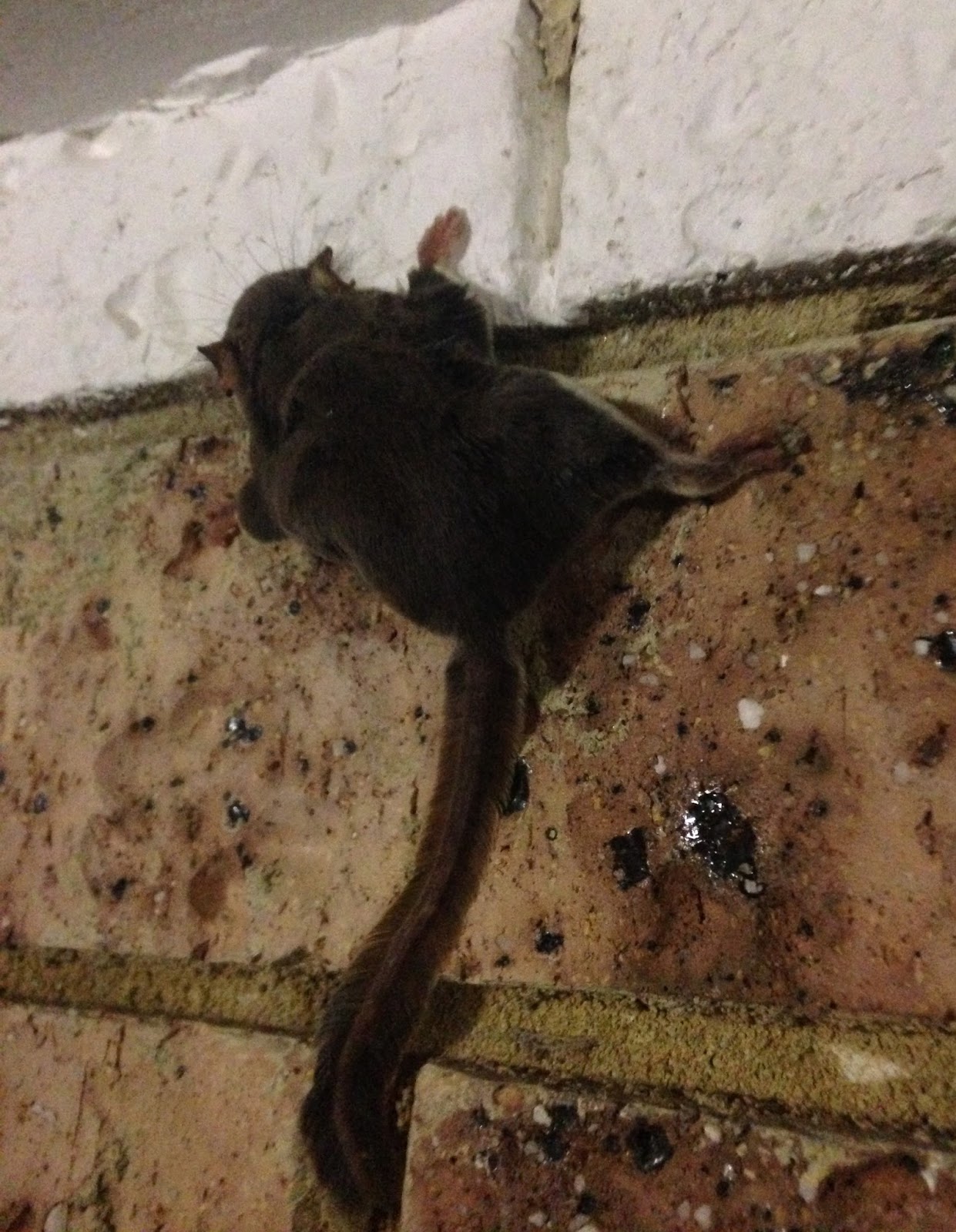
Wonder 13 years later - Benj came home late one night with his brother and they both called out to me to come downstairs. When I got there they took me outside to see this creature climbing along the wall of the carport.


It was bitterly cold outside and we stood shivering while Benj climbed on the back of his brother's ute to get some closer photos...it kept moving so the photo is a bit blurred, unfortunately. Then we all argued about what we thought it was - a baby brush-tailed possum or sugar glider?? Whatever it was, everyone thought it was really cute.

Update: it looks like this litte creature is a Feather Tail Glider  Acrobates aculeatus. They are related to the Pygmy Possum and I think this one would have been an adult.


To see the World in a Grain of Sand
And Heaven in a Wildflower
Hold Infinity in the palm of your hand
And Eternity in an hour

William Blake
Moozle's nature notebook


Another great find. It's out of print but I've seen it on ebay for under $10...


Linking up with Celeste at Keeping Company


Wednesday, 27 July 2016

Back to the Classics - The Five Red Herrings by Dorothy L. Sayers (1931)


 www.bookdepository.com/Five-Red-Herrings-Dorothy-L-Sayers/9780450012488/?a_aid=journey56


Lord Peter Wimsey, although an Englishman, was well-received in the close-knit fishing and artistic community of Galloway and had passed many a season in the area. One night when he was having a drink at the local pub, a dispute broke out between Campbell and Waters, two of the resident artists, and they came to blows.
Campbell was universally disliked, 'a devil when he's drunk and a lout when he's sober,' and since his arrival in the community there had been nothing but rows and bickering. After the men were forcibly separated, Campbell stormed off in high dudgeon into the night.
The next day he was found dead at the bottom of an outcrop of granite; his body lying face down in the burn and an unfinished painting on a sketching easel on the rock ledge above. There seemed little doubt that Campbell had accidentally fallen as he stepped back to observe his painting. But then Wimsey noticed something everyone else had missed. He declared that it was a case of murder and that it had been committed by an artist.

'...I don't mind betting this is the most popular thing Campbell ever did. Nothing in life became him like the leaving it, eh, what?'

There were six suspects, all of whom detested Campbell and had grievances against him. Five of the suspects were red herrings; one was the killer, and it took all the ingenuity of Wimsey and the local 'pollis' to piece events together and decide who was responsible.

It was a marvellous day in late August, and Wimsey's soul purred within him as he pushed the car along. The road from Kirkcudbright to Newton Stewart is of a varied loveliness hard to surpass, and with a sky full of bright sun and rolling cloud-banks, hedges filled with flowers, a well-made road, a lively engine and the prospect of a good corpse at the end of it, Lord Peter's cup of happiness was full. He was a man who loved simple pleasures.

I relished the setting of The Five Red Herrings - a part of Scotland about 180 km south of my birthplace, and there is quite a bit of Scottish brogue in the dialogue, which I know sometimes causes problems if you're not familiar with the tongue. The BBC audio version is good and is narrated by Patrick Malahide who does a pretty decent Scottish accent, for a sassenach, although two of the police detectives sound almost identical.

Elizabeth George, a mystery writer herself, had this to say about Sayers:

While many detective novelists from the Golden Age of mystery kept their plots pared down to the requisite crime, suspects, clues, and red herrings, Sayers did not limit herself to so limited a canvas in her work. She saw the crime and its ensuing investigation as merely the framework for a much larger story, the skeleton - if you will - upon which she could hang the muscles, organs, blood vessels and physical features of a much larger tale.

George said that Sayer's writing was like a tapestry and this is so true. I've read a number of the Lord Peter Wimsey novels and there is a  richness and attention to detail that you don't usually find in detective fiction. I enjoy her literary allusions, Latin quotations, the intellectual stimulation and the humour woven into her novels.
Speaking of humour, in The Five Red Herrings Wimsey decides to re-enact the crime, having guessed the murderer's identity but having insufficient evidence to make an arrest. The Chief Constable, Sir Maxwell, is chosen to be the corpse and Wimsey plays the murderer.

'Now, corpse, it's time I packed you into the car. I probably did it earlier, but you'd have been so uncomfortable. Come and take up your pose again, and remember you're supposed to be perfectly rigid by now.'

'This may be fun to you,' grumbled Sir Maxwell, 'but it's death to me.'

'So it is,' said Wimsey. 'Never mind. Ready? Up you go!'

'Eh!' said Macpherson as Wimsey seized the Chief Constable's cramped and reluctant body and swung it on to the back seat of the Morris, 'but your lordship's wonderful strong for your size.'

'It's just a knack,' said Wimsey, ruthlessly ramming his victim down between the seat and the floor. 'I hope you aren't permanently damaged sir. Can you stick it?' he added, as he pulled on his gloves.
'Carry on,' said the corpse in a muffled voice.


A nice little extra included in the Hodder and Stroughton editions of Sayer's Wimsey novels, (pictured above) but not in the HarperTrophy or Dover copies, is a short and entertaining 'biography of Lord Peter Wimsey, brought up to date...and communicated by his uncle Paul Austin Delagardie.'


Sayer's Lord Peter Wimsey's mystery classics are scheduled as free reads in the Ambleside Online Year 12 curriculum, although we've used them at a younger age after Agatha Christie's novels and the Father Brown series by Chesterton had been read to death.


This is my entry in the Back to the Classics 2016 - Classic by a Woman category