Showing posts sorted by relevance for query CK Thompson. Sort by date Show all posts

Thursday, 3 September 2015

Australian Natural History: Monarch of the Western Skies by C.K.Thompson (1946)


Monarch of the Western Skies was the first book written by C.K. Thompson that we owned. I came across it at a secondhand shop more than ten years ago and picked it up not knowing anything about the author but as it cost less than a dollar, I thought it was worth trying. It became my eight year old boy's favourite book for a long time and was also enjoyed by all the other children. Since then we've had the pleasure of reading some of his other books and I don't hesitate to snap up any books by this author when I come across them.


C.K. Thompson wrote most of his Natural History books for children around 1940's to 1950's and unfortunately they are now out of print. He wrote without sentimentality but with an intimate knowledge of the Australian landscape and its fauna. I've just finished reading aloud this wonderful story of a wedge-tailed eagle to Moozle as part of our Australian version of Ambleside Online Year 4 and I think that this book and Warrigal the Warrior (the story of a dingo I wrote about here) are the two best books by C.K. Thompson that we've read so far.

Monarch of the Western Skies follows the life of 'Wedge-tail' from the eyrie on the fringe of the western plains whilst under the care of his dutiful parents and continues to follow him over the course of his life as an adult bird of prey - the world's second largest eagle.
We not only learnt about the wedge-tailed eagle in this book but also about a number of other animals native to Australia and others, such as rabbits and sheep, which are not.  Rabbits were first brought here by Governor Phillip in the First Fleet, mostly to be kept as pets, but in 1859 a ship arrived from Europe with 24 wild rabbits for a Victorian land owner who let them loose on his property so he could chase them and shoot them for sport. 
Six years after the rabbits were let loose, the owner had killed over 20,000 but he thought that there were still about 10,000 more running around.
In our story, Wedge-tail was singled out as being responsible for killing a lamb and measures are taken to try to shoot him. But he has an ally who had witnessed the destruction inflicted by rabbits and understood the role the eagle played in keeping down their numbers.

None of them the sheep were over-burdened with brains, and as long as the Eagles made no attempt to interfere with them, the woolly animals were content not to initiate any moves. Not for a single moment would any of them have considered attacking these visitors f on the clouds. Being sheep, they were not built that way. But one or two of them did vaguely associate these Eagles with something unpleasant, though they did not know what caused the mistrust. Deep thinking is not a characteristic of one of nature's stupidest animals. 


Wedge-tail did not like crows. He regarded them as so many parasites that hung around an eagle after he had caught his dinner, hoping to collect the scraps, and so win a meal without having to work for it.


Another bird that annoyed him, for a different reason, was the magpie...
They were pests but he could understand their and appreciate their urge to protect their heir homes - not that he would ever gave despoiled one. He had no desire to attack a magpie. That bird was a gentleman compared with a crow.
Fierce bird that he was, arrogant and intolerant where his own rights were concerned, Wedge-tail did not in the least mind when a couple of tiny yellow-tailed thornbills attached their pretty little nests to the bottom of his eyrie. He knew that they did this to escape the attention of prowling butcher birds and other predatory slayers.


I highly recommend this living book. It makes a great read aloud and would interest a wide range of ages. I appreciate the author's knowledge, his literary style and the realistic but endearing portrayal of the animals he wrote about. I just wish someone would reprint them.




Thursday, 6 November 2014

Australian Natural History: Warrigal the Warrior by C.K. Thompson


Unfortunately C.K. Thompson's books are all out of print but we've been fortunate enough to pick up a few at secondhand book shops and Lifeline book sales. Our copy of Warrigal the Warrior was published in 1948 and is a wonderful story based on the Australian dingo.

Charlie Harrison was employed as a dingo-killer or 'dogger' and in his travels he came upon a young part-dingo pup who had been separated from his parents. Harrison's first reaction was to immediately shoot the animal, but when the young dingo showed no fear of the man and gazed up at him curiously, the usually tough dingo-killer couldn't bring himself to do the deed. When the dingo then approached Harrison, licked his hand and allowed himself to be picked up, he won his way into the dingo-killer's heart.
Harrison returned to his camp with the dog and not long afterwards two weary prospectors came along and were invited to share a meal.
When the visitors realised that Harrison had a dingo pup and intended to keep it they were surprised and tried to talk him into killing the dog but he refused:

"Don't do it, mate," said McPherson earnestly. "You'll have nothing but trouble if  you start that. I've known other fellows to try to rear dingoes as pets and every one of them regretted it. So will you. Apart from anything else, you'll never hold him. He might stay with you for years, but in the end he will go back to the wilds."


"I don't agree with that at all," said Harrison. "He is only a pup now. If I can keep him away from the dingo pack from now on, he will become domesticated - just the same as if he were a sheep dog or a cattle dog. Why should he want to return to the dingo pack?"


"Because the wild and primitive life is born in him, " said McPherson. "Sheep and cattle dogs have been bred under domestic conditions  for thousands of years. They are part and parcel of human life, yet sometimes they go wild. So what chance have you got with a dingo?"

Harrison eventually took Warrigal into town when he went to visit his sister and her husband. When he had to travel to the city, he asked them to care for the dog, and gave instructions that Warrigal should be kept tied up at all times. His brother-in-law, unaware that the dog was a dingo, took pity on the animal and started to let him off his chain at night.  The township became perplexed when they started to find chickens, sheep and other animals that had been killed during the night with no trace of a perpetrator. The riddle was solved when a boy who had teased Warrigal during the day when he was tied up to his kennel, was given detention after school for fighting in the playground and was required to write an essay on Australian wildlife:

Moodily he turned the pages and came across another animal. The dingo. Yes, a few bits about dingoes would go well in the essay.

But as the boy began to write from the book, his interest became aroused. He threw down his pen and gave himself up wholly to reading.


"Dingo or warrigal...the Australian wild dog," he mumbled aloud. "It has a sharp muzzle, ears short and erect...bushy tail...color varies between light reddish brown and black...unable to bark, but yelps...at night howls dismally...a silent hunter..."
This book was a fascinating insight into an animal that has been little understood. When C.K. Thompson wrote this book more than sixty years ago he said in the introduction that,

There is a new generation that knows little about the bush and the creatures that inhabit it.

The tragic Azaria Chamberlain case in the Northern Territory in 1980 highlighted this:
  "at the time, Australia wasn't able to believe that a wild dog could do such a thing."

And more recently an episode on Fraser Island, off the southern coast of Queensland that resulted in the death of a 9 year old boy.

I have not sought to glorify Warrigal, neither have I condemned him. 
I have just tried to present him as he really is, without fear or favour, affection or ill-will.
He is as nature fashioned him.
C.K. Thompson

Warrigal the Warrior is 130 pages in length and is illustrated with black and white pictures. It makes a great read aloud and would be enjoyed by a wide range of ages.

Linking up this month with Brona's Books:


Thursday, 11 December 2014

Thunderbolt the Falcon by C.K.Thompson (1904-1980)


This is the story of two boys and an old man who capture and train a peregrine falcon. The story is set in Australia but by skilfully weaving history and the sport of falconry into his tale, the author has made his story interesting to readers outside of Australia also - especially so because the peregrine falcon is found in many places throughout the world.

The story begins with Joe, a young larrikin and an avid reader of adventure books. As a result of his being unable to find the latest Buffalo Bill novel on his last trip to town and his reluctance to complete the list of jobs left by his mother when she went out for the day, his attention was drawn to an old book lying on the floor. 'Flower of Knighthood' had been commissioned as a doorstop as well as other sundry uses in the past and for want of a better occupation Joe took the book outside, sat under a tree and began to read it.
Presently he found himself awash in English history and consequently when his friend David, who was born in England came along some time later, he quizzed him about the Black Prince, Edward the Third and the sport of falconry. In the course of their conversation Joe discovered that David's Grandfather, Mr. Mannering, had been a gamekeeper in England and knew a great deal about falcons and hawks.
The boys eventually convinced Grandfather Mannering to teach them the art of falconry and they subsequently set out to capture a juvenile falcon and begin its training as a hunting hawk. The author goes into some detail about the method used for training falcons and also describes numerous other creatures such as cicadas:

"The locusts make the row by rubbing their hind legs across the drums," remarked Joe knowingly.
"That's just where you are wrong, and in any case they are not locusts," said Grandfather. "They don't rub their legs across the drums at all. It is all done by vibration. Underneath the drums on each side of the cicada's body is a hole covered with skin and full of muscles. The insect, using these muscles, causes the skin to vibrate in and out and the drum acts as a sort of amplifier or loud-speaker. The faster the cicada vibrates his muscles, the louder and harsher is the row he kicks up."

C.K. Thompson wrote numerous books about Australian wildlife (eg. the dingo) which sadly are out of print, but if you can get hold of any they are wonderful sources of information on Australian Natural history intertwined in stories that contain both action and interest. Many of his children's books were written in the 1950's so they reflect that generation's outlook and use of language and the writing sometimes feels a little dated but his stories still have a strong appeal to children around the ages of about 8 years and up.
112pages. 


Wednesday, 14 October 2015

Ambleside Online Year 5 - with Australian Substitutes: Updated

What, then, have we to do for the child? Plainly we have not to develop the person; he is there already, with, possibly, every power that will serve him in his passage through life. Some day we shall be told that the very word education is a misnomer belonging to the stage of thought when the drawing forth of 'faculties' was supposed to be a teacher's business. We shall have some fit new word meaning, perhaps, 'applied wisdom,' for wisdom is the science of relations and the thing we have to do for a young human being is to put him in touch, so far as we can, with all the relations proper to him.
Charlotte Mason, Volume 3, pg 75


This is my (updated) plan for Moozle's Year 5 using Ambleside Online with some adaptions/substitutions to reflect our Australian situation. These are mostly for History and Biography, although I always add some Australian Natural History and don't usually follow the AO schedule for Composer, Artist, Folksongs and Hymns.
We schedule our year over three terms (Australian schools have four terms per year) and have breaks to fit in with whatever might be happenening regardless of where we are in the term. I've just found this to be the easiest way to make AO work for us.

AO Year 5 covers the time period from 1800 to 1914, the beginning of World War I. Books that we're  replacing with substitutes are:
This Country of Ours, Of Courage Undaunted (Moozle has read this before), and possibly George Washington Carver (may use it as a free read).
Otherwise we are primarily using the Year 5 schedule as linked above.


Term 1 (1800-1840's)

History of Australia by Manning Clark, Meredith Hooper and Susanne Ferrier - Chapters 8 to 14  (1995 edition). I started this in Year 4 and will continue to use it to cover Australian History until the end of Year 6.

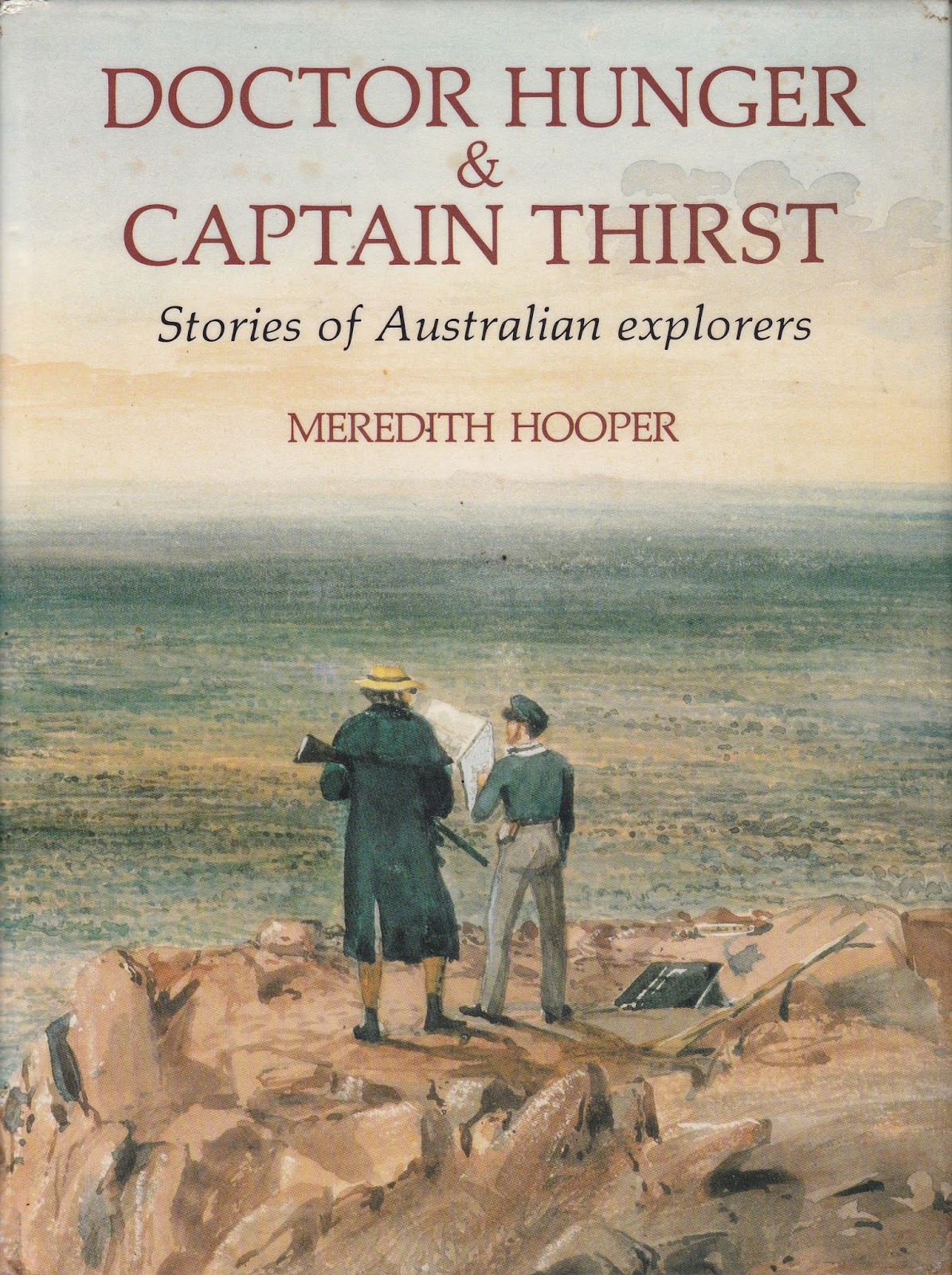
Doctor Hunger & Captain Thirst: Stories of Australian Explorers by Meredith Hooper
Chapters 1 to 3

Margaret Catchpole (1762-1819) by Nance Donkin


Term 2 (1840-1860's)

History of Australia - Chapters 15 to 16

Doctor Hunger & Captain Thirst - Chapters 4 to 8

River Rivals by Ian Mudie


Term 3 (1860's-1914)

History of Australia - Chapters 17 to 21

Doctor Hunger & Captain Thirst - Chapters 9 to 15

The Singing Wire: The Story of the Overland Telegraph by Eve Pownall


Natural History


His parents know that the first step in intimacy is recognition; and they will measure his education, not solely by his progress in the 'three R's,' but by the number of living and growing things he knows by look, name, and habitat.

Charlotte Mason, Volume 3, pg 76

All my children have enjoyed the Ambleside Online selections for Natural History e.g. books by Ernest Seton Thompson and William Long so we keep these on the schedule and add in a couple of Australian titles. Tiger Cat by C.K.Thompson is one Moozle will be enjoying this year.


Read Alouds

A Fortunate Life by A.B. Facey. We started this book a few months ago and are about a third of the way through. It's a wonderful autobiography of the author who was born in 1894 and grew up on the Kalgoorlie goldfields and in the wheat-belt of Western Australia. There are a few maps sprinkled throughout the book and we've been using these to cover the geography of Western Australia.


It cannot be too often said that information is not education. You may answer an examination question about the position of the Seychelles and the Comoro Islands without having been anywise nourished by the fact of these island groups existing in such and such latitudes and longitudes; but if you follow Bullen in The Cruise of the Cachelot (or in our case, the life and travels of Albert Facey) the names excite that little mental stir which indicates the reception of real knowledge.

Charlotte Mason, Volume 3, pg 169


Plutarch

Themistocles is the man whose life we have started to study. His is an interesting life to learn about as there are a few incidents in the story we already have some background knowledge on - Xerxes, The Battle of Thermopylae and King Leonidas, for example.

Shakespeare


We haven't started another Shakespeare play yet but I've been watching this Royal Shakespeare Company version myself - not suitable for Moozle but I may use it with Benj. As yet I'm undecided on whether to do Hamlet - a comedy would be a nice change after our stint with Macbeth.


Updated to add:

Our Sunburnt Country covers similar material to History of Australia. She reads it on her own:

Term 1 - chapters 6, 7 & 8
Term 2 - chapter 9
Term 3 - chapters 10, 11 & 12

I read History of Australia aloud as the content is a little more mature and will also be reading aloud Doctor Hunger & Captain Thirst. Most of the other books on the AO schedule will be read on her own, with the exception of Madame How & Lady Why.


Maths


Maths just seemed to click for Moozle when we started Singapore Maths 4B and she started to get into decimals. 4A and some of the previous books were a struggle and I was wondering how on earth we'd ever get through the Singapore books I'd bought, so I am relieved. This is the first time anyone in our family has found maths difficult in the earlier grades. There were some hiccups with highschool level maths from time to time but that wasn't any surprise.


I didn't want her to just get her work done and get it right, but to actually find some enjoyment in the process. I gave her this book to read a few weeks ago and today she read about a card game on positive and negative numbers which we ended up playing together.


Science Biography


Robert Boyle, 'The Father of Modern Chemistry.' Moozle read a chapter from one of the suggested online sources chapters for Isaac Newton and then I gave her this book on Robert Boyle to take her through the remainder of the first term:


This eight and a half minute video gives a short introduction to Robert Boyle & his times:


I will probably substitute The Story of Madame Curie by Alice Thorne a Signature Biography for George Washington Carver in third term.

We continue with Latin (usually only once a week); French and Dawn's free ebook 'a Biblical study of the underpinning ideas found in Charlotte Mason's motto, I Am, I Can, I Ought, I Will.'