Friday, 22 April 2016

Nature Poetry: Poetry Month Celebration

The author of the beloved children's book, Charlotte's Web, was not surprisingly, also a poet. I love this poem which he wrote for his wife in 1929...


 Natural History
 
  The spider, dropping down from twig
  Unwinds a thread of her devising:
  A thin, premeditated rig
  To use in rising.

  And all the journey down through space,
  In cool descent, and loyal-hearted,
  She builds a ladder to the place
    From which she started.

  This I, gone forth, as spiders do,
  In spider’s web a truth discerning,
  Attach one silken strand to you
  For my returning.

   E.B. White (1899-1985) 

Garden Orb Weaving Spider I came across on my walk


A Noiseless Patient Spider

A noiseless, patient spider,   
I mark’d, where, on a little promontory, it stood, isolated;   
Mark’d how, to explore the vacant, vast surrounding,   
It launch’d forth filament, filament, filament, out of itself;   
Ever unreeling them - ever tirelessly speeding them.            
 
And you, O my Soul, where you stand,   
Surrounded, surrounded, in measureless oceans of space,   
Ceaselessly musing, venturing, throwing, - seeking the spheres, to connect them;   
Till the bridge you will need, be form’d - till the ductile anchor hold;   
Till the gossamer thread you fling, catch somewhere, O my Soul.

Walt Whitman (1819-1892) 


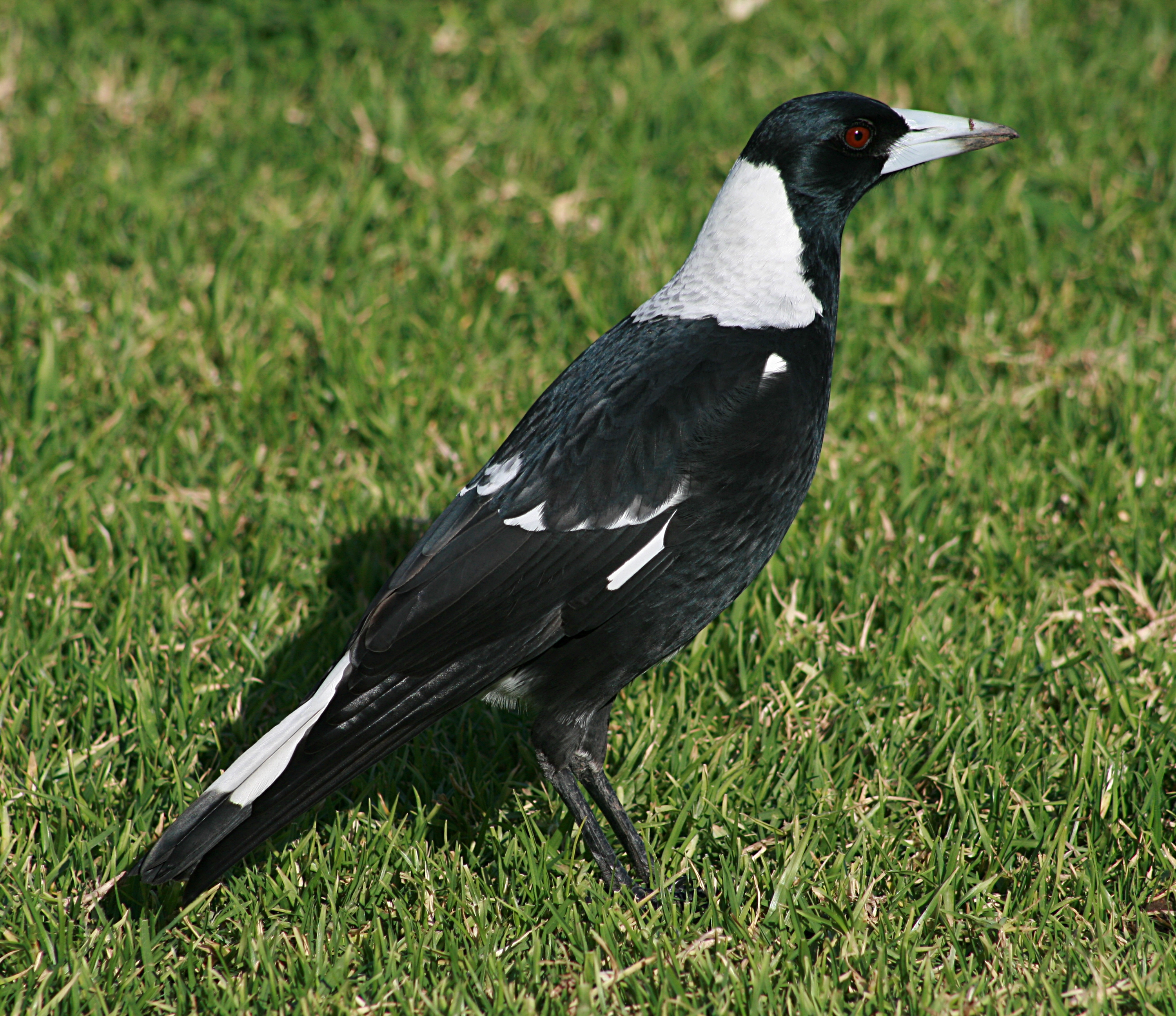
 Australian Magpie (c. Toby Hudson)


Magpies  

Along the road the magpies walk
with hands in pockets, left and right.
They tilt their heads, and stroll and talk.
In their well-fitted black and white.

They look like certain gentlemen
who seem most nonchalant and wise
until their meal is served - and then
what clashing beaks, what greedy eyes!

But not one man that I have heard
throws back his head in such a song
of grace and praise - no man nor bird.
Their greed is brief; their joy is long.
For each is born with such a throat
as thanks his God with every note.

Judith Wright (1915-2000)


Sunrise, Northern Territory, north of Alice Springs, 2011


The Australian Sunrise


The Morning Star paled slowly, the Cross hung low to the sea,
And down the shadowy reaches the tide came swirling free,
The lustrous purple blackness of the soft Australian night,
Waned in the grey awakening that heralded the light;
Still in the dying darkness, still in the forest dim
The pearly dew of the dawning clung to each giant limb,
Till the sun came up from ocean, red with the cold sea mist,
And smote on the limestone ridges, and the shining tree-tops kissed;
Then the fiery Scorpion vanished, the magpie's note was heard,
And the wind in the she-oak wavered, and the honeysuckles stirred;
The airy golden vapour rose from the river breast,
The kingfisher came darting out of his crannied nest,
And the bulrushes and reed-beds put off their sallow grey
And burnt with cloudy crimson at the dawning of the day.


James Lister Cuthbertson (1851-1910)


Leaf-tailed Gecko by Moozle aged 11


The Gecko

The Gecko lying on his stone
Is always very much alone,
Nor is the reason hard to trace
By those who've seen its form and face
It's hard to realise a mite
Can be so venomous a sight,
Or in its little frame compress
Such concentrated ugliness.
Now wonder other creatures fly
Each time a Gecko ambles by.
No wonder that its chosen mate
Recoils from the connubial state.
Yet underneath its skin, we're told,
There beats a heart of purest gold.
Its children do not know neglect;
It treats its mother with respect.
It never, ever beats its wife,
And lives a most unblemished life.
Its aspect is its sole defence
Against the world's malevolence.
So when you see a Gecko stay
Uncharitable thoughts and say:-
"The gruesome are not always gross-
even a reptile bears its cross!"

Leon Gellert (1892-1977)


http://theedgeoftheprecipice.blogspot.com.au/p/poetry-month-celebration.html


Monday, 18 April 2016

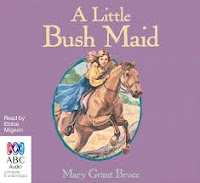
A Little Bush Maid by Mary Grant Bruce (1875-1958) - Classic Children's Literature Event 2016


A Little Bush Maid was published in 1910 and is the first book in the Billabong series by Mary Grant Bruce. There are fifteen books altogether and they follow Norah Linton from when she was a twelve year old growing up at Billabong, her father's property in rural Victoria, through to her adult years.

It's best to read the books in chronological order just to get the characters straight (although we didn't because it took us a decade to gather all the titles in the series) but the books do stand alone.
The author wrote the Billabong series over the years 1910 to 1942 and they reveal a very different Australia than that of today. They are historically interesting - three of them have World War I as a backdrop (From Billabong to London; Jim & Wally; Captain Jim) and are set in locations other than Australia.

A Little Bush Maid starts off slowly as Norah and the other characters are introduced. Norah's father was widowed when she was a baby, and he was left to bring up both her and her beloved older brother, Jim. Her upbringing so far has been unconventional. She has had no formal schooling and she spends her days in her father's company, helping out on the property and growing 'just as the bush wild flowers grow.' Jim is at boarding school in Melbourne and as the story opens, he comes home with two of his friends, Wally and Harry, for the school holidays.

A Little Bush Maid may not immediately entice a young reader as they may initially be put off by the lack of action, but it is worthwhile to keep going. There is still a good deal of lighthearted, humorous banter between the characters and when the action does begin, the story picks up quickly. Norah discovers the camp of a mysterious old hermit, the young people have encounters with venomous snakes, a disgruntled swaggie sets fire to the Linton property and a visit to the circus nearly ends in tragedy.
The title of the first book probably isn't appealing to boys, but although Norah is the main character, there are strong male characters in all the books.
Age-wise, a confident reader of nine would enjoy this book, but if they like the book as much as some of my children did, you will want to start looking for more books in the series. They are out of print but the first title can generally be found easily enough and a kindle version is available online at Gutenberg (see below).
The Mary Grant Bruce Official Website has a list of the books in chronological order.

As the book was written in 1910, the attitudes and views reflect that time period. Chinese workers, Aboriginals and servants have attributes ascribed to them that are not acceptable these days and in 1992 a revised edition produced by Angus & Robertson was published with some omissions to reflect this.

 1992 Version


We have an unabridged copy and a 1992 edition and I noted some of these changes:

Norah was driving a horse and carriage and referred to the two horses as 'Darkie' and N***er. In the revised edition the second horse's name was changed to 'Blackie.'

A remark made about black Billy, the Aboriginal station hand was omitted:

"Queer chap, that," said Dr Anderson, lighting a cigarette. "That's about the only remark he's made all day."

I'm surprised they didn't omit the reference to the cigarette...

This sentence referring to the Chinese gardener was omitted:

Wally's own idea was to tie him up by the pigtail, but this Jim was prudent enough to forbid.

In the afterward written by Barbara Ker Wilson in the 1992 revised edition she states:

With hindsight, we disclaim many of the ideas, opinions and attitudes of 1910, and a few paragraphs which might be thought of as racist today have been omitted from the text. But it would be profitless to criticise the author of a story written at that time for relaying the attitudes of her day through her characters.

Another revised edition (illustrated, same text as the book above & easy to find)


Interesting - we've been listening to an audio version of Tom Sawyer by Mark Twain and I was thinking how that book would be absolutely decimated if you took out the ideas, opinions and attitudes of the time in which it was written.
Literature is the product of a culture. Alexandr Solzhenitsyn said that 'literature is the living memory of a nation.' If we sanitise our past we are removing those memories and how do we learn and overcome our blind spots if we do not remember?

Gutenberg has four books in the series available in a kindle edition:

1) A Little Bush Maid
2) Mates at Billabong 
6) Captain Jim
7) Back to Billabong


This hardback version is unabridged and was published by John Ferguson Pty Limited in 1981. It also contains the next book in the series, Mates at Billabong:


An unabridged audio published by Bolinda Publishing is also available. I haven't listened to it but there's an excerpt here.


http://www.bookdepository.com/Little-Bush-Maid-Mary-Grant-Bruce/9781486288267?ref=grid-view


We used The Little Bush Maid as a substitute for American Tall Tails in AO Year 3. The Billabong books fit chronologically into Years 5 & 6 of Ambleside Online but we've mostly used them as free reads from the age of around 9 years.

Linking this to the 2016 Children's Classic Literature Event at Simpler Pastimes.


Monday, 11 April 2016

Poetry Celebration Tag

As part of  the Poetry Celebration at The Edge of the Precipice during April, Hamlette has posted some questions which I've answered below.


What are some poems you like?

I've loved poetry for as long as I can remember so I'm culling a lot here...


The Hound of Heaven by Francis Thompson (1859-1907)

"Ah, fondest, blindest, weakest,
I am He Whom thou seekest!
Thou dravest love from thee, who dravest Me."


The Fool's Prayer by Edward Rowland Sill (1841-1887)

"The ill-timed truth we might have kept -
Who knows how sharp it pierced and stung!
The word we had not sense to say -
Who knows how grandly it had rung!"


When You are Old by William Butler Yeats (1865-1939)


Ozymandias by Percy Bysshe Shelley (1792-1822)


The Pulley by George Herbert (1593-1633)


Scots Wha Hae by Robert Burns (1759–1796) Because I'm a Scot...


What are some poems you dislike?

Nothing really stands out. There are lots I don't care for but there are so many good poems anyhow I don't think too much about those I don't fancy.


Are there any poets whose work you especially enjoy?  If so, who are they?


George Herbert
William Butler Yeats
Leon Gellert

I like the humourous poetry of Hillaire Belloc, Arthur Guiterman, Edward Lear, and this piece by Australian poet, Thomas E. Spencer, How McDougal topped the score


Do you write poetry?


Yes, I do but I haven't written much in recent years. Most of my poetry has been reflective & personal but I've written a number of songs - poetry set to music.


Have you ever memorized a poem?

I've memorised poems I've read to my children, because I read them over & over for years and I know snippets of longer poems. Poems set to music have definitely helped me enjoy and memorise poetry and these days it seems to be the only way I really memorise well.


Do you prefer poetry that rhymes and had a strict meter, or free verse?  Or do you like both?

I probably prefer poems that rhyme as long as it's not forced but they don't have to have a strict meter.


Do you have any particular poetry movements you're fond of?  (Beat poets, Romanticism, Fireside poets, etc?)(If you haven't got any idea what I'm talking about, that's fine!  You can check out this list for more info, if you want to.)


I'm not familiar enough with all these terms to answer this question properly but I'm not fond of poems that are too flowery and have an overabundance of references and allusions to matters I have no idea about. I like to be able to make a connection in some way with what I'm reading. I enjoy reading ballad poems aloud to the kids - some favourites have been:


The Destruction of Sennacherib by George Gordon Byron
Horatius at the Bridge by Thomas Babington Macaulay
The Highwayman by Arthur Noyes
Lady Clare by Alfred, Lord Tennyson


Some other posts related to poetry:

Poetry Selections for Memory Work
Poetry as a Means of Intellectual Culture
Ideas for Poetry with Children

Saturday, 9 April 2016

Parents as Rulers - scope & limits

Parents as Rulers is the title of the second chapter or essay in Charlotte Mason's book, Parents and Children. The idea that we rule our children sounds almost strange to our modern ears. Isn't that what controlling, legalistic parents do?
To rule means to have authority over or to govern - that is, to direct and control; to keep within the prescribed limits; to regulate, to influence, to restrain.

When children are very young, we have to exercise control over them until they learn some inner restraint. To do otherwise would be neglectful, not to mention dangerous. But while we recognise the principles of authority and obedience in the home, there are parameters to be aware of:

* Parents are under God's authority; they are His deputies i.e. they have authority to act on His behalf. 'Order is the outcome of authority.' On the other hand, children are quick to discern if parents are being arbitrary (making rules for their own convenience) and are not governing by fixed principles.


'I am a man under authority...' Matthew 8

In School Education, Pg 15, CM distinguishes between authority and autocracy and defines the latter as 'independent or self-derived power.' Authority, on the other hand is neither of these. It isn't harsh or indulgent and operates on fixed principles. 

* Parents represent God to their children - the child makes his first approach to the Infinite through his parents.

...a human being comes into the world, not to develop his faculties nor to acquire knowledge, nor even to earn his living, but to establish certain relations...
To complete his education, I think there is but one more relation to be considered - his relation to Almighty God.

School Education, Pg 89

* Parents hold their children as a public trust to be trained as is best for the welfare and blessing of the community

* The authority of parents is provisional (temporary; for a set time) and has limitations

* Parental authority encourages autonomy - children should be gradually acquiring the ability of self-government

Charlotte Mason said that no parent escapes the call to rule. He may abdicate or give over his functions and authority to someone else, but in so doing, he hands over his rights as a parent to that person.
She writes about the practice of giving the training of infants into the hands of institutions or 'Maternal Schools,' (which I mentioned here) and said that it was a new thing in the history of the world and that even the Spartans left the children to their parents for the first seven years!

Perhaps such public deposition of parents is the last calamity that can befall a nation. These poor little ones are to grow up in a world where the name of God is not to be named; to grow up, too, without the training in filial duty and brotherly love and neighbourly kindness which falls to the children of all but the few unnatural parents.

CM uses strong language to describe this practice - alienation, desecration of the home, children growing up orphaned...

The Abdication of Parents

Parents may abdicate their authority formally or by default and such abdication is immoral. In  Towards A Philosophy of Education there is an interesting observation about anarchy - it is a mere transference of authority. The causes of this are:

* Parental desire for approval or popularity results in them allowing children from an early age to do what is right in their own eyes.

* Busyness and pre-occupation - one day the parent wakes up to find the authority he has neglected to use has been taken up by others not as competent.

* The love of an easy life lures parents into letting things take their course. Their children seem to be doing fine, they can relax...

The Limitations of the Parent's Authority

* Parental authority is solely for the advantage of the child - I really like the examples CM gives here: a mother makes her adolescent daughter go outside and get some exercise, rather than allow her to sit around inside reading or whatever - because it's in the best interests of the daughter. The introverted dad who discourages his children from social interaction because he is a man of quiet habits, is not considering their needs, but only his own, and is using his authority unlawfully. Bringing up children is not about parental comfort and when I've taken that road the temporary peace is soon overtaken by longer lasting consequences.

* There comes a time when the parent's right to rule is finished and they need to abdicate gracefully - even if the grown up son or daughter still lives at home. And if the parents think their offspring are not to be trusted in ruling themselves, CM has a an opinion on that -

...most likely their parents are to blame for not having introduced them by degrees to the full liberty which is their right as men and women.

Mmmm...we have young adults still living at home, and while I agree that children need to be eased into this liberty over time, I also think it's difficult for them to fully attain this while they're still at home. They can contribute financially, but until they have the responsibility of their own homes, they don't really appreciate all it entails.
There's a tension between many parents who still have their grown-up children at home, and we've certainly felt it at times, but we've also noticed that it wasn't difficult for them to adapt to having their own households when they did finally leave home. They came into full liberty when the final responsibility was on their shoulders and not ours.

'...the highest art lies in ruling without seeming to do so...Happy is the household that has few rules...'


Wednesday, 6 April 2016

An Elegy for a Lost Generation

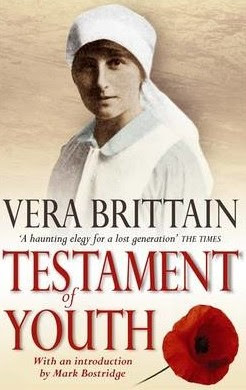
During the month of April I'm taking part in a Poetry Celebration (see link on the right). I recently started reading Testament of Youth by Vera Brittain, a WW1 memoir, described as 'A haunting elegy for a lost generation.' and decided to read some World War 1 poetry for the challenge. Vera Brittain had become engaged just before her fiancee went to the front in 1915. She writes of the tension she felt every time she heard the sound of the doorbell or the ring of the telephone, thinking that it could be news that her fiancee was dead. In addition to this continual anxiety, a new fear began to plague her:

...a new fear that the War would come between us - as indeed, with time, the War always did, putting a barrier of indescribable experience between men and the women they loved, thrusting horror deeper and deeper inward, linking the dread of spiritual death to the apprehension of physical disaster. Quite early I realised this possibility of a permanent impediment to understanding. 'Sometimes,' I wrote, 'I have feared that even if he gets through, what he has experienced out there may change his ideas and tastes utterly.

http://www.bookdepository.com/Testament-of-Youth-Ver-Brittain-Shirley-Williams/9780860680352?ref=grid-view


When I read Leon Gellert's poem, The Husband (? 1917) it confirmed the validity of Vera's fears. The husband comes home bereft and unable to shake off the memories and trauma of the war. He keeps his memories to himself and a barrier falls between himself and his wife as he thrusts the horror deeper within himself. He cannot even touch his wife's hair without the sense that he is defiling her. The husband has left the war zone but the war still goes on inside him.

The Husband

Yes, I have slain, and taken moving life
From bodies.  Yea! And laughed upon the taking;
And, having slain, have whetted still the knife
For more and more, and heeded not the making
Of things that I was killing.  Such 'twas then!
But now the thirst so hideous has left me.
I live within a coolness, among calm men,
And yet am strange.  A something has bereft me
Of a seeing, and strangely love returns;
And old desires half-known, and hanging sorrows.
I seem agaze with wonder.  Memory burns.
I see a thousand vague and sad tomorrows.
None sees my sadness.  No one understands
How I must touch her hair with bloody hands.


Tuesday, 5 April 2016

2016 Classic Children's Literature Event: Sir Nigel by Arthur Conan Doyle


During the month of April I'm linking up at Simpler Pastimes for Amanda's Classic Children's Literature Event. I hope to read at least two books for the Event and here is the first (I cheated and actually started before the 1st April...): Sir Nigel by Arthur Conan Doyle.


Sir Arthur Conan Doyle is best known for his Sherlock Holmes' detective character but he also wrote some excellent historical novels. 
In 1891, Doyle's novel, The White Company, was published. This book tells of the adventures of Sir Nigel Loring and his men and is set during The Hundred Years' War. Fifteen years later, in 1906, the 'prequel,' Sir Nigel, was published. This book, set at the beginning of the war, details the exploits of the squire before he became a knight. 

Nigel of Tilford is the last in a long line of a famous but now impoverished family. Brought up by his aged grandmother, the Lady Ermyntrude, Nigel is small in stature but has a heart full of chivalrous intent, and is determined to win honour and become a knight. 
Together with his lusty attendant, Aylward, they find adventure and seek their fortunes in England and France alongside Edward III, the Black Prince and Sir John Chandos, a Knight of the Garter.


http://www.bookdepository.com/Sir-Nigel/9780486471440


If you've read The Merry Adventures of Robin Hood and Otto of the Silver Hand by Howard Pyle, you will get an idea of what to expect from this book. Doyle's humour is reminiscent of Pyle's Robin Hood. Sir Nigel is brimming with humorous episodes and downright fun as Nigel follows his romantic ideals and goes about 'winning worshipful worship.' However, there is also much serious content and brutality that reflects the time period of the story, which is also the case in parts of Otto of the Silver Hand, but even more so in Sir Nigel. 
A couple of instances of the more serious aspects of the book which come to mind: 
In Chapter XI of the story, the reader is introduced to Sir John Buttesthorn and his two daughters, Edith and Mary:

...Never had two more different branches sprung from the same trunk. Both were tall and of a queenly graceful figure. But there all resemblance began and ended.

Edith was yellow as the ripe corn, blue-eyed, winning, mischievous, with a chattering tongue, a merry laugh, and a smile which a dozen of young gallants, Nigel of Tilford at their head, could share equally among them. Like a young kitten she played with all the things that she found in life, and some there were who thought that already the claws could be felt amid the patting of her velvet touch.


Mary was as dark as night, grave-featured, plain-visaged, with steady brown eyes looking bravely at the world from under a strong black arch of brows. None could call her beautiful, and when her fair sister cast her arm around her and placed her cheek against hers, as was her wont when company was there, the fairness of the one and the plainness of the other leaped visibly to the eyes of all, each the clearer for that hard contrast. And yet, here and there, there was one who, looking at her strange, strong face, and at the passing gleams far down in her dark eyes, felt that this silent woman, with her proud bearing and her queenly grace, had in her something of strength, of reserve, and of mystery which was more to them than all the dainty glitter of her sister.


Later on in Chapter XII, Edith is deceived by a cunning nobleman into running away with him after he makes a false promise of marriage. Nigel, Mary and an old priest seek out the couple and find, as they expected, that the nobleman had no intention of marrying Edith but it was not until Nigel had a dagger at the man's throat that Edith saw through the deception. She returned home chastened and thankful that she had escaped from a situation that would have brought shame and disgrace to both herself and her family.
This situation was handled so well by Doyle that younger readers could get a sense of the moral peril Edith was in without being burdened by information above their heads or maturity level. 
Some other scenes occurred which may be too intense for some younger readers:

The butcher of La Brohiniere had captured some of Nigel's company and imprisoned them in a castle and when the English tried to make an attempt to free them, La Brohiniere started to hang some of the men from the parapets. When Nigel later succeeded in finding a way into the place where the English were imprisoned, he found a strange and horrible scene:


It was a great vaulted chamber, brightly lit by many torches. At the farther end roared a great fire. In front of it three naked men were chained to posts in such a way that, flinch as they might, they could never get beyond the range of its scorching heat. Yet they were so far from it that no actual burn could be afflicted if they could but keep turning and shifting so as continually to present some fresh portion of their flesh to the flames. Hence they danced and whirled in front of the fire, tossing ceaselessly this way and that within the compass of their chains, wearied to death, their protruding tongues cracked and blackened with thirst, but unable for one instant to rest from their writings and contortions.

Sir Nigel would appeal to anyone interested in historical, well-paced, adventurous types of book. I'd recommend it for confident readers who have enjoyed books by  authors such as G.A Henty, Rosemary Sutcliff, Henry Treece, and especially Howard Pyle. Each of these authors wrote realistic historical fiction for children. Most of my children read this book around the ages of 10 to 12 years and thought it was a great story. Moozle (11years of age) is reading it for the second time. I think the humour throughout is an added attraction for her and helps to keep the story buoyant.


The passages you may want to pre-read before handing the book to your children are from these two chapters which I've linked to a free online version:

Ch XII How Nigel Fought the Twisted Man of Shalford
Ch XX How the English Attempted the Castle of La Brohiniere


There is an excellent audio version narrated by Stephen Thorne:


Arthur Conan Doyle was proud of the research that went into his historical novels and he wrote this explanation about the content of Sir Nigel:

I am aware that there are incidents which may strike the modern reader as brutal and repellent. It is useless, however, to draw the Twentieth Century and label it the Fourteenth. It was a sterner age, and men’s code of morality, especially in matters of cruelty, was very different. There is no incident in the text for which very good warrant may not be given. The fantastic graces of Chivalry lay upon the surface of life, but beneath it was a half-savage population, fierce and animal, with little ruth or mercy. It was a raw, rude England, full of elemental passions, and redeemed only by elemental virtues. Such I have tried to draw it.


Sunday, 3 April 2016

Australian Poetry in World War 1


Leon Gellert (1892-1977) is said to have written some of the best poetry that came out of WW1 and is generally considered to be Australia's finest war poet. I stumbled upon one of his poems in a small anthology of Australian verse, The Call of the Gums, and sought out more of his work. A volume of his poems, which was published as Songs From a Campaign, hasn't been reprinted since 1917, as far as I know, and it's not easy to find his poetry in print.
The drawings below were done by Gallipoli artist, Major Hore (1870-1935). They are taken from  Gallipoli & the Anzacs site, which also contains the background information related to the drawings and much more besides. It is well worth a good look around.


Anzac Beach – June 1915


Leon Gellert was 23 years old when he landed on Anzac Beach (better known as Anzac Cove) on 25 April 1915 with the 10th Battalion, South Australia. In July he was evacuated to Malta due to illness and shrapnel wounds, and after that to London. There he was declared medically unfit for duty, and was discharged from the forces at the end of June.

North Beach – Evening Nov 5. 1915


Anzac Cove

    There’s a lonely stretch of hillocks:
    There’s a beach asleep and drear:
    There’s a battered broken fort beside the sea.
    There are sunken trampled graves:
    And a little rotting pier:
    And winding paths that wind unceasingly.
    There’s a torn and silent valley;
    There’s a tiny rivulet
    With some blood upon the stones beside its mouth.
    There are lines of buried bones:
    There’s an unpaid waiting debt:
    There’s a sound of gentle sobbing in the south.


‘Early Morning Gallipoli’ – Oct 1915


The Cross

'I wear a cross of bronze,' he said,
                   'And men have told me I was brave.                 
He turned his head,
   And pointing to a grave,
'They told me that my work of war was done.'
His fierce mouth set.
'And yet, and yet…..'
   He trembled where he stood,
 'And yet, and yet'…..
I have not won
     That broken cross of wood!' 


‘Finis’ – Dec 20 1915 – Evacuation


The Last To Leave

The guns were silent, and the silent hills
had bowed their grasses to a gentle breeze
I gazed upon the vales and on the rills,
And whispered, "What of these?' and "What of these?
These long forgotten dead with sunken graves,
Some crossless, with unwritten memories
Their only mourners are the moaning waves,
Their only minstrels are the singing trees
And thus I mused and sorrowed wistfully

I watched the place where they had scaled the height,
The height whereon they bled so bitterly
Throughout each day and through each blistered night
I sat there long, and listened - all things listened too
I heard the epics of a thousand trees,
A thousand waves I heard; and then I knew
The waves were very old, the trees were wise:
The dead would be remembered evermore-
The valiant dead that gazed upon the skies,
And slept in great battalions by the shore.


A short biography of Gellert is here and some of his poems are available online e.g. allpoetry,
and as a PDF here.
The AusLit  website has a list of the contents of Gellert's book Songs of a Campaign.


 I'm linking this post to the Poetry Month Celebration at Edge of the Precipice.


Friday, 1 April 2016

Classic Children’s Literature Event for the Month of April


This is the second year in a row I'll be participating in the Classic Children's Literature Event hosted by Amanda at Simpler Pastimes.  During the month of April read as many Children's Classics as you wish, post about them on your blog and then link your post up at Simpler Pastimes. There is also an optional read-along title, Emile & the Detectives by Erich Kastner. It's not too late to join up, the rules are simple i.e. read a Children's Classic/Classics written prior to 1966 & write a bit about it. So come and check it out.
I hope to read at least two books this month for the challenge and I'll add them here as I decide on the titles.

1)  Sir Nigel by Arthur Conan Doyle (1906)
2)  A Little Bush Maid by Mary Grant Bruce (1910)
3)  Golden Fiddles by Mary Grant Bruce (1928)