Friday, 24 August 2012

Handicraft for Boys


Handicraft
Manual occupation; work performed by the hand.

Handiwork
Work of the hands; product of manual labor; manufacture.
Work performed by power and wisdom. Psalm 19 (KJV)
 
I wanted to focus on handicrafts/manual work for older boys (about 10 -12 years of age and up) in particular here but I'll also mention a few things we've done with younger ones.

Handicrafts such as crotcheting & knitting are good for developing fine motor skills and I did these with all the boys when they were younger. A couple of them also made wall hangings for their rooms which incorporated basic hand sewing & patchwork. I found the window of opportunity closes fairly quickly on these activities so sooner rather than later is probably better.

The wall hanging on the left was done by my at the time 14 year old boy. He chose the picture from a colouring book, printed it out, and using a rectangle of calico (homespun), he traced the picture onto the material with a pencil by putting them both up to the window. Then he got some iron on pellon and ironed it to the back of the outlined material and then back-stitched the outine with double stranded embroidery cotton.
He chose some scraps to do a border around it, used the sewing machine to stitch them on; folded the border and hand-stitched the border to the back.

To hang it up you can get a slim, straight stick or rod, attach it to the back with a couple of stitches and hang it on a hook.

Teaching them how to thread and use a sewing machine had them making dress-up articles such as Robin Hood outfits, pouches (money bags), capes and shorts. They enjoyed this for quite some time - this was their first taste of a power tool.

And of course, cooking. Two of my boys are very good in the kitchen - the other two are just happy to eat.  Two books that inspired them to cook spring to mind:

How to Make an Apple Pie & See the World by Marjorie Priceman


A young baker decides to make an apple pie, finds the market is closed and so embarks on a journey through Italy, France, Sri Lanka, England, Jamaica & Vermont to find the ingredients. At the end of the story is a recipe for making the pie and one of my boys still makes it even though he has outgrown the book.

The Redwall Cookbook by Brian Jacques

Brian Jacques is the author of the Redwall series of books which our boys enjoyed around the ages of 9 -11 years. The cookbook still appeals for older ages. 

In the Redwall stories 'the food has as much a part of the saga as the battle, the quest, the poems, the riddles, and the songs.'
You can read about him here.


A book series for boys of about 8 - 12 years of age is the BushBoys by James Tierney. 


These stories are set in the Australian bush and include quite a bit of know-how on camping and bush skills. Here is the blog where you can view the books.

For the older  boys I was pleased to find some out of print books online that I'd seen at the library a while ago but have since disappeared. These books, the 10 Bushcraft Books by Robert Graves are available here and a PDF version is here.


 An enthusiastic bushwalker, skier and pioneer of white-water canoeing,
he foresaw how a knowledge of bushcraft could save lives in the Second World War. To achieve this end, he initiated and led the Australian Jungle Rescue Detachment, assigned to the Far East American Air Force. This detachment of 60 specially selected A.I.F. soldiers successfully effected more than 300 rescue missions, most of which were in enemy-held territory, without failure of a mission or loss of a man.
An essential preliminary for rescue was survival, and it was for this purpose that the notes for these books were written. These notes were later revised and prepared for a School in Bushcraft which was conducted for nearly 20 years. As far as is known, "The 10 Bushcraft Books" are unique. There is nothing quite like them, nor is any collection of bushcraft knowledge under one cover as comprehensive.

These books seem to me to be a good substitute for Nature Study for Australian students using Ambleside Online in the upper years.

A quote from Book 9 in the section titled Weather Lore:

An infallible weather forecast, if a change of weather is coming up, is in the nautical couplet:

"When the rain is before the wind, your topsail halyards better mind, But when the wind is before the rain, then hoist your topsails up again."

In plain words this says that when rain comes first without wind then expect a long period of bad weather with high winds and heavy rain. But when wind comes first and is followed immediately by rain, then fine weather will follow at short notice.

Many people are trapped by bad weather in the bush every year, and if they but knew of this simple weather sign they could be prepared, and get out to a position of safety before really bad weather sets in.

Another infallible weather signal is the appearance of cumulus nimbus cloud, a foreteller of thunderstorms. While a greenish light in the sky preceding a thunderstorm is an almost certain sign of heavy hail.

As our boys became more physically mature they became invaluable around the place. BB says that he wants them to be confident enough to tackle a job; to have a 'can do' attitude and be able to find out how to do something if they don't already know. 

The  internet can be a good resource. BB recently found a Youtube video to help repair our electronic washing machine - he watched it and then explained to our 17 year old what he needed to do & he then did the work and saved us a few hundred dollars.

When it comes to things like axes, electrical type work, chainsaws or other potentially dangerous material, obviously the level of maturity and in some cases, physical strength is a consideration.

Some things we've done:

Electronic kits - in Australia Dick Smith sells kits to help you get you started
Old appliances for the boys to pull apart
Gardening - pruning, planting, weeding
Plumbing - replaced a large pipe outside, changed washers; fixed toilet cisterns
Painting
Home renovations - knocked out brick walls (great fun; huge mess)
Changing different types of light bulbs eg. fluorescent tubes
Car maintenance
Sanding down wood
Bought old wooden desk & restored, stained etc
Read directions for new stove & showed mum how to use it
Chop wood, light fire
Built a computer; installed programmes
Senior First Aid course at age 14 (St. John's Ambulance - if you have a group of about 6 people you can ring them and organise a course)
Pocket knives & how to use them safely
Soldering
Archery


Kitchen renovations - knocking out walls, painting, plumbing........


Equal opportunity - girls get in on the action


Learning how to use sound equipment and recording music


For a number of years BB and the boys met regularly with 3 other homeschooling dads & their boys and between them taught the boys a number of skills using Contenders for the Faith - a Handbook for Young Men. They ranged in age form 6 years to about 17 years old at the time and they learnt some valuable skills.


Do you see a man skilled in his work?
    He will serve before kings;
    he will not serve before obscure men.


Thursday, 16 August 2012

The Dangerous Article for Boys

'Why boys don’t need to get in touch with their feelings and how you can protect them from people who think they do (with a list of books to help you fend these people off).'

An interesting article by Martin Cochrane which follows on a bit from my review on Landscape With Dragons but with a different slant (check out his comments on the current vampire books) :

http://www.memoriapress.com/articles/dangerous-article-boys.html


Monday, 13 August 2012

A Landscape with Dragons


A Landscape with Dragons - The Battle for Your Child's Mind by Michael O'Brien

I first read this book about 10 years ago and for me it was one of those 'stand out' books that I return to and reflect on to refresh my thinking. The author examines fantasy books and movies for children in a way that I haven't seen addressed by any other author that I've read.

For a long time my husband and I avoided any sort of fantasy literature for our children - partly because we had a teenage girl living with us for a number of years who had really struggled with 'addiction' to science fantasy material and we didn't want to put any stumbling blocks in her way - and partly because as Christians we struggled with the whole 'magic/fantasy' issue ourselves and were reluctant to let our children loose with that type of material while we felt uneasy about its suitability.
  • Where were the boundaries when it came to this type of literature?
  • What was the difference between books written by authors such as C.S. Lewis, George McDonald and J.R. Tolkien, or Anne McCaffrey and Ursula Le Guin?
  • How could we discern what was suitable?
  • What if after reading the The Chronicles of Narnia, our children developed an appetite for more fantasy?
  • Would they develop a fascination for more questionable types of fantasy or even occult material?
  • Are you alarmed when you peruse the shelves at the local library and see how much of the content contains witches and sorcery?
  • Has anyone else had these concerns??

The author, calling our times the 'Age of Noise,' writes lucidly of the battle for our children's minds, the role of fairy tale and symbols, the growing illiteracy of Western society with our minds becoming increasingly passive and image oriented, the  invasion of the imagination  and the shift in our culture from a Christian worldview to a neopaganist  worldview.

A very helpful section in the book is the author's 'makeshift scale' in which he divides the field of children's culture into four categories in order to assess material eg:

Material that is fundamentally good but disordered in some details.......material that appears good on the surface but is fundamentally disordered.

He also stresses the need for parents to be vigilant and prayerful and that our primary tool for discernment  must be our own interior barometer.
He suggests asking ourselves some questions when we are assessing a book or film eg:

  • Does the story reinforce my child's understanding of the moral order of the universe?
  • Or does it undermine it?
  • What does the author say about the nature of evil?

The book  is deep, beautifully written, readable, and insightful.
The author is Catholic and his beliefs come through strongly in certain sections (in particular, 'Some Notes on Spiritual Discernment') but his message transcends denomination and his writing is very empowering, relevant and practical.

Some quotes from the book:

There is no perfect work of art, nor is there any work of fiction that does not in some small or large way fall short of a complete vision of reality. But there is a crucial difference between a flawed detail and a flaw in the fundamental  vision.

The imagination was originally created to be God's territory, a faculty of man's soul that would help him to comprehend the invisible realities.

The purpose of dragons in literature, and of the fascination children have for them is to arm the soul with an ever-developing discernment of spirits. The purpose of the fairy tale is not to breed superstition but rather to defend the mind against superstition.

Since  this book was published in 1998, he analyses and critiques movies such as Star Wars and  books written by authors Madeleine L'Engle, Stephen Lawhead and others, but I think his principles really transcend the time frame and can be used to discern current literature and film also.

There is a large comprehensive list of recommended family reading material contained at the end of the book and also a list of suggested reading materials for parents.

Although primarily written for parents this would be a worthwhile book for older teens to read especially if they are considering the study of education or literature later on.

Published by Ignatius Press.

Friday, 10 August 2012

Hymn Study

Generally we listen to our current hymn and folksong each day and then when I think we've learned them well enough I'll choose some new ones to learn, going back to review earlier selections from time to time.
So this is the hymn we've just started.

'Tis So Sweet to Trust in Jesus


This version has added a chorus:

You're the shelter in the storm
You're the dearest friend I know
Oh, Light of the world, carry me home
Oh, for grace to trust Him more


Here is the original  hymn with guitar chords: http://www.worshiparchive.com/song/tis-so-sweet-to-trust-in-jesus

Friday, 3 August 2012

Picture Study


Our current picture study is the work of the Australian Impressionist, Arthur Streeton (1867 - 1943).

These paintings are what we've covered so far and the plan is to go on to other artists from what is known as the 'golden era' of Australian painting - Tom Roberts and Frederick McCubbin in particular.

Blue Mountain Tunnel

When we first started studying the works of Arthur Streeton I’d chosen this painting partly because we’ve had numerous trips to that area and partly because I thought the subject of the painting would appeal to the boys.


This particular painting was done with watercolour on canvas but then we realised that there was another  painting of the same scene at Lapstone, ‘Fire’s On,’ which was done in oil on canvas. 


At first glance we noticed the oil painting was more intense but then we saw the smoke and different groupings of people, including the accident victim being carried out of the tunnel, and realised the difference in the paintings was more than just the medium used to paint them.


 Fire's On


This narration was done by my 12 year old son.  He had studied the paintings for a few minutes each day for a about week and then I asked him to write down his observations from memory - he added the pictures later.


We’d read the story behind the paintings from an art book we have, Great Australian Paintings, a Lansdowne publication.


Purple Noon's Transparent Might


Redfern Station


Autumn


  Circular Quay


Online paintings of Australian artists large enough to use as a screensaver were difficult to find and then I discovered this great site http://www.the-athenaeum.org/ 
The images above are from The Athenaeum.
Below are some picture study narrations some of my children have done at different times from different artists.


Wednesday, 1 August 2012

Nature Notebook


Birds  have been the major focus we've had for the past month in our nature study. It never ceases to surprise me how often we see a bird we'd never seen before even in just our own area.

Unfortunately, we don't always get a photo, or a decent one at any rate, before they fly off, but we try & note specific features such as colour, size & shape of the beak, long tail feathers, general size of the bird and the noise it makes.

Usually we can get a good enough description to compare our observations with photos in our bird book - or we can narrow it down to a couple of choices.

These are some birds we've managed to get photos of just recently.

Magpie-Lark 

(Grallina cyanoleuca) Commonly known as a peewee because of the sound it makes and is apparently neither a magpie or a lark. I think this one is a male and he came tapping on the window at a friend's house about half an hour's drive from us. We haven't seen them around here as they avoid the densely wooded areas.


Australian Wood Ducks 

(Chenonetta jubatta) Not a great photo; the female is on the left, male on the right of the photo. These actually landed in a tree next to the house and because we've only seen mallard ducks in our area we didn't recognize them as ducks - they have longish necks & look a bit like geese. We found them running around in a garden up the road & took the photo there.


These photos of water birds were taken on the weekend on the Central Coast (New South Wales) on Lake Munmorah. We definitely don't see any of these birds near us although we did see a White Faced Heron on a football oval nearby.


Australian Pelican

(Pelecanus conspicillatus) The name says it all! Unmistakeable. 
The smaller birds are Little Pied Cormorants (Phalacrocorax melanoleucos).
A group of cormorants are called a 'gulp'! 

Later in the day a pod/squadron of pelicans came sailing majestically across the lake - I didn't have a camera, unfortunately.


I think this bird with the striking coral beak is a Caspian Tern (Sterna caspia).
I only saw this one on its own.


This looks like either an Intermediate Egret (Ardea intermedia) or a Great Egret (Ardea alba).

The Great Egret has a distinctive, long, kinked neck - which I think this one has - but if anyone can tell me for sure I'd appreciate it.


A unique  book we used as a read aloud was The Birds, Our Teachers, by Dr. John Stott.

There are estimated to be 9,000 different species of birds in the world and the author has seen about 2,500 of them in his travels and in this book he combines biblical truths and his own  experiences with information about birds (he calls this 'orni-theology').

Expanding  on Martin Luther's exposition on the Sermon on the Mount,

 'You see, He is making the birds our schoolmasters and teachers......We have as many teachers and preachers as there are little birds in the air,'

he demonstrates how the birds teach us about such things as faith, gratitude, repentance, and joy.
The book is well illustrated  throughout and includes birds from many different parts of the world.

Australian Brush Turkey

(Alectura lathami) This is one bird we don't like having around mainly because it might decide to build a nest in your garden - if you're happy to have a hill about 4 metres in diameter and 1 metre high then go ahead and let them stay - we always chase them away. I must admit we've seen a couple of baby brush turkeys and they are very cute.

They  behave a bit like chickens - scratching around on the ground etc.-
actually we had one today who thought he was a chicken - he got into their shed and was eating their food until he saw me and took off very heavily over the fence, but they are larger and can get quite aggressive towards cats and dogs.

This is him on the run. The (breeding) male has a bright red neck.


Tuesday, 24 July 2012

Narration/Composition


Narration is basically retelling what you've read or had read to you. I call it composition if it's a written narration. If it's some other form eg. a drawing, I  call it a creative narration but they are all forms of retelling and are all valid.

I thought I'd share some ideas I've used to help my children narrate/compose. I'll add notes as I go to explain.

7 year old girl - after listening to a gospel account.


And after listening to Beautiful Stories From Shakespeare by E. Nesbit


I didn't know she was doing this one but her brothers were doing their compositions so she decided to do one as well.


 12 year old (just give me the facts) boy.


The idea for this narration came from Anne White's Plutarch Study Guide when we were studying Poplicola.


 14 year old boy - an article for a magazine after we finished Longitude by 
 Dava Sobel as a read aloud and a retelling from a chapter in Churchill's History of the English Speaking People.


A creative narration after spending time on Mozart in our composer studies.


 This was done by my son earlier this year when he was 16 years old. He is a maths man, a late reader and always struggled with writing - mentally & physically. I've spent the last few months honing his oral narration and have spent years doing dictation and tearing my hair out over his spelling.

 This is a narration he wrote in the form of a letter after reading a chapter from David Howarth's The Voyage of the Armada.


Gradually, bit by bit his spelling has improved and now he knows a word 'looks' wrong even if he can't work out how to spell it. His punctuation has improved also and I can see an improvement in his writing which I know is a direct result of regular oral narration ie. he comes to me after every reading & tells me about what he's read.

I have to admit that it’s taken me some time to realise the value of oral narration. Maybe it sounded too simple - I don’t know why I thought that when I find it so difficult to intelligently retell anything I’ve read or heard - but I did. 
Maybe it was because my oldest 3 (girl, boy, girl) were natural writers and didn’t struggle in the process that I was led to believe that if my children were readers they would just automatically become writers. 

We’d always done some oral narration, my intent usually being to check if they’ve been paying attention while I’ve been reading aloud, or to check to see if they’d learned something I thought they should have; but I hadn’t used it as a means for them to tell what they knew or what they thought was interesting or important.

Today I asked my son to do a narration in verse form after we'd read from Plutarch. He's just turned 17 years of age and I could tell he enjoyed doing this whereas 6 months ago he wouldn't even have attempted it.


A couple of months ago I read Charlotte Mason's A Philosophy of Education (Volume 6) for the first time and found it very valuable. On page 193 she writes, "Many children write verse as readily as prose, and the conciseness and power of bringing their subject matter to a point which this form of composition requires affords valuable mental training."

She also mentions 'exercises in scansion' (had to look up this word - ie. checking the rhythm) and not long ago I discovered that the The Grammar of Poetry by Matt Whitling has lessons in scansion - I'd only just started this recently with my 15 & 17 year old boys so it will be interesting to see how  these exercises will effect their verse writing down the track.

I've kept  lists of different ideas for writing that I've gleaned from all sorts of places or thought of or which have been suggested by my children but there are a few that seem to work better than others and we tend to stick mainly to those, although I do try to get them to vary things somewhat.

 I also find that if they get too creative and use the computer for graphics and fancy stuff it becomes more of an exercise in using technology as opposed to writing but sometimes with very reluctant writers it helps them to ease into expressing themselves.


Tuesday, 17 July 2012

Nature Detours & Derailments


A lovely Sunday afternoon after a busy weekend and a previous week of various family members in different stages of the flu and Best Beloved (BB) & I with our youngest (Moozle) in tow decide to go on a nature ramble.
So off we go down our street but before we reach the end of the road we get talking to a neighbour's son who is moving back home and has a truck on the side of the road with a range of worldly goods belonging to himself and 2 other family members who are also moving in. 

There being no one else in sight to help, BB offers the services of himself and three of our sons who are enjoying a leisurely afternoon are at home after an early morning start helping out with the setting up at church. So off goes Moozle to call her brothers to come and assist and when they arrive she & I continue walking and leave the men to their labours……………

The local bush regeneration folk have very helpfully put up signs on various trees and ferns around the place. I often get the names of  ferns mixed up so I wanted to take some photos with the bright idea that we should go around our place and put signs up on all of our flora.


      False Bracken Fern


Also known as the smooth-barked Apple Gum and Rusty Gum, these trees shed their reddish bark profusely in summer. They are also the trees most likely to drop branches around here. Their life span is about 150 years.


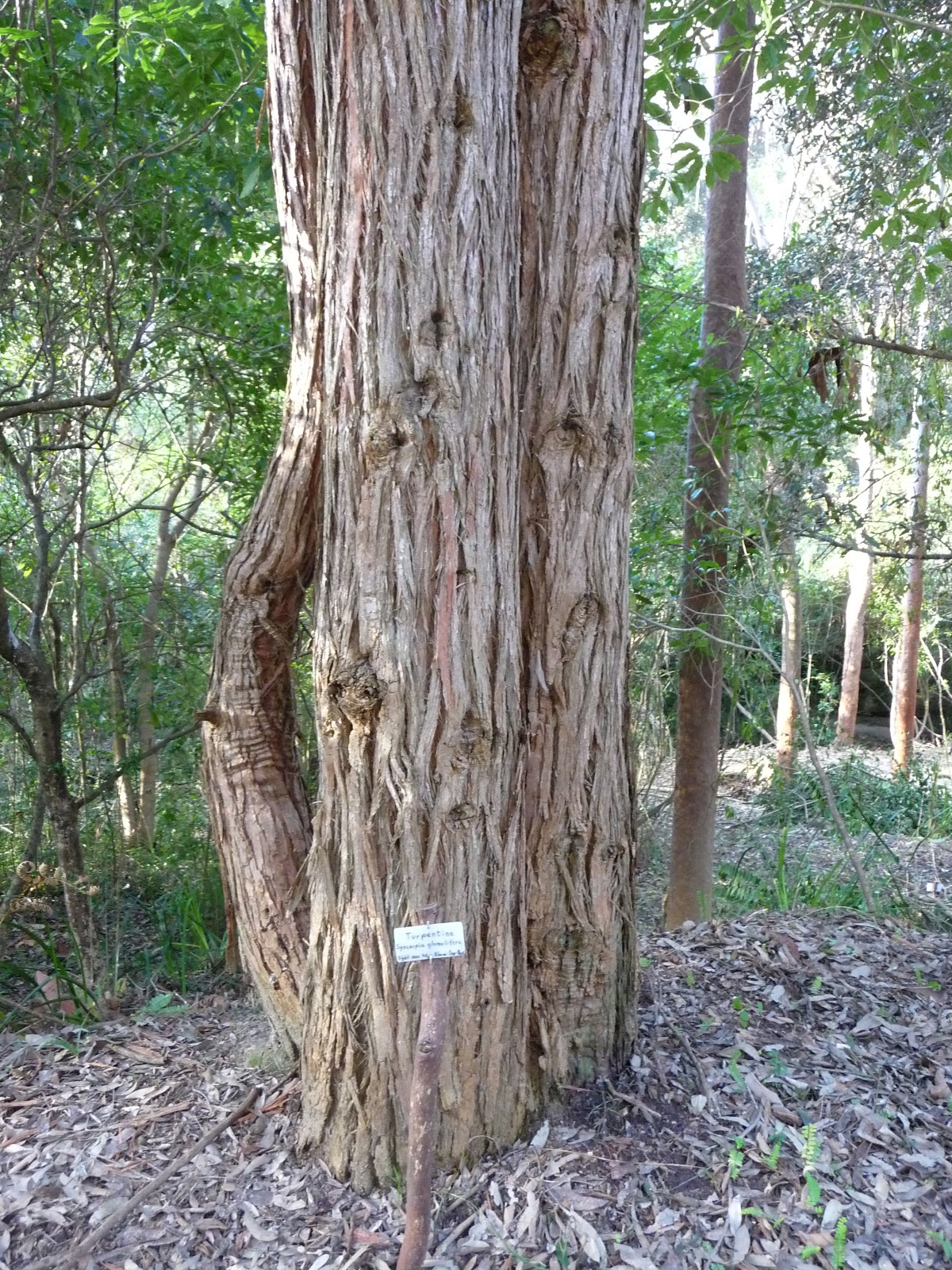
Turpentine (Syncarpia glomulifera) - lovely tall, straight tree with very distinctive rough bark. The crushed leaves smell like turps. I've read that timber from this tree is one of the most fire resistant timbers that can be found anywhere.


Flooded Gum - also known as Rose Gum. Huge and quick growing.


We wander back and meet BB and we decide to go up to the lookout not far from us.
This is our favourite spot to come and get some perspective, to pray and get some time out as a couple.

Cavities under rocks and lots of places to explore, quite steep in places


BB is thinking like a 20 something  and jumps across some rocks suddenly twisting his ankle…..very painfully. I get him to stagger back to safety and leave Moozle to keep an eye on him while I go back home to get a car & a young lad to help……..

So here we are at home with BB lying on the lounge with a very fat left ankle.


Some great images to help identify Australian trees and their fruit/flowers.

http://www.allcreativedesigns.com.au/pages/galltrees4.html


Sunday, 8 July 2012

Where the Battle Rages


A quote that has usually been attributed to Martin Luther but which may actually be a misattribution - regardless of who actually wrote it, it is worth pondering:

“If I profess, with the loudest voice and the clearest exposition, every portion of the truth of God except precisely that little point which the world and the devil  are at that moment attacking, I am not confessing Christ, however boldly I may be professing Christianity. Where the battle rages the loyalty of the soldier is proved; and to be steady on all the battle-field besides is mere flight and disgrace to him if he flinches at that one point.”

Where is the battle raging at the moment?

What is being attacked at present?

Two of my sons and I have been reading "How to be Your Own Selfish Pig (and other ways you've been brainwashed)" by Susan Schaeffer Macaulay.
What I really like about the book is the common sense approach she uses to illustrate how our worldview or beliefs have consequences and affect how we live out our lives.

In his book, My Utmost for His Highest, Oswald Chambers said this about emotion:

 '........the only test as to whether we ought to allow an emotion to have its way is to see what the outcome of the emotion will be.'

We might well say the same thing about an idea or a particular line of thought. 

What would be the outcome of this if we pushed it to its logical conclusion?

Going back to the battle quote above: the point of attack might not look like  much of a threat or it may not seem particularly important because we haven't pushed the idea to its logical conclusion and discerned what the outcome would be.......


'The true soldier fights not because he hates what is in front of him, but because he loves what is behind him.'
 G.K. Chesterton 

So with these thoughts here is something well worth listening to.


Marriage Webcast from Australian Christian Lobby on Vimeo.