Showing posts with label Espionage. Show all posts

Sunday, 19 January 2020

Tinker Tailor Soldier Spy by John le Carré (1974)


'...Mr George Smiley was not naturally equipped for hurrying in the rain, least of all at dead of night...
Small, podgy and at best middle-aged, he was by appearance one of London's meek who do not inherit the earth.'


Control, the commander of the Circus (the highest level of British Intelligence) is eased out of his position and dies not long afterwards. His second in command, George Smiley, is later forced out into retirement after a series of operational disasters and the Circus is restructured.

'After a lifetime of living by his wits and his considerable memory, he had given himself full-time to the profession of forgetting.'

But Peter Guillam, a former colleague whose role in the Circus has been curtailed since the restructure, has evidence that Circus has been infiltrated by a mole over a period of decades. He recruits Smiley to 'spy on the spies.'
As Smiley works to uncover this betrayal in the upper echelons of the organisation, he also faces a  betrayal in his personal life.

The Spy Who Came in From the Cold was the first Cold War novel by John le Carré that I'd read (see my review in this post).
* Tinker, Tailor, Soldier, Spy, was the second. The two books have similarities and share one or two characters but they both may be read as stand alone titles.
Betrayal is a dominant theme in both books, but it is more fully explored in the second.
Le Carré writes superbly and his plots are complex. Both novels are psychological thrillers and somewhat dark, which is not surprising for books about espionage.

Normally I'm only attracted to softer vintage espionage - authors such as John Buchan and Helen MacInnes - but le Carré sucked me in with his masterful exploration of character. He made me care about some of these characters. People such as Smiley and Bill Roach, the new boy at school who was considered dull, if not actually deficient, and blamed himself for the break-up of his parent's marriage; Jim Prideaux, the enigmatic hunchbacked teacher who arrived at the school as a temporary replacement:

'Bill had a feeling he could not describe that Jim lived so precariously on the world's surface that he might at any time fall into a void; for he feared that Jim was like himself, without a natural gravity to hold him on.'

And Peter Guillam, who in a moment feels not only betrayed but orphaned by the man who inspired him most: 

'His butchered agents in Morocco, his exile to Brixton, the daily frustration of his efforts as daily he grew older and youth slipped through his fingers; the drabness that was closing round him; the truncation of his power to love, enjoy and laugh; the constant erosion of the plain, heroic standards he wished to live by...
His suspicions, his resentments for so long turned outwards on the real world - on his women, his attempted loves - now swung upon the Circus and the failed magic which had formed his faith.'


This is an excellent, gritty read but I sometimes felt out of my depth with the complexity of the plot, although I found with both of le Carré's books that once I have the whole picture at the end of the book it helps me untangle some of the threads and I can then skip back to sections where I got a little lost and work things out.

* When a movie was made of the book in 2011, the commas were removed for the film title.


Saturday, 19 October 2019

A Bookish Catch-up


Our recent overseas trip afforded me some good opportunities for lighter reading. With very long flights from here to the U.K and back and a about six hours of train travel in between I managed to get through a few books that I took with me plus some others I picked up on our travels.
Light reading for me tends to lean towards detective/spy novels so I’ll start with those.

Passenger to Frankfurt by Agatha Christie (1970)


This was a strange one. It often felt more like a half-baked John Buchan story than an Agatha Christie novel with its international intrigue and bizarre characters. It was promising to start off with at first  when an unknown woman approached Sir Stafford Nye, a British diplomat, at Frankfurt airport with a tale that she would be killed if she didn't get to London. She persuaded Nye to give her his cloak and take his place on the flight. Unfortunately, Christie lost the plot a little later which was unfortunate as it could have been a good story if she had stuck to what she was good at.
There was no detective in this story and no crime as such, but there were double identities, spies, fake officials, an assassination, and a romance to top it all off.

An underlying theme was a resurgence of Nazism based on an event which came to light in this story:
As WWII progressed and Hitler was facing defeat, a plan was concocted to get him out of Germany to safety elsewhere.
Towards the end of the war, a German psychiatrist who dealt with megalomaniacs had a visit from a government official and the Führer. The psychiatrist was treating twenty-four ‘Adolf Hitlers’ at the time (as well as fifteen Napoleon’s, ten Mussolini’s, and five reincarnations of Julius Caesar!)
The psychiatrist arranged for the two men to meet and mingle with the most amiable of the Führer  patients and retired from the room. The meeting over, the two visitors left hurriedly.

Not long after this visit one of the psychiatrist’s ‘Hitler’ patients started showing signs of agitation, demanding to go immediately to Berlin. His behaviour was so fierce and unlike his usual self that the psychiatrist was relieved when a couple of days later his family took him home and said they would arrange private treatment there for him.

A clandestine investigation in the years after the war resulted in the belief that the real Führer was left in the asylum by his own consent and was not long after smuggled to Argentina, had a son by a ‘beautiful Aryan girl of good family,’ and died insane, believing he was commanding his armies in the field.
The fake Führer supposedly left the psychiatric clinic with the government official and it was his body that was found in the bunker.
At the time of this story a ‘young Siegfried’ arises, supposedly Hitler’s son, but actually a rank impostor. With backing from powerful people in high places, this young man was harnessing the youth of his country to bring about a new world order by means of violence, anarchy, drugs and what not.

It was a rather convoluted story with an equally baffling ending that seemed to come out of nowhere.
This is definitely not a standard Christie novel and I nearly didn’t finish it, but it did have its interesting bits so I carried on. Not one I’d ever bother reading again and definitely not one I’d recommend for anyone new to Agatha Christie. She should have left this sort of story to authors who knew how to write spy/espionage novels - such as John Buchan or Helen Macinnes.

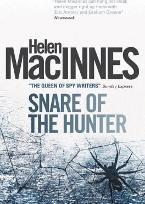
Speaking of Helen Macinnes, I picked up this title from the gift and secondhand shop at the Armitt Museum in Ambleside for £1:

The Snare of the Hunter by Helen Macinnes (1974)


Helen Macinnes was born in Scotland and went to live in the USA in 1937. Her books are usually set during WWII and the Cold War period. Both she and her husband, Gilbert Highet, a classicist who worked at one time for British Intelligence, travelled widely and this is reflected in Macinnes’ books.

The Snare of the Hunter has its beginnings in Czechoslovakia when Irina Hradek, the former wife of Jiri Hradek, a high ranking official in the Czech secret police, leaves the country to make her way to the west. She is astonished that her former husband, an ambitious and ruthless man, doesn’t hinder her defection but it becomes obvious that something sinister is afoot when those who are involved in helping her get to the west die in curious circumstances.

Irina’s father, a famous author living in secrecy after defecting to the west years before has friends who are helping Irina escape. They enlist the help of David Mennery, an American journalist who had lived in Czechoslovakia years before and had known Irina then.
Mennery had wanted to marry Irina but her mother, a Communist offical, had done everything to prevent the marriage. He left the country and put Irina out of his mind.
Now all these years later he again meets the woman he once loved, learns the circumstances of her life since then, and as he desperately tries to get her to safety, his love is rekindled. But Irina is now her ex-husband’s prime target. She cannot be allowed to reveal incriminating evidence about Hradek and his ambitious designs; evidence he discovers that she is carrying with her.

There’s a good bit of suspense in this story although Macinnes is an old school spy/espionage author who places more emphasis on character, place, and ideals than on the action that modern writers in this genre tend to concentrate on.

And now on to the detective novel. Bookshops in the U.K are wonderful repositories of crime classics and detective fiction. Not just the odd one or two but all the Josephine Tey books were to be found on the shelves in shops such as Waterstones and Blackwell Books. I usually have to order these books online and rarely find them at secondhand book sales. They also had the whole series of the British Library Crime Classics that I haven’t seen here at all. Glasgow, Oxford and London especially, are a book lover’s paradise.

I bought this Tey title in Bloomsbury in London and read it while I was away.

The Man in the Queue by Josephine Tey (1929)


This is the first in Tey’s Inspector Grant series of which there are only six, which is unfortunate because Alan Grant one of the most likeable detectives in fiction. Now that I’ve read The Man in the Queue I only have one more book in this series to read: ‘A Shilling for Candles.’

The Man in the Queue is a mystery surrounding the stabbing murder of a man who was lined up outside a London theatre waiting to be admitted to the last performance of a popular musical. No one had witnessed his murder and the press of people around him kept him upright until the doors to the theatre opened and he fell forwards.
He had nothing upon his person to reveal his identity and a loaded revolver was found in his pocket.
Inspector Grant is brought in to cover the investigation and by a painstaking process and some good luck, he manages to identify the victim and from there, the prime suspect.
One of the most interesting aspects of this book was the exploration of circumstantial evidence: how facts, evidence, and motives come together to pinpoint a suspect. In Grant’s mind there was a clear case to incriminate his suspect, but something felt wrong. What if all this was merely a series of accidents that were completely unrelated? What if he had arrested the wrong man?

‘Was the man by any remotest possibility telling the truth? If not, he was the most cold-blooded wretch Grant had ever had the unhappy lot to meet. But the man appeared unconscious of Grant’s scrutiny; he seemed wholly absorbed in his story. If this was acting, it was the best Grant had ever seen, and he deemed himself a connoisseur.’

Josephine Tey’s books are always satisfying reads and I enjoyed this one as much as her others. Being the first book in the series I thought it would lack some finesse but she didn’t disappoint.
The only quibble I have, if you could really call it that, is that her description of Detective Alan Grant in her first book didn’t match another description that stayed in my mind after reading The Daughter of Time. In The Daughter of Time Grant is confined to a hospital bed after an accident on the job and was wincing at the indignity of being thrown around by a small nurse he nicknamed the midget.

‘...she dealt with his six-feet-odd with an off-hand ease that Grant found humiliating.’

For years I pictured Grant as a tall, solid, garrulous type of fellow and then I read this in The Man in the Queue, which didn’t sit with the picture I had in my mind after reading The Daughter of Time:

‘If Grant had an asset beyond the usual ones of devotion to duty and a good supply of brains and courage, it was that the last thing he looked like was a police officer. He was of medium height and slight in build, and he was - now, if I say dapper, of course you will immediately think of something like a tailor’s dummy, something perfected out of all individuality, and Grant is most certainly not that; but if you can visualize a dapperness that is not of the tailor’s dummy type, then that is Grant.’

The resolution of this mystery came out of the blue and was as unpredictable as it was clever. Once again Tey has Grant romping around the Scottish Highlands which is always a treat.
Tey's books are available free for Kindle @ebooks Adelaide.


Death Walks in Eastrepps by Francis Beeding (1931)


Francis Beeding is the pseudonym for the writers Hilary St George Saunders and John Palmer who wrote over thirty crime and thriller novels together from the 1920’s up to the 1940’s.
This book is an Inspector Wilkins’ mystery and is set in a quiet English seaside resort and was once called one of the ten greatest detective novels of all time.
The plot is quite complex but I actually had an inkling later in the book about the identity of the murderer, which is so unlike me! I’m usually hopeless at predicting things like and this was probably a first for me.

At its roots, this is a story of unbridled ambition and festering resentment and the lengths such a person in their pride will go to achieve their aims. The Eastrepps Evil, as the real murderer came to be called, framed a man for the murder of a number of people before he was finally caught but it was too late for the accused...

A good old page turner published by Arcturus Crime Classics who publish unjustly neglected works from the 1930’s (the golden age of crime writing) to the 1970’s.

The Lakes District Murder by John Bude (1935)


This is a book I found on the shelf at a place where we stayed while in the Lakes District. I’d never heard of the author before but when I saw the title and that the book was published by the British Library I got stuck into I so I could finish it before we moved on.

Bude’s detective is Inspector Meredith, a well-respected and hardworking policeman with a quiet domestic life that includes a teenage son who helps his dad out with some sleuthing and a wife who doesn’t want their son to go down the same path as his father. Apart from a couple of mentions, Meredith’s family life is kept in the background and gives him no trouble.

The story begins with the apparent suicide of a young man who is part owner of a garage and petrol station situated in an isolated location. What at first appears to be a fairly straight forward investigation turns into a complex puzzle as Meredith finds that there are things that don’t add up: there is no apparent motive; the young man was happily engaged to a young woman and had no financial difficulties. The circumstances surrounding the death suggested an elaborate pre-meditation, but the man had made his dinner, set the table and left the kettle on the stove just before his death occurred which just didn’t fit in with the suicide theory.

What follow is a fairly complex and technical investigation which unearths a possible fraud. Some of this went over my head as it involved mathematical and mechanical calculations but I took a liking to Inspector Meredith and was interested enough to try another of his books.

A great aspect of a book like this is the insight it gives into the life of a policeman in the days before mobile phones, the Internet, and decent transportation. Meredith could use a landline if it happened to be available but otherwise he had to send someone off on a bike with a message. He relied mostly on a motor bike or the train to get around. In a place like the Lakes District, travel was slow and only the larger towns such as Carlisle were accessible by train.
Police work was a difficult occupation and sleuthing required a steady mind, a dogged persistence, and lots of leg work.
A good read if you like mental gymnastics but don’t let me put you off trying another of his books because this next one is a cracker:

Death Makes a Prophet by John Bude (1947)


A visit to a Waterstones bookstore in London presented me with a dilemma: a wonderful display of neglected old British Crime Classics recently reprinted. I think in all there are about seventy-four books by a variety of authors including Freeman Wills Croft, George Bellairs, E.C.R. Lorac, John Bude and others, but I had to limit myself to one as I already had other books earmarked and the exchange rate between the Aussie Dollar & the U.K Pound leaves us decidedly worse off.

I decided in the end to try another John Bude title and thought this one looked promising. I didn’t regret my pick and thoroughly enjoyed this droll, and at times a little dark, crime novel.
The Children of Osiris was a cult created and led by the High Prophet, Eustace K. Mildmann, a widower with an only son, Terence, who was twenty-one years of age at the time of this story.
The cult, adopting the initials of their full title, referred to their doctrine as the Cult of Coo, or Cooism. Their dogmas included a mixture of Ancient Egyptian beliefs and bits and pieces of lesser known religions with a modern twist.

The Cult of Coo believed in ‘magic numbers, astrology, auras, astral bodies, humility, meditation, vegetarianism, immortality, hand-woven tweeds and brotherly love.’

Mildmann was a sincere, dreamy man who believed Cooism was the key to all life’s mysteries.

‘His best ideas had always come to him when sunk in a self-imposed trance, or, as he pithily expressed it, “during a phase of Yogi-like non-being.” (“Non-being” figured as a very important factor in the Cult of Coo, though nobody seemed able to define its exact significance.)’

When he moved to the trendy Welworth Garden City in the 1940’s he found the right soil for his ideas and before long a group of intellectuals ripe for the picking. When the Hon. Mrs. Hagge-Smith came on the scene she totally embraced Cooism and became Mildmann’s patron and financial backer.

The author spends the first half of the book building the scene for a murder by introducing the various characters associated with the cult; their backgrounds, quirks, ambitions and petty jealousies. The second half of the book is more serious, although it still has some sparks of humour, and it's here that Inspector Meredith makes his first appearance.
There are some bizarre and baffling circumstances for Meredith to untangle. This book was quite different to The Lakes District Murder, mostly because of the humourous aspects that Bude scattered throughout, but also because the plot didn’t go into intricate details about things that I knew nothing about.
Some of my favourite parts are those that deal with Terence. Here was an athletic, practical young man with the appetite of a horse and the physique of a boxer. He was the very antithesis of his father who ‘had done everything to undermine his normality.' From clamping down on his tremendous appetite with a strict vegetarian diet, giving him a very small allowance of sixpence a week, requiring him to wear ‘rational clothing’ which included shorts in the middle of winter, and making him a Symbol-bearer in the Temple.

One day Terence met Denise, Mrs. Hagge-Smith’s secretary and immediately fell in love with her. She didn't mind him either.

‘Terence...shot a quick glance at the miracle in his midst and asked abruptly:
“I say, don’t think this is rude of me, but do you have manifestations?"

“Manifestations?”
It sounded as if he were referring to insects or pimples.

“Yes, you know - astral visions and all that sort of thing. Spirit shapes.”

“No - I cant say that I do. I dream rather a lot after a late supper. But I’m not at all psychic, if that’s what you mean.”

“I am,” announced Terence, to Denise’s surprise. “I’m always having astral manifestations. I get quite a kick out of it.” His eyes assumed a dreamy expression and then suddenly narrowed, as if he were trying, there and then, to penetrate the Veil. “Its marvellous sometimes how clearly I see things. They’re so terribly realistic.”

“Things?” enquired Denise. “What things?”

“Steaks mostly. But sometimes its mutton-chops or steak and kidney pudding. I just have to close my eyes, relax my mind and body, and there they are...You think it’s blasphemous of me to see things like that, don’t you? I know it’s not very high-minded, but -

“I don’t think anything of the sort. I think its very clever of you to see anything at all.

Terence just couldn’t work up any enthusiasm for peanut cutlets and raw cabbage and he confessed to his new-found friend that he went on the binge the week before and spent ten-weeks pocket money on a good feed.

Inspector Meredith always considered this investigation involving the Children of Osiris to be one of the most interesting, bizarre and exacting of all his cases.

At the same time I was getting my first introduction to John Bude, Sharon @Gently Mad was getting hers. She has written a review of another of his titles, The Cheltenham Square Murder, which sounds good.

And lastly, I read my first western:

Riders of the Purple Sage by Zane Grey (1913)


Apparently this book was a bestseller when it was published and has never been out of print. It made the author famous and created the new Western genre.
Set among the canyons and sage plains of Utah in the early 1870’s, this book has a strong romantic element and plenty of action.

A long running feud between Gentiles and Mormons comes to a head when Jane Withersteen, the daughter of the man who founded the Mormon settlement at Cottonwood, ignores the dispute and offers hospitality to an outsider.
A Mormon elder who plans to make Jane one of his wives threatens vengeance but he underestimates her courage and determination.
One day a lone rider of the plains comes to her house and with the help of the man who experienced hospitality at Jane’s hands, they try to help her hold out against those who seek her ruin.
I wasn’t sure what to expect from a Western and was surprised it had such a strong romantic element. I thought it was a bit melodramatic at times and ‘Lassiter,’ the lone rider who comes to Jane’s assistance was a little larger than life in his shooting and fighting abilities.

A fairly enjoyable read but I can’t say that I love the Western genre. I’d have to read some more of them to determine that.
Free online at Gutenberg.


What would you choose if you wanted a light read? I probably wouldn’t have picked up a book like Riders of the Purple Sage to read at home but I appreciated a book that wasn’t too demanding while we were travelling. I did contemplate taking a doorstopping epic like Les Mis or War & Peace for the plane trip but I’m glad now that I didn’t.


Tuesday, 6 February 2018

Mr. Standfast - How do I Love Thee? Let me Count the Ways...


This is the third time I’ve read Mr. Standfast by John Buchan. It’s one of my favourite books by this author and the third time around hasn’t diminished my ardour.
Mr. Standfast is the third book of five in Buchan’s Richard Hannay novels that began with The Thirty-Nine Steps, and was followed by Greenmantle. The book was published in 1919 after the Bolshevik Revolution and as World War I was coming to a close. Buchan’s story opens in 1917 when Hannay was serving as a Brigadier in France. He is recalled by British Intelligence to pose as a pacifist in order to infiltrate a spy ring that threatens to bring about an Allied defeat on the Western Front.
Hannay, an upfront man of action, is disgusted with the idea of being a fake pacifist, but he sees his duty, does what is required of him, and by the second half of the book he’s well and truly in on all the action, and nearly gets annihilated a couple of times.
There is a romantic element in this story as Hannay falls in love with the charming Mary Lamington, who is also working for British Intelligence. There are some tense moments for him when the sinister Graft von Schwabing, the German master of disguise, succeeds in tricking Mary. She walks into his trap and finds herself on the 'Underground Railway' heading into Germany with him.


https://www.bookdepository.com/Mr-Standfast-John-Buchan/9781846971556/?a_aid=journey56


What I loved About Mr. Standfast

•    Buchan uses the theme of Pilgrim’s Progress throughout the book. When Hannay is given his assignment via Mary, she tells him to buy a copy of Pilgrim’s Progress and ‘get it by heart.’ When he receives letters and messages about his assignment, they are written in a style reminiscent of John Bunyan. Some of the chapter headings are taken directly from Pilgrim’s Progress: The Village Named Morality; The Valley of Humiliation; The Summons Comes for Mr. Standfast.

•    Buchan has a very literary style and perceptive insights into human nature. Add those qualities to his grasp of the historical setting and his ability to tell a thrilling political/spy adventure story and the result is a winner.

•    Buchan was a fellow Scot and I love his descriptions of the Scottish Highlands and its people. He also had a very full and interesting life, living in South Africa and later in Canada where he held the position of Governor General. This wide experience of life is reflected in his writing.

•    Buchan’s characters: Mr. Blenkiron, who starred in Greenmantle makes his appearance again in Mr. Standfast, this time as a healthy man cured of his chronic dyspepsia; Sir Archie Roylance, the light-hearted youth who previously served with Hannay and now is in the flying Corps, and Mary Lamington, the courageous and patriotic eighteen year old girl who wins Hannay‘s heart.

•    My favourite character in this book would have to be the wiry and wise, Peter Pienaar, an old associate of Hannay’s from South Africa who participated in some previous adventures. He had found his niche in the Flying Corps and gained a reputation for skill amongst his fellow flyers, but also from Lensch, the German aviation hero. Peter had been downed by Lensch in a air fight and at the beginning of this story he is a crippled prisoner of war. The Pilgrim’s Progress was his constant companion and he had singled out Mr. Standfast as his counterpart because he did not think he could emulate Mr. Valiant-for-Truth. How wrong he was!

Among the unopened letters was one from Peter, a very bulky one which I sat down to read at leisure. It was a curious epistle, far the longest he had ever written me, and its size made me understand his loneliness. He was still at his German prison-camp, but expecting every day to go to Switzerland...
Peter's letter was made up chiefly of reflection. He had always been a bit of a philosopher, and now, in his isolation, he had taken to thinking hard, and poured out the results to me on pages of thin paper in his clumsy handwriting. I could read between the lines that he was having a stiff fight with himself. He was trying to keep his courage going in face of the bitterest trial he could be called on to face - a crippled old age. He had always known a good deal about the Bible, and that and the Pilgrim's Progress were his chief aids in reflection. Both he took quite literally, as if they were newspaper reports of actual recent events.
Peter preferred Valiant-for-Truth to Mr Greatheart, I think, because of his superior truculence, for, being very gentle himself, he loved a bold speaker...He thought that he might with luck resemble Mr Standfast, for like him he had not much trouble in keeping wakeful, and was also as 'poor as a howler', and didn't care for women. He only hoped that he could imitate him in making a good end.

But the big courage is the cold-blooded kind, the kind that never lets go even when you're feeling empty inside, and your blood's thin, and there's no kind of fun or profit to be had, and the trouble's not over in an hour or two but lasts for months and years. One of the men here was speaking about that kind, and he called it 'Fortitude'. I reckon fortitude's the biggest thing a man can have—just to go on enduring when there's no guts or heart left in you.

Peter was writing for his own comfort, for fortitude was all that was left to him now. But his words came pretty straight to me, and I read them again and again, for I needed the lesson. Here was I losing heart just because I had failed in the first round and my pride had taken a knock. I felt honestly ashamed of myself, and that made me a far happier man.


Mr. Standfast by John Buchan is my choice for the Back to the Classics Challenge 2018: Re-read a favorite classic

John Buchan's Richard Hannay novels are scheduled as free reads in the AmblesideOnline Year 11 curriculum, but they are also great reading for around age 12 to 13 years and up. My kids loved them.


Friday, 26 September 2014

The Thirty-nine Steps by John Buchan


The Thirty-nine Steps, written in 1914, is the first of five thriller/espionage novels in the Richard Hannay series by John Buchan. Barely a hundred pages long, Buchan's story begins with his thirty-seven year old hero returning to England after a long period in Africa. Disappointed and fed up after only a month of his new life, he believed himself to be 'the best bored man in the United Kingdom.'


Less than twenty-four hours later he becomes caught up in an international plot intended to incite a world war.
Hannay's adventures began when Scudder, a strange, nervous little man living in a nearby flat came to him with a wild tale of an anarchist conspiracy.  Hannay believed the man was genuine, if not a little mad, and gave him shelter as Scudder was in mortal fear of his life. Three days later, Hannay returned to his flat after a business meeting to find his guest lying sprawled on his back with a long knife through his heart pinning him to the floor.
Any doubt of the veracity of Scudder's tale had gone and Hannay found himself placed in a position where both the conspirators and the police were after him.
Assisted by the discovery of Scudder's pocket book which contained some details of the plot, Hannay embarked on his escape initially masquerading as a milkman and thereafter in various other disguises. The chase begins and Hannay is hunted throughout the Scottish countryside (beautifully described by Buchan) and in a series of highly improbable encounters and Providences, he eventually gains the help of Sir Walter Bullivant, a senior official in the British Foreign Office.


Suddenly I remembered a thing I once heard in Rhodesia from old Peter Pienaar...
He was the best scout I ever knew...
Peter once discussed with me the question of disguises, and he had a theory which struck me at the time. He said, barring absolute certainties like fingerprints, mere physical traits were very little use for identification if the fugitive really knew his business...
If a man could get into perfectly different surroundings from those in which he had been first observed, and - this is the important part - really play up to these surroundings and behave as if he had never been out of them, he would puzzle the cleverest detectives on earth.


The Thirty-nine Steps is a quickly paced story, and although it lacks the depth and level of mystery of some of Buchan's later novels, it is a great introduction to the espionage genre and his novels in general, especially for a younger reader.
Although it has the peculiarities and prejudices of its time it lacks the sordid material that often inhabits other more contemporary books of this nature. Most of my children read this book around the age of 13 and thoroughly enjoyed it and have read many of his other novels.
There are some of his novels that are better left until later (Witch Wood,
for example) but the remaining four Richard Hannay books would be enjoyed by the 14 to 16 year old age group.

These are:

Greenmantle (1916)
Mr. Standfast (1919) - my favourite; contains allusions to The Pilgrim's Progress
The Three Hostages (1924)
The Island of Sheep (1936)

The Thirty-nine Steps can be found at Project Gutenberg and a good Kindle version is available here.
Librivox has a well done audio narrated by Adrian Praetzellis.


Monday, 30 September 2013

Ambleside Online Year 6 with a 13 year old

Where to place students in the Ambleside Online curriculum is a question that comes up repeatedly and seems to cause much angst. I think the problem is we look at the year number and think our child is a certain age and therefore needs to be in a year that would correspond with the year they would be in if they were going to school.

When my older sons were doing Ambleside Online Year 8, one of my daughter's friends was in college doing a liberal arts degree and was reading books such as Utopia and the essays of Francis Bacon, books my two sons were using in their AO reading .

I took awhile trying to figure out where to place my just turned 13 year old son, Bengy, and decided Year 6 would give him an opportunity to cover Modern History, which he was keen to do. In previous years we'd worked our way through the Middle Ages and the Renaissance & Reformation and then he had a year of a combination of AO books from various levels as I worked out whether to place him in year 6 or 7 and got my two older boys going with Year 8.

Looking at the books for Year 6, I decided they would work for a 13 year old and that I could add extra reading for World War 2 to beef it up a bit and make up for some books he'd already done.

We basically followed the AO schedule but omitted books we's used in previous years i.e. Genesis: Finding our Roots; It Couldn't Just Happen; Age of Fable and a number of the free reads.

We added in to the weekly schedule:

The Book Of Marvels (Geography) - an AO year 5 book.

Bush Days by Amy Mack (Australian Nature Study)

The Mystery of the Periodic Table by Benjamin D. Wiker (Science)


Exploring the History of Medicine by John Hudson Tiner (Science)


I made out a list each week and allowed him to space out his readings and work however he wanted. He had to work around the times when we did devotions, read aloud, Plutarch and Shakepeare as a group and our weekly trip to music lessons. About half way through the week I would ask him how he was going and make sure he was on track to finish everything by the end of the week and in return he'd remind me that I needed to do his dictation with him.
This is a sample of the weekly schedule he followed:


Favourite scheduled books:


The Hobbit, Never Give In, Albert Einstein and Galileo & The Magic Numbers.

Grammar 

Easy Grammar Plus by Wanda Phillips. I just bought the reproducible teacher's text. It's huge and has the worksheet on the right hand side and the answers on the left, which you could cover up if you wanted to write in the actual book. He did about 3 pages a week. Abebooks may be the cheapest way to get it.


Latin

We've used a few different resources for Latin in previous years but this year I gave him Getting Started with Latin by William Linney. Some of it has been review for him but he likes the way this book explains things and it has solidified and made sense of what he'd covered earlier.
If you have a boy who doesn't see the point of Latin, this video I posted a couple of months ago might be helpful for him to watch, especially if he's into computers. 

Science 

Oral narrations are required after each reading and a written narration with illustrations explaining about something he'd read once a week in his science notebook.


We used a number of online videos to supplement his science reading. I posted some that we used with  Secrets of the Universe here.
I also put a number of other science videos we used on Pinterest  including The Birth of an Island which lined up with the 7th chapter of The Sea Around Us.


Life Skills/Manual Work/Handicraft

Bengy continues to enjoy baking. His forte is pies and this was an experiment where he adapted an apple pie recipe by adding a packet of frozen berries (thawed before use) to the apple filling. The experiment was a ripping success and I barely had time to take the photo before it disappeared. I make sure my children know how to work the oven & are safety conscious but I leave one of them in charge & vacate the room if possible - it's better if I'm not looking because it often looks crazy & gets messy but as long as it gets cleaned up afterwards & nobody gets hurt I'm happy. I'm very blessed to have two sons who are very competent in the kitchen! I did try with the other two...


Sound system - my husband is involved with sound production and the boys help out. Bengy has learned to set and pack up and operate the sound system and has assisted at live productions.

Volunteer work - leader at children's holiday programme; projector at church; piano/keyboard in church band; helps lead weekly kid's ministry with his older sister. My children have gravitated to kid's ministry and/or music ministry, areas both my husband and myself have been involved in most of our adult lives. It's very encouraging to see them keen to serve and develop the gifts God has given them.

Life skills

This year I taught him to use the sewing machine and he made a wheatbag.
Computer - picked up skills from his dad and older siblings.
Cleaning the bathroom, cooking.

Written Narrations

Poetic narrations would be the first choice for this young man but I try to get him to try other variations. One he enjoyed was a science quiz. He asked a series of questions, to which he knew the answers and tested everyone else. Here's one of them:


Poetic narration from his Ancient History reading and Shakespeare's The Tempest


Read Alouds

Ourselves by Charlotte Mason


The Hiding Place by Corrie Ten Boom

The Merry Adventures of Robin Hood by Howard Pyle

The Swiss Family Robinson by Johann Wyss

Otto of the Silver Hand by Howard Pyle


Additional Free Reeds

The Riddle of the Sands by Erskine Childers - a pre WW1 espionage type novel. 
Bengy didn't enjoy it too much, 'way too much detail and not enough story; might have been interesting a hundred years ago......' - a couple of his older brothers enjoyed it though.

 Beau Geste by Percival Christopher Wren- an old classic adventure novel of the French Foreign Legion written in 1924.

Hereward the Wake by Charles Kingsley - free read in AO Year 7; set around the time of the Norman conquest.

The Black Arrow by Robert Louis Stevenson AO Year 7 free read; War of the Roses & Richard the Third before he becomes king.

The Sledge Patrol by David Howarth - Greenland, WW2. Howarth has written some good non-fiction WW2 books we have enjoyed.


Greenmantle & The Island of Sheep by John Buchan. We love this author's books.

Heroes of Asgard by A & E Keary

Murder on the Orient Express by Agatha Christie

Message From Malaga by Helen MacInnes - espionage, set in Spain during the Cold War


The Unconquerable (also known by the title, Why Still We Live) by Helen MacInnes - Poland, WW2

The Guns of Navarone by Alistair MacLean - WW2; set on a fictional island in Greece

Bear Island by Alistair Maclean - a thriller novel set on an island in the Arctic Ocean about a search for stolen gold from WW2.


Economix by Michael Goodwin - my husband read this book and suggested I give it to the boys to read. Although it's American its general comments are applicable to other areas of the world. You can see sample pages here.

https://www.bookdepository.com/Economix/9780810988392


Plutarch - Dion, Pericles

Shakespeare - The Tempest; A Midsummer Night's Dream. I have a Pinterest board with some resources we've used for Shakespeare.


Timelines - weekly entry


Typing - we use this free online typing tutor; I like it because it uses sections from decent books such as Pinocchio for typing practice.

Geography - free download from Seterra

Maths - completed Saxon Algebra 1 this year - we've use Art Reed's Algebra 1 DVD this time around and Bengy really likes the way he explains concepts. We've used Saxon Maths from 5/4 to Calculus in our family, partly because that was what was available years ago, but we've continued because they've worked well for us, mostly. Two of the boys struggled with Saxon around Algebra 1 & 2 and both of them had a break from Saxon for about 9 months; one did Geometry & the other Khan Academy. If I'd had the DVDs it would have been easier.


Some people hate Saxon and think that it only teaches them to pass tests and they can't transfer their knowledge and don't understand the 'why,' but that hasn't been the case for us otherwise I would have looked  at something else. Others say there are too many problems per lesson but that can be worked around. Our older children were well prepared for the SAT exams they did and have had no trouble when they did science requiring maths or maths at university.

Earlier this year I found Bengy was taking so long to finish a lesson even though he understood everything and enjoys maths so I told him he only needed to do 3 lessons a week. He's been splitting the lesson into two: one day he views the DVD and does the practice from the book and about half the problems; the next day he does the second half of the practice problems.

The beauty of home education is that we have a choice and we can use whatever works for a particular child and we don't have to allow someone else's opinion to push us to change something that is working well for us.
I also think having a good solid foundation in the early years is so important to understanding highschool level maths.
This site gives some help for working out how to record Saxon on a transcript.

Other

Swimming, squash
Piano & theory lessons