Sunday, 31 January 2016

Handicrafts Ideas for Children


Handicrafting is something that has aways given me great satisfaction. In the busyness of bringing up a large family, I always tried to have something I could put my hands to, if only for a few minutes at a time. So much of my day was taken up with doing work that left no visible evidence at the end of the it. Working on a creative project over a period of time produced something tangible and very satisfying.
The world our children are growing up in is the world of the instant, the quick fix. I made a list one time of everything I could think of that could be made instantly. It was significantly long but 'handicrafts' wasn't on it.
As with many other things, learning and aquiring certain skills is so much easier in childhood. When  my older children finished homeschooling and started studying and then working, they had less time for other things. Handicrafts were one of those things that seldom got a look in but I know the skills remain and that they will return to them later on. I used to weave but I haven't set up my loom since my eldest was born. But the knowledge is still there and I'll get back to it again. In the meantime I've developed other skills that are easier to just pick up and do as I have time - quilting and patchwork at present. I started a quilt for a daughter two years ago and I'm still working on it but I know it will be something she will treasure.
This article makes an interesting point on passive entertainment, virtual experience and the lack of true creativity: Handicraft: The Ancient Tradition of Creating Things with Your Hands

Don't despise the day of small beginnings (Zechariah 4:10)...how often have I said that to myself? 
Young children may not produce an heirloom but they are aquiring skills and honing their hands and can take pleasure & pride in their work.
Salt Dough & Origami have been all the rage at our place lately. We haven't had heirloom quality productions...yet...but I have always loved seeing my chidren busy with their hands, losing track of time and absorbed in what they are doing.

Moozle just had a birthday and she scored oodles of lovely paper and has been making dresses...
I thought these were really cute. They make pretty gift cards - with some double-sided tape on the back to hold them in place on various coloured background paper.


The dresses below were significantly larger & made with thicker paper to be strung together & used for bunting...


This video shows how they are done:


Salt Dough is a great handicraft for all ages and a good option if you have young boys. We were introduced to salt dough after I found a book when browsing in the craft section of the library & was really surprised at how creative it can be.


Later I found Dough Crafts by Isolde Kiskalt at a secondhand book sale which has been helpful to have on hand for ideas. Salt Dough is cheap to make - you can start with just salt & flour, some kitchen implements & away you go. We bake or air dry the dough & decorate with water colours (or just leave it plain) after it has dried & cooled. Then it may be varnished which helps longevity and protects the salt dough model against humidity.


Before & after with the model painted...


Snipping with scissors gave the echidna (modelled off a hedgehog) his spines. The snout isn't quite long enough for an echidna but I thought she did a good job with the scissors.


Coffee beans were suggested for the eyes but we didn't have any. Some kitchen utensils that are very useful are: a garlic press (good for making hair), a sieve, scissors, skewers (for patterns on the dough but also to test if the dough is baked properly).


Salt Dough Recipe

2 cups flour (plain, 'all purpose')
2 cups salt
1/2 cup water

Mix the ingredients together & knead thoroughly - an electric mixer or food processor will give the best results.
The dough dries out very quickly so cover it up when not in use.

Salt dough may be air dried but it takes a while, depending on the thickness of the model. The dough will take twice as long to dry in an electric oven compared to a gas oven (microwaving isn't suitable).
The dough will crack if it's dried too quickly.


The highest reward for a person's toil is not what they get for it, but what they become by it.

When love and skill work together, expect a masterpiece.
 
 John Ruskin (1819-1900)

  
Update: July 2016 - this is Moozle's latest (ongoing) project using the abundance of leftover material I've used on different projects. It's fairly slow work but she's been doing it while I read aloud:


Wednesday, 27 January 2016

Reading Europe: The Third Man by Grahame Greene (Vienna)


I didn't finish the only other book by Grahame Green I attempted to read. I think it was The Power & the Glory, but it was a while ago so I'm not certain. I just remember I didn't like it much at the time and didn't bother finishing it.
When I saw an audiobook of The Third Man in the library, a title I hadn't heard of before, I thought I maybe...possibly, I could give the author another shot. Then I saw that it was narrated by Martin Jarvis, one of my all time favourite Dicken's narrators, so I grabbed it.


http://www.bookdepository.com/The-Third-Man-Graham-Greene-Martin-Jarvis/9781904605287?ref=grid-view


The Third Man is a thriller set in Vienna just after WW2 when the city was divided into four allied zones which were administered by Britain, USA, Russia & France. A fifth zone in the inner city was administered by all four powers.
Rollo (Holley) Martins flys into Vienna with the intention of visiting Harry Lime, a friend from his school days, but he arrives just in time to see his burial. As Martins sets about his own investigations into his friend's death, he becomes suspicious and believes that Lime has been murdered.
A confrontation with British officials reveals some aspects of Harry's life that Martins had been unaware of, but he refuses to believe the information at first. Gradually, he begins to see that the boyhood friend he had always admired so much had clay feet. But surely Harry would never have been involved in anything like the police have suggested? A larrikin, perhaps, but not a murderer. This is not the Harry he knew...

The Third Man is a novella on which Grahame Greene based a movie script, so the story was originally never meant to be read (see the author's explanation here). Martin Jarvis does an excellent job as narrator (no surprise there), and creates just the right mood in the telling.

If you Google 'The Third Man,' it's the movie that always comes up on the search.
This made me curious about the movie, so I did a search and found it could be viewed on STAN. For those of you who have no idea what this is (and I didn't until my son told me), it's similar to Netflix. I don't watch many movies but when I do I like them to be EPICS (like six hours of Pride & Prejudice, for example) but all the reviews I read were positive so I decided to watch it anyhow.


The Third Man was filmed in 1949 and the atmosphere of the decay and uncertainty that pervaded Vienna after the close of WW2 was wonderfully captured - old bombed buildings, the underground sewer system, an old-fashioned Ferris wheel, the fear and general cynicism among the populace. Then there was the background zither music throughout (also on the audio) that painted the city in sound. The movie is a great history lesson in itself and spawned the Third Man Museum.
For some history & a look at life in post-war Vienna see here
For some great photos of the actual locations mentioned in The Third Man see here (scroll down the page).

The soundtrack played by one man on one instrument - the zither:


Saturday, 23 January 2016

Our French Folksongs for 2016

We've been listening to some traditional music from Quebec known as 'Quebecois music.' Most of the songs below are traditional French songs performed by the group Le Vent du Nord.
We enjoy the mix of instruments the group uses. I'd never seen a hurdy gurdy played before! Some of their songs remind me of fairy tales and they don't always make sense when translated into English - you can read a bit about this on the link above. They are great listening for any age but especially for older kids who are put off by the cartoonish versions of French songs.
Hope you enjoy these as much as we have!


Noces Tragique (Tragic Wedding) features the Jew's Harp which gives the song a very distinctive sound, as well as some Quebec foot percussion/tapping. One of my girls is a violinist & she can't understand how someone can play, sing & foot tap at the same time.


Noces Tragique

Ce sont deux jeunes gens qu’on fait alliance ensemble,
À la première nuitée ils ont couché ensemble
Oh ! mon époux bien vite levez-vous
Je crains de ne pas finir mes jours

Oh non, nenni la belle, y’en aura des remèdes
Je ferai venir le plus grand médecin
Qu’il soit dans l’Europe ou dedans le Rhin

S’il tardait à venir, j’irai à sa rencontre
Je lui dirai médecin hâtez-vous
Je crains que ma mie ne finisse ses jours

Quand il fut arrivé la belle n’était point morte
Elle tira sa main en dehors du lit
En disant adieu mon mari

Si Dieu l’avait voulu aurions vécu ensemble
Vécu ensemble d’une douce amitié
Mais hélas la mort va nous séparer

Que bénie soit la mort quand Dieu nous la présente
Y paraît qu’un jour dans son Paradis
Nous y serons enfin réunis

Oh mère apportez-moi mes gilets de soie verte
Faut que j’en découse, découse le velours
Car ma mie a fini ses jours


Le Vieux Cheval (The Old Horse)

Mon cher voisin qui m'envoyait chercher
Un vieux cheval blanc qui est à l'extrémité

Prends ton verre et moi la bouteille
Buvons un petit coup, affilons nos couteaux
Dépêchons-nous, d'aller y lever la peau

Mon cher voisin tu t'es laissé aller
Combien d'hivers t'as été mal hiverné

Tu m'entendras plus sacrer après toi
Personne n'aura aucun pouvoir sur toi

Tu traîneras plus ton maître en hiver
Tous ces capucins et toutes ces valises.


No actual words in this next song (except for what sounds sort of like dumdadedeedlydum) but it is fun:


And now for something completely different...Les Champs-Elysees is a well-known French love song. An English translation is here.


Update:


C'est L'aviron goes all the way back to 15th Century France. An English translation of the song  is here.


Some other posts relating to learning French:

 French Lessons -  what we used to get started; free resources & folksongs

The Avion my Uncle Flew

Wednesday, 20 January 2016

Classical Academic Press - Review & Give Away! French for Children

 Paris, 2015


Moozle, my ten year old, has been learning French informally for a few years, mostly by listening to French folksongs and copying French phrases into her notebook. This has worked quite well up until recently. Her pronunciation sounds natural, and she speaks the French she knows with confidence, but I knew that it was time she started a more formal programme. This was easier said than done.
We've had a chequered history in the foreign language department in our home, but it wasn't through lack of resources. I don't like to think about how much money has gone into buying curricula that sounded so promising but in reality just didn't work for us. Some of these purchases were not thorough enough, others were better suited to adults or older independent students, and some were just plain old boring.

I was reluctant to make any more expenditures after being disappointed with what I'd already purchased, but then I saw that Classical Academic Press (CAP) was about to publish French for Children. I'd been receiving their monthly eNewsletter, Insights, for about a year and liked what I'd read:

  Our motto “Classical Subjects Creatively Taught,” describes the essence of all that we publish. We seek to produce classical curricula and media with a clear design and structure, incremental and systematic instruction, all with a touch of delight, creativity, and flair.

This is what I was after for my daughter...structure, but with delight, creativity & flair.
Classical Academic Press kindly gave me a free copy of this curriculum for review purposes, and here are my considered thoughts after putting it to use in our home school.

A General Overview:

French for Children, Primer A is the first text in a three year series for elementary students. It is recommended for grade 4 and up and has a similar structure to CAP's Latin series for children.
There are 17 Chapters and a choice of weekly schedules to allow the course to be completed in either half a year or a full academic year of thirty weeks.
French for Children takes a creative immersion-type approach which uses dialogue, translation, chants, vocabulary, dictation, grammar, and quizzes.
It is well laid out, uncluttered, and the text is easy on the eyes.

What the French for Children programme includes:


French for Children: Primer A - Student text, 245 pages.


French for Children: Primer A - Answer Key


French for Children: Primer A - 7 DVD Set & Chant CD


What French for Children looks like in practice:

This will vary a little depending on whether you are covering the material over a half or full academic year. I recommend watching the first DVD to get an overview of the course before you start. It takes you through the structure of the lessons and explains the various components.
A 15 page section called the 'Pronunciation Wizard' is located at the beginning of the Student Text and as the student progresses through the course they are instructed to refer back to various sections to read explanations and listen to the relevant audio track.
This is how I've structured the chapters:

Listen to the Dialogue -  A story is woven together throughout the course & Moozle follows along while listening to the audio. This is partly in French, partly in English and introduces new vocabulary. She gets an idea of  what the new words mean from the context and tells me what she thinks is happening. The dialogue translation is in the back of the Student Text.

Chant -  phrases & sets of words to help with pronunciation. 'Je parle, tu parles, il/elle parle.' These are on the CD and Moozle repeats them aloud after listening.

Vocabulary - new words (about ten per chapter). These are meant to be memorized & students may make their own flashcards for this purpose. I've been getting Moozle to write them down in her French notebook.

Video - these are about 45min to an hour long each, so there is a lot of information. Sometimes I divide them over two days or go over parts if I think it necessary. The DVD's are very helpful for a parent who doesn't have a knowledge of French, or needs to brush up on what they did years ago, and are an integral part of the course.

Grammar - this course emphasizes grammar but also gives grammatical instruction in an incremental way so it's suitable for a child who may not have done much grammar previously, but is ready for the concepts e.g. at a grade 4 level.

Worksheets & Quizzes - these include translation exercises, completing charts, verb forms, grammar exercises etc.

La dictée - dictation! In France, and several other countries (Switzerland, Belgium, Poland, and Canada, for example), the dictations are structured contests, similar to spelling bees. This is something I hadn't attempted with Moozle because my French pronunciation wasn't to be trusted, but the dictation selections are on the CD and I just have to press a button. It's the same as standard dictation except, of course, the sentences are in French: 'Elle travaille beaucoup.'

Some thoughts:


I think this is a very thorough curriculum; well structured and methodical, while at the same time  including enough variety to keep it engaging and interesting.

Personally, I think it is in keeping with the Charlotte Mason approach if it is used, as CAP recommends, for grade 4 and up, as this is generally when the study of grammar is introduced in a CM education.

The grammar content in Primer A starts with subjects and verbs and continues to add in other concepts such as infinitives, verb conjugation, tense and noun gender.
After a few years of getting ears and tongue accustomed to French words mostly through the medium of folksongs, French for Children is an ideal next step for us.
I think it would also be a good starting point for a student who hasn't had any prior experience with the French language because of its multifaceted approach.
The only thing I'd add is listening to French folksongs on a regular basis. We are continuing to do this and I've included a playlist of some that we have used below .


Classical Academic Press has a very generous 64 page pdf of the French for Children: Primer A  Student Text that you may download and try out. There is also a free audio MP3 sample here and the  video below is the first chapter of the course (about 45 mins long).


Classical Academic Press are giving away two French for Children: Primer A bundles for USA residents. To enter head across to Brandy @ Afterthoughts and Amy @ Living & Learning and enter the draw.

A 20% discount off of all CAP French products with the discount code FFC2016 is also available through to January 31st for anyone to use. It is also valid on the already discounted French for Children full-program (the bundle). If a person in the USA orders from CAP with the 20% off and then wins the giveaway, they will be refunded.

The giveaway finishes at midnight on the 31st January and winners must respond to the notification email by the given deadline or another winner will be chosen instead.

Congratulations to the two winners: Laura L & Sharron C!


A playlist of a variety of French songs and folksongs that we've used at different times:


Friday, 15 January 2016

The Day of the Triffids by John Wyndham (1903-1969)


www.bookdepository.com/The-Day-of-the-Triffids-John-Wyndham-Barry-Langford/9780141185415/?a_aid=journey56


John Wyndham's novel, The Day of the Triffids, which was published in 1951, is one of the early science fiction novels. The author called it a logical fantasy and it is a very interesting work of speculative fiction. Written in the first-person, it is a reflective and well-written look at the 'what if' of a post apocalyptic world where the majority of the population suddenly goes blind.

Bill Masen chances to be in hospital swathed in eye bandages when the spectacular green meteor showers lit up the sky. When he awakens the next day - the day his bandages are scheduled to be removed - it was to find that everyone who has witnessed the meteor shower has lost their sight.
In the ensuing chaos, bioengineered plants - the venomous, mobile, and carnivorous triffids, already adapted to a sightless existence - use the opportunity to assert control.

'It must be, I thought, one of the race's most persistent and comforting hallucinations to trust that 'it can't happen here' - that's one's own little time and place is beyond cataclysms. And now it 'was' happening here.'

The Day of the Triffids has been on high school reading lists in Australia and New Zealand, even quite recently, and I can understand why. In many ways the story is timeless. Genetic modification, biological warfare, and environmental concerns are even more relevant today than they were in John Wyndham's time, but the author's penetrating observations of the human psyche, morality, and social structures is what I found most compelling.

An essay comparing Wyndham with another British science fiction author, H.G. Wells, said of the former:

'...by fastidiously shrinking back from the sensational, Wyndham found a unique literary voice. He described the odd rather than the fantastic, the disturbing rather than the horrific, the remarkable rather than the outrageous. He dealt in menace, not terror. This quietness of tone was to prove effective and likeable.'


On order & civilisation:

'I was not yet ready to admit, after nearly thirty years of a reasonably right-respecting existence and law-abiding life, that as long as I remained my normal self, things might even yet in some inconceivable way return to their normal. Absurd it undoubtedly was, but I had a very strong sense that the moment I stove-in one if these sheets of plate-glass I should leave the old order behind me for ever: I should become a looter, a sacker, a low scavenger upon the dead body of the system that had nourished me. Such a foolish niceness of sensibility in a stricken world! - and yet it still pleases me to remember that civilised usage did not slide off me at once, and that for a time at least I wandered along past displays which made my mouth water while my already obsolete conventions kept me hungry.'

'I think we'll all have to try to see ourselves not as the robbers of all this, but more as - well, the unwilling heirs to it.'


Some classical allusions:


'In the country of the blind the one-eyed man is king.'

'Oh, yes, Wells said that, didn't he? - Only in the story it turned out not to be true.'

'The crux of the difference lies in what you mean by the word country - patria in the original,' I said. 'Caecorum in patria luscus rex imperat omnis - a classical gentleman called Fullonius said it first: it's all anyone seems to know about him. But there's no organised patria, no State, here - only chaos. Wells imagined a people who had adapted themselves to blindness. I don't think that is going to happen here - I don't see how it can.'


On loneliness:

'Now, for the first time I began to feel the horror that real loneliness holds for a species that is gregarious by nature. I felt naked, exposed to all the fears that prowled...

Until then I had always thought of loneliness as something negative - an absence of company, and, of course, something temporary...That day I had learned it was much more. It was something that could press and oppress, could distort the ordinary, and play tricks with the mind. Something which lurked inimically all around, stretching the nerves and twanging them with alarms, never letting one forget that there was no one to help, no one to care. It showed one as an atom adrift in vastness, and it waited all the time it's chance to frighten and frighten horribly - that was what loneliness was really trying to do; and that was what one must never let it do...'


On leisure & knowledge & utilitarianism:

'...from my reading of history, the first thing you have to have to use knowledge is leisure. Where everybody has to work hard just to get a living and there is no leisure to think, knowledge stagnates, and people with it. The thinking has to be done largely by people who are not directly productive  - by people who appear to be living almost entirely on the work of others, but are, in fact, a long term investment...'


 Linking this post to Back to the Classics 2016 - fantasy, science fiction, or dystopian classic.

Friday, 8 January 2016

Reading Europe: Decision at Delphi by Helen MacInnes (1907-1985)


When you know that the author of numerous spy/espionage novels spanning World War II and the Cold War era had a degree in French and German, travelled throughout Europe with her husband (a professor of Classics and History) using the money they'd earned from translating German literature, and had witnessed first-hand the rise of the Nazis, you would expect her novels to have a ring of authenticity.
If you also learnt that her husband served with the British Intelligence and was a pioneer of the art of using the psychological profiles of Nazi leaders such as Hitler, Goebbels, Goering, and Himmler (based on his psychoanalysis of Roman emperors) to predict their behaviour under different circumstances, you would expect Helen MacInnes's writing to be well-researched. Known as the 'Queen of Spy writers,' MacInnes's books show her intimacy with the philosophies and politics of the times she wrote about and lived through.

Decision in Delphi, written in 1960, was predominantly set in Greece and follows a young architect, Kenneth Strang, on what at first appeared to be an innocent assignment: to visit the ruins of Ancient Greece and its western empire, and to reconstruct in his drawings the temples and theatres as they had once stood.
A photographer was to join him in Italy, but even before they met, there were a series of mysterious events and ill-omened encounters which foreshadowed dangerous times ahead.
When Strang arrived in Europe he was swept up in a conspiracy spearheaded by a nihilist known as Odysseus, and as the action intensified, it reached its climax at the Temple of Apollo in Delphi.

The whole Acropolis opened up to their eyes, a high plateau of solid rock, a vast bare sweep of sloping grey stone, uneven yet worn smooth. Once there had been many statues and altars and sanctuaries, a multitude of offerings and memorials, a forest of marble richly decorated in colour and with gold. Now, except for a few rejected fragments lying scattered around, a pathetic remembrance of things past, there were only the remains of three temples left standing - with their rows of fluted columns rising, heavy drum on heavy drum of marble, the gold and sculpture and treasures looted, 
the dark-red and blue painted decorations washed and faded into whiteness. The houses of the gods, the Greeks had called them.

Some thoughts:

*  Helen MacInnes's books are peppered throughout with historical, philosophical, classical & mythological references. I always feel enriched after I've read her novels and that I've gained a deeper knowledge of historical events and a better acquaintance with the European landscape.  Her writing has a literary quality and is very descriptive and enjoyable.

And feuds were common, too, in the Peloponnese, that large southern stretch of Greece now joined to the mainland only by a bridge over the Corinth Canal; the man-made island of scattered towns where Homer's heroes had been kings, of lonely farming and fishing villages, of wild mountains and cruel coasts, of hardy people and long memories.

*  Her belief in freedom and her concerns about tyranny played a large part in her novels. Fascism, communism, existentialism and nihilism are common themes running through her writing.

It was extraordinary what a small piece of resistance could do for one's morale.

*  I knew very little about Greek history prior to reading Decision in Delphi but Helen MacInnes shed some interesting light into the country's dark times. After World War II, approximately 28,000 children were kidnapped by the Greek Communist rebels during the Greek Civil War (1946 to 1949) and taken to countries behind the Iron Curtain. This was called the Paidomazoma or 'Child Gathering,' and it was the first time I'd ever heard of it. This and other events in Greece which followed the second world war play a central part in the storyline of the book.

No wit, no humour in those eyes, no sympathy, no gentleness. They only held a strange mixture of aggressive intensity and impersonal coldness. She was the educated, dehumanised female, the dedicated machine.

...the infallibility of evil was one myth he wasn't going to increase by believing in it...

MacInnes's books don't contain gratuitous violence; there is usually a romance, or the hint of one, and any adult themes are treated discreetly. Compared to the spy thrillers of today, her writing may be considered tame. The strong points of her books are the main characters, usually amateurs who unwillingly become caught up in plots, her descriptions of the landscape and peoples, and the historical and political content. If you enjoy Dorothy Sayers, I think you'd also appreciate MacInnes, although the latter's books are an easier read. They are very different writers but both had classical influences and they each delve into their own particular interests thoroughly.


Further reading:

History Today - the end of the Greek Civil War
Child abduction by the Communists during the Greek Civil War: the Paidomazoma

Video on the Greek Civil War, a  British political documentary produced in 1986. Some graphic content - 'The Hidden War.'


Linking this book to Back to the Classics 2016, Reading Europe Challenge, and Mount TBR Challenge.


Tuesday, 5 January 2016

Cultivating a Scientific Habit of Mind


Flannel Flowers (Actinotus helianthi) 


Charlotte Mason's Ourselves, which is Volume 4 of her Original Homeschooling Series, is fast becoming one of my favourites in the series, although I tend to say that every time I read one of her books. I've been reading Ourselves aloud over the last four and a half years and have enjoyed sharing her wisdom with my children whilst gleaning some for myself at the same time.

One of her ideas that impressed me recently was her connection between the inability to form a scientific habit of mind, and the habit of generalisation in our speech.
There are behaviours or attitudes in my children, and in myself also, that I don't automatically connect to other areas of life or learning. Some aspects of learning seem to be dependent on individual ability or innate talent and the tendency is to conclude that a lack in certain areas stems from the fact that there is no natural affinity for them. Charlotte Mason turns that idea on its head.

So what does it mean to generalise?

The habit of generalising, of stating something about a whole class of persons or things which we have noticed in only one or two cases, is one to be carefully guarded against...'All the cups are cracked,' when one is so...'Oh, no, I can't bear Rossetti's pictures': the critic has seen but one. 'I love Schumann's songs': again, the critic has heard one.

Charlotte Mason called it 'loose' talk, and observed that it disables us in accurate observation:

Let us stop generalisations of this kind before they escape our lips. They are not truthful, because they give the idea of a wider knowledge or experience than we possess; and by the indulgence of this manner of loose statement, we incapacitate ourselves for the scientific habit of mind - accurate observation and exact record.

At times I've talked to a couple of my children about not embellishing their nature or science notebooks with art work, or using unrealistic colours - a pink butterfly when the one they'd seen was orange and black etc. My aim is not to stifle their creativity but to teach them to accurately observe and record what they are, in fact, seeing. The embellishments were a sort of generalisation; a space filler. By drawing something they are not actually observing, in a notebook designed to depict what they have observed, allows the habit of inattention or 'looseness' to develop.


With the increase of the habit of observation comes an increase of the power of observation, that is, in fact, the power of accurate observation. More is seen, and the ability to discriminate between similar objects rapidly develops. Use of the power increases the power, even as the muscles of the body are developed by their frequent employment.


Wednesday, 30 December 2015

2016 European Reading Challenge

Can't help myself...


I saw this challenge and decided some of the titles I've picked for other 2016 challenges would qualify. I'll possibly also add a couple of children's books set in Europe that I've been wanting to read.
For the details, and to sign up, see Rose City Reader.  Basically you read books by authors from any of these European countries, or books set in these countries:

Albania, Andorra, Armenia, Austria, Azerbaijan, Belarus, Belgium, Bosnia and Herzegovina, Bulgaria, Croatia, Cyprus, Czech Republic, Denmark, Estonia, Finland, France, Georgia, Germany, Greece, Hungary, Iceland, Ireland, Italy, Kazakhstan, Latvia, Liechtenstein, Lithuania, Luxembourg, Malta, Moldova, Monaco, Montenegro, Netherlands, Norway, Poland, Portugal, Republic of Macedonia, Romania, Russia, San Marino, Serbia, Slovakia, Slovenia, Spain, Sweden, Switzerland, Turkey, Ukraine, United Kingdom, and Vatican City.
 

The idea is to 'tour' Europe but you may read just one book or as many as you like, although each book must be by a different author and set in a different country. This means that only one book from one of the four UK countries will count.
I'll be deciding on my books throughout the year and will add them here as I go, with links to my reviews/thoughts on them but these are some I have in mind:


Greece - Decision at Delphi by Helen MacInnes
Austria - The Third Man by Graham Greene
France - I Will Repay by Baroness Orczy
Germany - All Quiet on the Western Front by Erich Maria Remarque
Netherlands - The Girl With a Pearl Earring by Tracy Chevalier
Turkey - The Road From Home by David Kheridian
Czech Republic - The Metamorphosis by Frank Kafka
Russia - Russia's Man of Steel by Albetrt Marrin
Poland - The Trumpeter of Krakow by Eric P. Kelly
Hungary - Dangerous Journey by Laszlo Hamori
Finland - Mercy at Midnight by Lois Hoadley Dick


Monday, 28 December 2015

Living Books for the 20th Century: Geography - I Find Australia by William Hatfield (1892–1969)


William Hatfield was the non-de-plume of Englishman Ernest Chapman, who emigrated to Australia in 1912 by working as a ship's steward. Arriving in Port Adelaide in the middle of summer, he jumped ship and struck out on foot for 'the interior.' With just the clothes on his back, and a cloth cap on his head, he reached Glenelg at sundown after walking in temperatures of over 110 degrees Fahrenheit.
The next day he had his first job - painting the exterior of a hotel. This lasted three weeks, and not long afterwards he was on his way to the centre of the continent. His aim was to see the enough in his travels to enable him to write about it one day.


I Find Australia is an autobiographical account of Hatfield's adventures and observations of Australia as he worked and travelled in mostly remote areas over the course of about 20 years.
When he first arrived in Australia, the author had basically no practical skills, but in his years of outback travel he became a skilled bushman, worked as a kangaroo shooter, dingo trapper, on sheep stations and cattle drives, and later became a well known author.

Unless you happen to be an astronomer, professional or amateur, you can go through life without really seeing the stars if you never camp out. And unless you camp out in the dry air of the desert, you will never believe, even then, what makes the traveller put them so rapturously into his tales.
You have to lie down clear of any trees somewhere out in the plains, looking straight up without tilting your head, to get the real beauty of them, the magnificence if it all. Out there in that dry air the stars won't wink. I had heard that only atmospheric moisture  gave stars the appearance of twinkling in and out, and here was proof, at any rate, that the air we were in was dry.

Some thoughts:


* This book is similar to A Fortunate Life by A.B. Facey in that it depicts a very different Australia from that of today. Facey's book was mostly set in Western Australia and although Hatfield's travels took him all over the continent, his book concentrated on Central and Eastern Australia. The two books complemented each other very well in that regard, although they were very different from each other in other ways. Facey's book included some good basic outline maps; Hatfield's didn't, and I wish publishers would think to add them to these types of books.

* William Hatfield was sympathetic to the Aboriginal people, which surprised me in a book written in the early to mid 1900's. He includes some derogatory words, 'n----r' etc but I don't think they reflected his personal stance.
  
The first handling of Colts was carried out mostly by black boys, a thing that came as the biggest contradiction I had to swallow in all my Australian experience, these men of a race classed by ignorant observers in the first place as the lowest species of humanity on earth; lazy, useless, cowardly and incapable of organised effort.
Instead of which I found them doing most of the stock work on all the big unfenced runs, where their bushcraft is unmatchable, doing all the hardest riding on all the roughest horses...

They knew each individual horse's track in the mob once they had seen it, and could follow it wherever it went, no matter how many others crossed it. Our finger-print experts lay down the assertion that no two men's fingers leave the same print. The blackfellow lays down the same thing with regard to tracks. The difference in his case is that he doesn't need charts and a microscope, relying entirely on his eye and his memory.


Being unlettered, they could not count, but they could tell by sight that a few sheep were missing from a mob of two or three thousand. They saw individuality in sheep, where we just lump them as so many ewes, lambs, wethers, or whatnot.


 A personal tragedy drove Hatfield to search for the man who had been the cause of it. He was consumed with getting his revenge and at one stage in his quest ended up stranded in the desert. It was there in his search for water that he met an Aboriginal man whose tribe had been responsible for a white massacre. He, too, had his own personal vendetta and would have killed Hatfield if the white man's knowledge of tribal ways hadn't intervened and spared him. He spent some time wandering with the tribe, waiting for the rain, which eventually came in torrents, experiencing the hospitality due to a friendly visitor.  It was there in the desert that he came to realise that if he continued on his course, he was doomed to end his life as a wanderer. There would be no peaceful old age for him.

And I looked on that soft new green spreading over the desert under the rain's caress and knew that it was good to live and let live...

And I rode away from old Grungunja's camp wondering what that old wizard of a stone-age race knew of the things he had done to me.


The book is out of print but not too difficult to find secondhand; it is 348 pages in length and includes a few black & white photographs.


I Find Australia was included as a Geography selection for Grade 10 in the Charlotte Mason/Parents' National Education Union (PNEU) curriculum. I'll be adding it to our 20th Century plans which I'm adapting from Ambleside Online Year 11.

Some information on William Hatfield can be found here & here.


This book is one of my choices for the Aussie Author Challenge 2105


Sunday, 20 December 2015

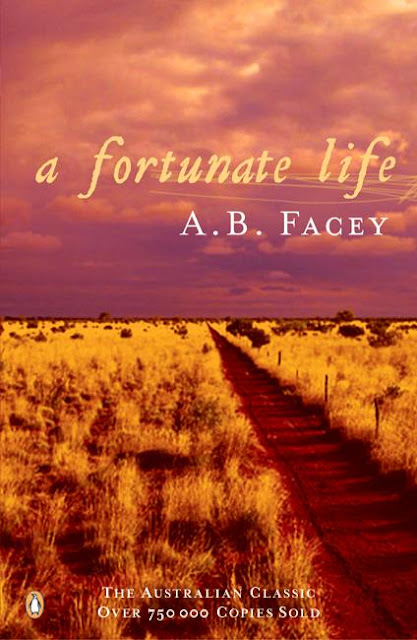
A Fortunate Life by A.B. Facey (1894-1982)


It's a tribute to Albert Facey that in his simply told, poignant autobiography, he was able to say that his had been a 'fortunate' life.
There were many episodes in his life which many would class as most unfortunate, but although he acknowledged his life had its share of hardship and difficulties, he was grateful for much.
Before he had turned two his father died, and not long afterwards his mother deserted him. His kind grandmother took on his care, but even so, circumstances forced him to start working when he was only eight years of age.
Denied a formal education, he grew up illiterate and because of this disadvantage he missed out on opportunities to learn a proper trade. As a young lad he was ill-treated and ill-used at times, doing work which was akin to slavery. He eventually taught himself to read and write, but it was a slow and difficult process.


http://www.bookdepository.com/Fortunate-Life-B-Facey/9780143003540?ref=grid-view


He survived Gallipoli, but two of his brothers were killed there, and Albert was to endure years of pain and disability from injuries he suffered in the trenches.
After four months on Gallipoli ('the worst four months of my whole life') a shell exploded in his trench, killing a mate and badly injuring himself. He was sent to Cairo for treatment and was repatriated back to Australia in 1915.

Albert said that he had two lives that were miles apart. Up until just after the war he had had a lonely and solitary existence but then he met Evelyn, the woman who was to become his wife:

After our marriage my life became something which was more than just me.

Albert and Evelyn raised a family through the depression years and Albert involved himself with the Trade Union movement and battled to improve the general conditions for workers.
When World War II broke out three of their sons enlisted. Only two of them returned home after the war. Their eldest son was killed in a bomb attack while defending Singapore.
Albert Facey was an ordinary man who overcame extraordinary circumstances. When he retired, Evelyn encouraged him to write down the story of his life. He crammed his stories into school exercise books, thinking that at some stage he would get copies printed for family members. The manuscript sat in a cupboard for years but in 1979, when he was eighty-five years of age, his autobiography came to the attention of the Fremantle Arts Centre Press and was accepted for publication.
A Fortunate Life was published in 1981, nine months before Albert died.

Some thoughts

A. B. Facey was a true historian, a story-teller. As I read the story of his life I could almost imagine he was sitting in the room speaking. It is simply written, understated, almost matter of fact, but totally real and engaging.

It's sobering to think that many people born in the late 19th or early 20th Century would have seen and endured similar circumstances - WWI, the Great Depression, WWII, industrial expansion. Death was a common visitor to many families and not just during the war years. We live in a very different world today.

Apart from Albert's time in Gallipoli, the book is mostly set in Western Australia and it is a fascinating account of frontier life in that state.

It was also interesting to read of the early days of the Trade Union Movement. Albert was a true Labor man and believed the Labor Party was on the side of the workers. I wonder what he would think about the Labor Party we have now?

Albert had a definite belief that Providence had brought his wife and him together, but towards the end of the book he said that the wars changed his outlook on things and that he found it difficult to believe in God.

I highly recommend this book for anyone - Aussie or otherwise. It is a valuable insight to the changes which swept through the 20th Century as seen by an ordinary person. It's also a beautiful love story and a lesson in perspective.


From the Afterword by Jan Carter:

What has Albert Facey left us? There is his description of childhood and adult-child relations at the beginning of this century which indicate how great the changes in childhood have been. There is his personal account of the dehumanising and brutal effects of war (the one defeat he felt morally unable to accept).
There is his documentation of the types and processes of work including some vanishing occupations. There are all these things and more, but in the end, Albert Facey's  autobiography must be classified as political history, for he contributes to the neglected history of this country...
From Facey, we know what it was like to be poor and young at the gold rushes...
We know what it was like to be an itinerant worker...
We understand the predicaments of a first-world-war private...
He describes being a husband and father with mouths to feed in the Depression...
Albert Facey is Australia's pilgrim.


Besides being a wonderful story for adults, this book is also suitable as a read aloud with some editing for younger listeners, or for readers around the age of 14 years and up. There is also an abridged version of the book for younger readers which is very well done.


A Forunate Life was one of my choices for the Aussie Author Challenge 2015.


Friday, 18 December 2015

A Reading Plan for 2016

For the past two years I've participated in AusRead during November, hosted by Brona's Books, and last year I added three more challenges: the Classic Children’s Literature Event, (also held during one month of the year), Back to the Classics and Aussie Authors Challenge. (update: forgot to add the 50 Classics in 5 years!). This year in addition to most of these, I'm adding a 'to be read' challenge. The idea is to choose books you already have but haven't got around to reading yet. I tried to fit in as many of these when I selected books for the Back to the Classics Challenge, so there are some cross-overs here (marked with an *) but some of the books I wanted to read were published later than the 'classic' publication cut off date of 1966 - Cancer Ward and Children of Men, for example.


So I thought that this Mount TBR Reading Challenge has my name all over it. I've discovered that signing up for something like this is a good discipline for my reading habits.
I've chosen the lowest level, Pike's Peak, and will plan to read 12 books from those listed below from my TBR mountain during 2016:


The Five Red Herrings by Dorothy L. Sayers

Decision at Delphi by Helen MacInnes *

If I Perish by Esther Ahn Kim

Cancer Ward by Alexandr Solzhenitsyn

The Refugees by A. Conan Doyle

Consider This by Karen Glass

The Edge by Dick Francis

A Good Man is Hard to Find by Flannery O'Connor

When Children Love to Learn
- Elaine Cooper, General Editor

A Lantern in her Hand by Bess Streeter Aldrich

The Tragedy of the Korosko by Arthur Conan Doyle

Brideshead Revisited by Evelyn Waugh

Frankenstein by Mary Shelley

The Disappearing Spoon by Sam Kean

Pastoral by Nevil Shute

Sense & Sensibility by Jane Austen *

Wuthering Heights by Emily Bronte *

Children of Men by P.D. James

Surprised by Joy by C.S. Lewis

The Road From Home by David Kheridian

Nothing Else Matters by Patricia St. John

King Solomon's Mines by H. Rider Haggard

The Harvester by Gene Stratton-Porter


Anyone care to join me?